
If a timeshare special assessment notice is vague, rushed, or backed by collection threats, I would not pay it until I reviewed the paperwork. These charges can reach $1,000 to several thousand dollars per owner, and if I ignore them, the fallout can include late fees, collections, credit damage, or even foreclosure.
Here’s the short version of what I’d watch for:
- Vague project details with no clear scope or cost breakdown
- Short payment deadlines that leave little time to review the charge
- Missing board approval or owner vote records
- Weak financial records or blocked document access
- Repeat assessments for the same type of work year after year
- Delinquency letters with changing numbers or threat-heavy language
- Outside collection pressure before the resort gives a clear paper trail
A proper notice should tell me what the money is for, how my share was calculated, why reserves were not used, and who approved the charge. If those basics are missing, I’d compare the notice against the declaration, bylaws, board minutes, reserve study, budget, insurance records, and account ledger before sending any money.
| Red flag | What I’d check first | Why it matters |
|---|---|---|
| Vague description | Project scope, bids, line items | I need to know what I’m paying for |
| Short deadline | Notice period in bylaws/CC&Rs | The board usually must follow its own rules |
| No clear approval | Vote records, meeting minutes | The charge may not have been approved the right way |
| Poor records | Budget, reserves, contracts | The amount may not add up |
| Repeat charges | Prior years’ statements | The resort may be filling a reserve gap |
| Delinquency threats | Ledger, late fees, notice terms | Added charges may not match the first bill |
| Outside collections | Validation notice, cure history | The account may have been pushed too fast |
Bottom line: I’d treat these seven signs as a checklist. If the resort cannot show clear records and a clean approval trail, the assessment needs a closer look before I pay.
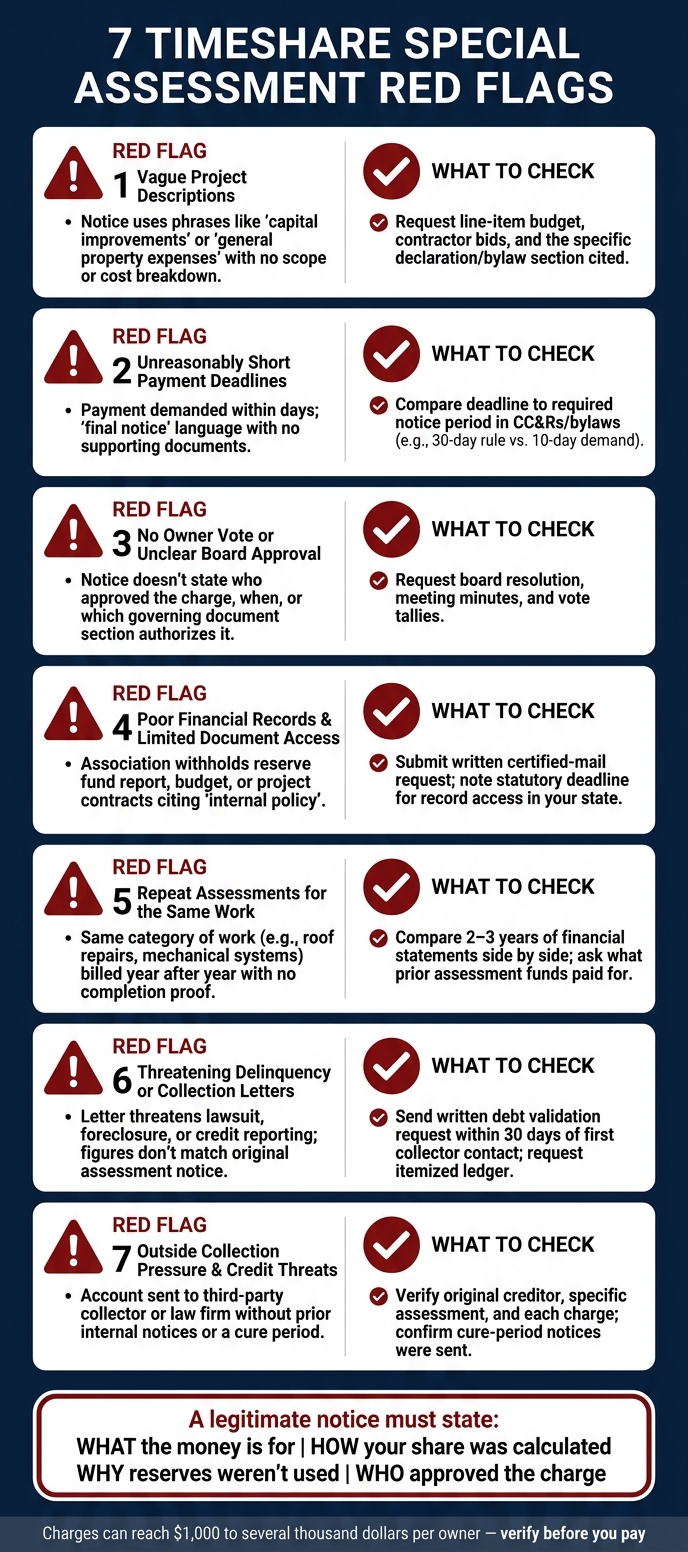
7 Timeshare Special Assessment Red Flags: Legitimate vs. Questionable Notices
Why Special Assessments Need a Closer Look
Boards do have the legal power to levy special assessments under the timeshare declaration, bylaws, and state law. But that power doesn’t mean owners should just accept a bill with no questions asked.
Owners should get clear notice, a cost breakdown, and documents that show how the charge lines up with the declaration, bylaws, and state law. When those basics are missing, it’s time to slow down and take a closer look.
That kind of disclosure matters for a simple reason: owners need to see where the assessment money is going.
The warning signs below fit into three buckets:
- Vague notices
- Rushed payment demands
- Aggressive collection pressure
There are seven warning signs to watch for.
sbb-itb-d69ac80
1. Vague Project Descriptions and Missing Cost Details
A special assessment notice that hides behind phrases like "specific work" or "specific project" is a problem. You should be told exactly what work is planned, where it will happen, and what the money is paying for.
Notice Transparency
A proper notice should spell out the project in plain English. For example, it should say something like "full roof replacement on Buildings A–D, including removal of existing shingles and installation of Class 4 asphalt shingles" instead of using a catch-all phrase.
It should also include the key numbers and the reason for the charge:
- The specific project
- The total budget
- Your share
- Why reserves or regular fees can’t cover it
If that information is missing, you’re being asked to pay without seeing the full picture.
Procedural Compliance
A legitimate notice should point to the exact declaration or bylaws section that allows the assessment. It should also show board approval and any owner vote required by the governing documents or state law.
If the notice only says "under the declaration or bylaws" without citing the actual document section, that’s a procedural gap worth flagging. It may sound minor, but details like this matter. If the board has the power to charge owners extra, it should be able to show where that power comes from.
Financial Documentation
Before paying, ask for the line-item budget, contractor bids, board minutes, and any inspection or engineering reports. Those records help you see whether the amount makes sense or if something feels off.
If those documents are withheld or delayed, treat that as a warning sign.
Send a written request for documentation as soon as the notice arrives, and keep copies of everything. That paper trail can help a lot if the dispute gets bigger later. A documented, good-faith effort to get answers puts you in a much stronger position.
If the notice stays vague, the next red flag is a deadline that gives you too little time to review it.
2. Unreasonably Short Payment Deadlines
A vague notice is bad enough. A vague notice with a deadline just a few days away is an even bigger red flag.
When a resort gives you almost no time to review a charge before threatening penalties, the deadline itself becomes part of the problem. It can box you in before you’ve had a fair chance to check what you’re being asked to pay.
Notice Transparency
A short deadline gets more troubling when the notice leaves out basic facts like the amount, the purpose of the charge, the due date, or any backup documents.
That kind of rush can shut down your chance to confirm key details:
- Whether the amount is correct
- What project or expense the charge is tied to
- Whether the board actually approved it
If those details aren’t in the notice, a tight payment window can feel less like a normal request and more like pressure.
Procedural Compliance
Pull out your CC&Rs and bylaws and check the required notice period. If the documents say owners must get 30 days’ notice, but you got a 10-day demand, that’s a procedural defect.
That matters. Boards usually have to follow their own rules when they issue assessments and set deadlines. If they don’t, the demand may be open to challenge.
Collection Escalation Risk
A first demand that says "final notice" or "pay immediately" without any supporting documents is a pressure tactic, not a clear assessment notice.
It skips past the basic step of telling you what the charge is, why it’s owed, and how it was approved. That’s a problem on its own.
If the deadline is rushed, the next step is to look at whether the board properly approved the charge.
3. No Owner Vote or Unclear Board Approval
If the deadline felt rushed, the next thing to check is how the assessment was approved.
Start with your declaration and bylaws. See whether they call for an owner vote or a board supermajority before a special assessment can go through.
Notice Transparency
The notice should clearly say who approved the assessment, when it happened, whether a vote was required, and which section of the governing documents the board relied on.
When that information is missing, it’s hard to review what actually happened. And if the notice leaves out vote details, owners can’t meaningfully check whether the process was handled the right way.
Procedural Compliance
Pull out your declaration and bylaws and find the section that deals with special assessments. This matters more than many owners think. Sometimes boards describe big projects as maintenance to sidestep owner-approval thresholds.
You’ll also want to confirm that the board approved the charge at a properly noticed meeting. Not by email. Not in a closed session. If a large assessment was on the agenda and you never got advance notice of that meeting, that’s a procedural gap worth looking into.
Financial Documentation
To verify the approval, ask for:
- The board resolution
- The meeting minutes from when the assessment was discussed
- Any vote tallies
Then compare those records to the notice. If the amounts don’t match, or the records don’t show a vote at all, you may have grounds to challenge the charge. Aaronson Law Firm can review these records for approval defects.
If the board can’t produce those records, the next red flag is poor financial documentation.
4. Poor Financial Records and Limited Document Access
If the board can’t show how the assessment was calculated, that’s a major warning sign. Homeowners should be able to see where the money is going. And a well-run association should be able to back up every charge with records.
Even if the approval process looks proper on paper, the charge still needs documents that show how the final amount was built. No paperwork? No clear way to check whether the number makes sense.
Notice Transparency
A proper notice should list the amount and point to the records behind it, like the reserve study and the project cost breakdown.
When a notice leans on vague phrases such as "project costs" or "capital improvements" without dollar amounts or specifics, it gets a lot harder to tell whether the charge is justified. That’s the issue. Broad wording can hide a lot.
If the association is still under developer control, it must disclose how assessment funds are being allocated.
Financial Documentation
Before paying, ask for the records that support the charge. That usually includes:
- The current budget
- The reserve fund report
- Financial statements
- Project contracts or bids
If the association says "internal policy" prevents access to those records, treat that as a red flag. Privacy rules may protect personal owner data or privileged legal communications. They do not usually block access to core association financial records.
Some states require associations to provide records within a set time frame. So if you make a written request, watch the statutory deadline closely.
Collection Escalation Risk
Here’s the hard part: without records, owners can’t check the assessment before collection pressure starts.
A records dispute does not stop the balance from being treated as delinquent. That means late notices, fees, and more pressure can show up while you’re still trying to get basic answers.
Put every request in writing. Send it by certified mail. That gives you a paper trail if the matter gets worse.
If the same assessment pattern keeps coming back, the issue may run deeper than missing paperwork.
5. Special Assessments That Keep Coming Year After Year
When the same assessment shows up again and again, the issue isn’t just where the money went. It’s also why the resort keeps coming back for more.
A one-time assessment for storm damage or a big repair can make sense. But repeated assessments for the same kind of work often suggest a long-running reserve funding problem, with the resort passing those costs back to owners.
Notice Transparency
A clear notice should spell out the project, the total budget, what was collected before, and what work has already been done. Without that detail, it’s tough to know whether you’re paying for a new job or getting billed again for something that was supposed to be finished already.
Vague wording like "ongoing renovations" with no itemized costs should make you pause. And if the notice looks almost the same as last year’s, send the board a written question asking what was completed with the earlier assessment funds and why another charge is now being added.
Financial Documentation
Put several years of financial statements next to each other and read them side by side. If you keep seeing assessments for the same category of work, such as roof repairs or mechanical systems, but there’s no clear sign the earlier project was completed, that’s a red flag for poor management or weak project follow-through.
It’s also smart to watch for large payments to related vendors. That can drive up costs and give you a reason to take a closer look.
Collection Escalation Risk
Repeat assessments can make it much harder to stay current. In some cases, they can push an account toward delinquency faster than an owner expects.
If you’re starting to fall behind, ask about a payment plan before late fees and collection action start. And when repeat charges come with urgent payment demands, the notice itself becomes the next red flag.
6. Threatening Delinquency or Collection Letters
A collection letter that threatens a lawsuit, foreclosure, or credit reporting is a red flag. Pay close attention to threats the collector can’t or won’t carry out. It also helps to compare the amount in the letter with the original assessment notice and the account ledger.
Notice Transparency
A legitimate delinquency notice should clearly list:
- The total assessment
- The original due date
- Any late fees or interest
- The reason for the charge
- What happens next if the balance isn’t paid
- Contact information for questions
- The contract or governing document that authorizes the assessment
If the notice shows only one past-due amount, leaves out the project description, or includes figures that don’t match what you were first billed, treat that as a red flag.
If a third-party collector is involved, send a written validation request within 30 days of first contact. Ask for an itemized statement that shows all charges, payments, and fees. If the amount still doesn’t line up, check the approval records before you pay.
Procedural Compliance
A collection demand that skips the cure period or adds penalties that were not in the original notice points to a process problem. Under the Fair Debt Collection Practices Act, third-party collectors cannot threaten actions they do not intend to take or are not legally allowed to pursue.
Collection Escalation Risk
Some warning signs show that collection pressure is heating up:
- An outside collector gets involved
- You receive repeated “final notice” letters
- The letter threatens credit reporting
Once outside collection activity starts, late fees and collection costs can pile onto the original assessment balance.
If you never got a clear original assessment notice, or the numbers keep changing without any explanation, that’s a strong reason to get a legal review. Aaronson Law Firm can review the letter and assessment records. Keep the notice, envelope, and payment history together for the next document review.
7. Outside Collection Pressure and Credit Threats
If the resort has already pushed the account to a third-party collector, the next step is simple: check whether the demand matches the original assessment.
Once a timeshare assessment lands with a collection agency or outside law firm, things usually get more formal. The paper trail starts to matter a lot more. Instead of standard resort invoices, you may begin getting certified mail from a third-party collector, often with language about delinquency, lawsuits, or other legal consequences.
Notice Transparency
The first collection letter should clearly state:
- the original creditor
- the collector
- the specific assessment
- each charge included in the balance
If those basic details are missing, that’s a red flag. It can also be a sign that the account was sent to collections before proper notice went out.
Procedural Compliance
Before an account moves to outside collections, many associations should send more than one written notice, give you a chance to cure the issue, and keep records of their contact attempts.
If the account reached outside collections without prior internal notices or a cure period, the process may be defective.
Collection Escalation Risk
An unchallenged collection file can later support a lawsuit or foreclosure effort. On top of that, a timeshare-related collection account reported to credit bureaus can stay on your credit report for up to seven years from the original delinquency date.
That’s why it helps to compare every figure in the demand against the original assessment notice and your account history. If the paperwork is incomplete or the numbers don’t add up, Aaronson Law Firm can review the collection records before the situation moves further.
Before you pay, compare the demand with what a legitimate assessment notice should include.
What a Legitimate Assessment Notice Should Include
A legitimate notice should give owners enough detail to check the charge for themselves. That notice is your first gut check.
Here’s the simple idea: if you can’t tell what you’re being charged for, how the amount was calculated, and why it’s due now, that’s a problem.
| Element | Legitimate Notice | Questionable Notice |
|---|---|---|
| Project Scope | Specific work, such as roof replacement or storm repairs | Vague terms like "capital improvements" or "general property expenses" |
| Cost Breakdown | Total budget, owner share, allocation formula | One lump sum with no breakdown |
| Timeline | Due date, installment terms, late-fee terms | Immediate deadline with no schedule or explanation |
| Reserve Funding | Reserve shortfall explained | No mention of existing reserves or why they weren’t used |
| Insurance Coverage | Says whether insurance applies and what deductible remains | No reference to insurance, even when work follows storm or structural damage |
| Contractor Info | Contractor named, bid or award explained | No vendor identified, no explanation of how work was awarded |
| Owner Access to Records | Tells owners where to review supporting records | Ignores records requests or provides only the demand letter itself |
If the notice misses items on this checklist, ask for the missing documents before you pay. That doesn’t mean the assessment is automatically wrong. It means you don’t yet have enough to verify it.
State law and your governing documents may require more. But the basic test stays the same: does the notice give you enough information to verify the charge? It should also cite the governing document section and list the approval or vote date.
Documents to Review Before You Pay
Before you pay, match the charge to the association’s governing documents and records. If the notice is vague or feels rushed, these papers help you see whether the assessment was allowed in the first place and whether the amount is right.
Start with your purchase contract, declaration/CC&Rs, and bylaws. Then review the board meeting minutes from at least the past 12 to 24 months. Those minutes often show when the board discussed the project, how it was framed, and whether the charge was approved the right way.
If owner approval was required, ask for the notice of meeting, ballot language, proxy forms, and vote tally tied to the assessment. Put those records next to the annual budget and reserve study. That side-by-side review can show whether the association already had money set aside for this type of expense or whether owners are being asked to fill a gap.
Then check whether insurance should pay part of the bill. If the charge came from storm damage or structural repairs, review the insurance coverage and deductible before you send any money. In some cases, insurance can lower the amount owners owe. In others, it can show that you’re being billed only for the part that was not covered.
It also helps to review the project bids or contracts, payment schedule, late-fee terms, and delinquency policy together. Look for a few basic points:
- The scope of work
- The due date
- Whether installments are allowed
- Any grace period
- The late fee amount
- Whether interest applies
- When the account may be sent to collections
State law may require access to these records within a set deadline after a written request. If the association refuses to share records or drags things out past the legal deadline, that’s a red flag.
Request everything in writing and keep copies. If key records are missing, ask for a breakdown, invoices, and the legal basis for the charge. If the records still don’t line up with the notice, the collection demand needs a closer review next.
When Collection Pressure Calls for Legal Review
When those warning signs turn into lien notices or foreclosure threats, this is no longer just a billing dispute. It’s a legal problem. In many states, an association can record a lien and move toward foreclosure over unpaid assessments. That means your timeshare interest itself may be on the line.
The pressure gets worse when a collector demands full payment right away, piles on extra fees, or reports a disputed debt to credit bureaus while the dispute is still active. At that stage, you’re not just dealing with annoyance. You may be dealing with damage to your property rights and credit.
If the assessment itself looks improper, Aaronson Law Firm can review the assessment, send demand letters, protect credit, and support litigation. If you have received a lien notice, foreclosure threat, or collection letter over a disputed special assessment, Aaronson Law Firm can review your options in a free consultation.
At that point, the next move is a legal review of the notice, ledger, and governing documents.
Conclusion
Before you pay or sign anything, watch for seven red flags: vague project details, short deadlines, missing approval, weak records, repeat assessments, delinquency threats, and collection pressure. Any one of these is a reason to slow down and check the charge with care.
If you spot one or more of those red flags, save the original notice, invoices, follow-up letters, and payment instructions. Then compare the assessment with your declaration, bylaws, budget rules, and payment terms to see whether the board had the authority to issue the charge and followed its own process. If the notice doesn’t line up with those rules, that gap matters. And that paper trail gives counsel what they need to assess the charge fast.
If the resort can’t clearly explain the charge, or if the notice comes with rushed deadlines or collection pressure, get a timeshare legal review before you pay. Aaronson Law Firm offers a free initial consultation to review disputed timeshare assessments before you pay.
FAQs
Can I dispute a special assessment without risking collections?
Usually, no, and there’s some risk if you try. Resorts often treat special assessments the same way they treat maintenance fees. So if you don’t pay, they may send the account to collections, cut off access, place a lien on the property, start foreclosure, or damage your credit.
If you think the assessment isn’t proper, put your concerns in writing and keep records of everything. It may also help to get legal advice. Aaronson Law Firm can assist with legal demand letters and credit protection strategies.
What records should I request first?
Start by asking for a detailed breakdown of the special assessment expenses. You want to see where the money is going, line by line. After that, review your timeshare agreement, HOA bylaws, and the resort’s operating budget to check whether the fees and fund allocations are clearly backed up.
It also helps to gather all of your records in one place, including:
- Your contract
- Payment receipts
- Maintenance fee notices
- Any prior special assessment bills
That gives you a clean paper trail if you need to question the charges or spot patterns in how the resort has billed owners before.
When should I talk to a timeshare lawyer?
Talk to a timeshare lawyer if you spot red flags like vague project details, hard-pressure collection tactics, unfair fee hikes, or foreclosure threats.
It also makes sense to get legal help if the resort won’t fix your dispute over maintenance fees or special assessments, or if you want to try to cancel your contract. Aaronson Law Firm offers a free initial consultation to look over your situation and walk you through your legal options.
Related Blog Posts
- 7 Warning Signs of Timeshare Contract Fraud to Watch For
- Understanding Timeshare Maintenance Fees and Legal Rights
- Why Timeshare Special Assessments Keep Increasing
- Consumer Bills Target Timeshare Fee Changes