
If you want the short answer: Florida gives you 10 calendar days to cancel, while Tennessee gives you 10 or 15 days based on whether you inspected the property on-site before signing.
I’d look at three things first:
- When the deadline starts
- Florida: the later of the signing date or the date you got the last required document
- Tennessee: usually the signing date, though late delivery of the public offering statement can still matter
- How notice must be sent
- Florida: written notice by mail, courier, or hand delivery
- Tennessee: hand delivery, prepaid mail, or email
- When the refund is due
- Florida: within 20 days of demand, or 5 days after cleared funds, whichever is later
- Tennessee: within 30 days after the seller gets the cancellation notice
That means the same “10-day” deal can work very differently in practice. In Florida, late documents can delay the start of the clock. In Tennessee, inspection status can add 5 extra days.
The main point: if I were close to the deadline, I’d focus less on the sales pitch and more on dates, delivery proof, and the exact notice method. A postmark, email timestamp, or courier record can decide whether a cancellation stands.
Quick Comparison
| Factor | Florida | Tennessee |
|---|---|---|
| Rescission period | 10 calendar days | 10 days with on-site inspection; 15 days without |
| Clock starts | Later of signing or last required document received | Usually signing date |
| Late disclosures | Can delay start of deadline | POS delivery can still affect rights |
| Notice methods | Written notice by mail, courier, or hand delivery | Hand delivery, prepaid mail, or email |
| When notice counts | Mailing date for mailed notice | Delivery date, postmark, or email timestamp |
| Refund deadline | 20 days after demand, or 5 days after cleared funds | 30 days after notice received |
| Deductions | May deduct prorated used benefits | No deductions stated here |
About 50% of the comparison turns on timing alone: when the clock starts and when notice becomes effective. The rest is refund timing and whether the seller can reduce the refund.
If I were checking my own contract, I’d confirm the signing date, document receipt dates, inspection status, and proof that notice was sent on time.
sbb-itb-d69ac80
Florida Rescission Rules Under Chapter 721
Florida’s timeshare cancellation rights come from the Florida Vacation Plan and Timesharing Act, found in Chapter 721 of the Florida Statutes. Under Chapter 721, buyers get a nonwaivable right to cancel during the statutory period.
Florida uses a firm 10-day rescission period under Chapter 721, and the law sets strict rules for notice and refunds.
If you use the timeshare during that 10-day period, you do not lose your right to cancel. But it may change how much money you get back.
Florida’s 10-Day Cancellation Window and What Starts the Clock
The 10-day period starts on the later of:
- the date you sign the contract
- the date you receive the last required document
That second point matters more than many buyers think. The clock does not begin until you have received all required documents, including the cancellation notice.
So it makes sense to check the delivery date for each document you got. Email timestamps, courier tracking, and postal delivery records can all help show when something arrived. If the developer sent disclosures on different dates, the 10-day period does not start until the last one is delivered.
The 10 days are calendar days, not business days. Weekends and holidays count.
Required Notice Wording and Accepted Delivery Methods in Florida
Florida law says the purchase contract must include specific cancellation language in plain terms. In substance, it has to tell you that you may cancel without penalty or obligation within 10 calendar days after you sign the contract or receive the last required document, whichever is later. It also has to say that cancellation must be made in writing.
The contract cannot cut down or waive this rescission right.
Florida accepts written notice by U.S. mail, courier, or personal delivery. If you mail the notice, it is effective when sent. That’s a big deal. You’re not waiting for the developer to open the envelope.
A trackable method can save you a headache later. Certified mail with return receipt or an overnight courier gives you proof of the send date if the developer later argues about timing.
Once the notice goes out, the next issue is the refund.
Florida Refund Timing and Buyer Protections After Cancellation
The developer must refund your money within 20 days of your demand or within 5 days after receiving cleared funds, whichever is later. This rule comes from Fla. Stat. § 721.08(2)(a).
The developer also cannot charge a cancellation fee or any other penalty if you rescind on time. The only allowed deduction is a prorated charge for benefits you already used, such as nights stayed.
Tennessee follows the same basic model, but its deadline and delivery rules are less uniform.
Tennessee Rescission Rules Under the Time-Share Act of 1981
Tennessee rescission rights under Tenn. Code Ann. § 66-32-114 can’t be waived.
Tennessee’s 10-Day vs 15-Day Deadline Based on On-Site Inspection
In Tennessee, the cancellation window turns on one simple detail: whether the buyer completed an on-site inspection before signing.
- If you completed an on-site inspection before signing, you have 10 days from the date of signing.
- If you did not inspect the property on-site before signing, you have 15 days from the date of signing.
There’s another piece that matters. The contract stays voidable until the buyer receives the public offering statement (POS). The developer is supposed to provide the POS by the contract date. So if the POS shows up late – or doesn’t show up at all – the buyer may have more time to cancel.
Tennessee Notice Wording and Delivery by Hand, Mail, or Email
Tennessee law says the cancellation notice must appear in boldface, conspicuous type in both the purchase contract and the public offering statement.
For delivery, Tennessee allows three ways to send a valid cancellation notice:
- Hand delivery to the other party or its agent for service of process at the address listed in the contract
- Prepaid mail to the address listed in the contract, with the postmark date controlling
- Email to the address listed in the contract or disclosures, with the timestamp controlling
That may sound like a small detail, but it isn’t. A notice sent late, or sent to the wrong place, can kill rescission even if the buyer is still within the deadline.
Tennessee Refunds, Mutual Cancellation Rights, and No-Waiver Rules
Under Tenn. Code § 66-32-114, the developer must refund all payments made in connection with the timeshare contract within 30 days after receiving the cancellation notice.
Tennessee law also gives the developer a reciprocal right to cancel during that same rescission period.
And the statute is blunt on waiver: no contract term can give up Tennessee’s cancellation right. Oral statements don’t override the law either.
Florida uses a fixed 10-day clock and a different refund timeline, so the state-by-state comparison matters.
Florida vs Tennessee: Side-by-Side Deadline, Notice, and Refund Comparison
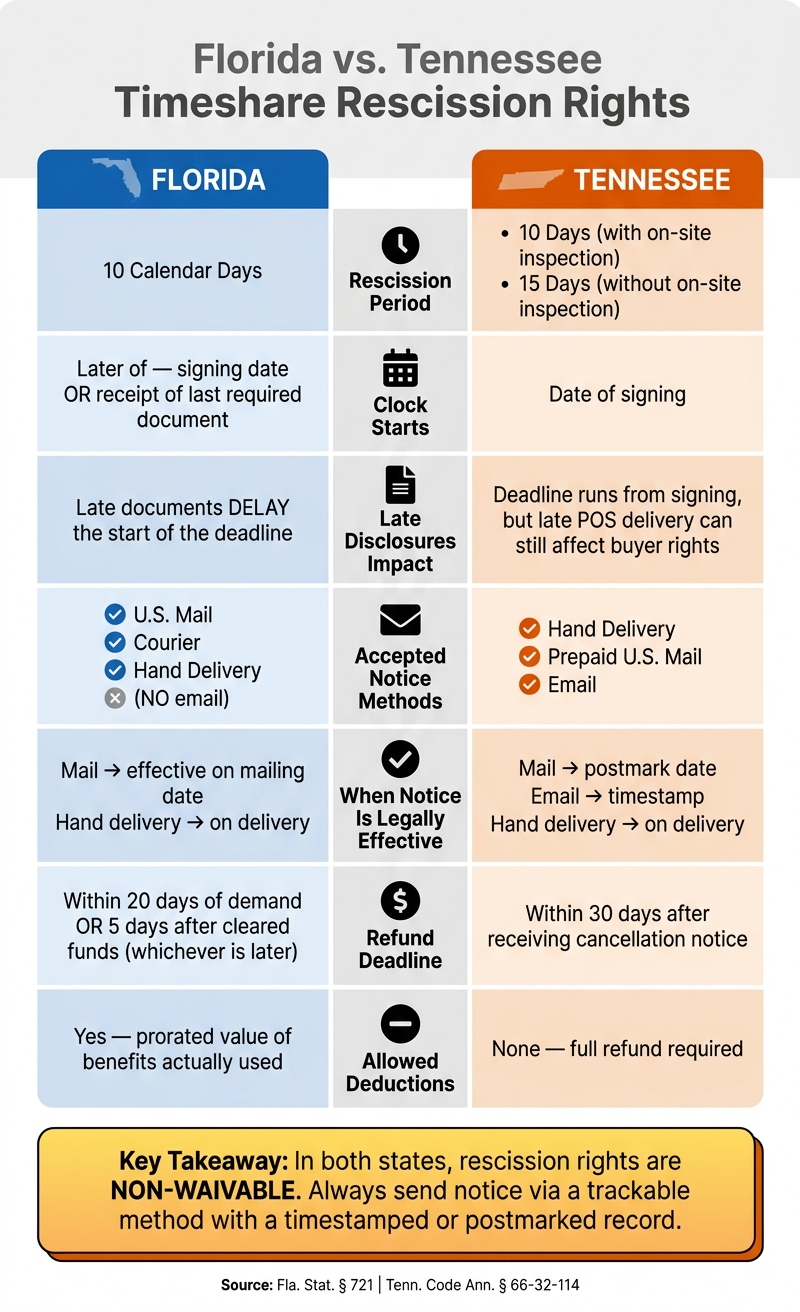
Florida vs Tennessee Timeshare Rescission: Side-by-Side Deadline & Notice Rules
These are the differences that matter most when you’re close to the cancellation deadline.
| Factor | Florida | Tennessee |
|---|---|---|
| Rescission period | 10 calendar days | 10 days (with on-site inspection) / 15 days (without) |
| What starts the clock | Later of the signing date or receipt of the last required document | Date of signing |
| Delayed disclosures affect deadline? | Late documents delay the start | Deadline runs from signing, but POS delivery still matters |
| Permitted notice methods | Written notice by mail, hand delivery, or courier | Hand delivery, prepaid U.S. mail, or email |
| When notice is legally effective | Mail: effective on mailing; hand delivery: effective on delivery | Hand delivery: on delivery; mail: on the postmark date; email: on the timestamp |
| Refund deadline | Within 20 days of demand, or 5 days after cleared funds – whichever is later | Within 30 days of receiving cancellation notice |
| Allowed deductions | Proportionate value of contract benefits actually received | No deductions |
Which State Gives Buyers More Time to Cancel
Tennessee may give buyers five extra days. That happens when there was no on-site inspection, which extends the rescission period to 15 days. Florida takes a different path: instead of adding days outright, it can push back the start of the 10-day period if the buyer gets the last required document late.
That difference can change everything when the deadline is tight. In Tennessee, you usually count from the signing date. In Florida, you may need to check both the signing date and the date you received the last required document.
How Notice Rules Can Determine Whether a Rescission Is Valid
Notice rules can make or break a cancellation.
Tennessee allows email notice. If the email is sent by the deadline and shows a timestamp, it can be timely. Florida does not expressly allow email notice, so the safer move is certified mail or a traceable courier. The key point in Florida is proof that the notice was sent within the 10-day window.
Put simply, Tennessee gives buyers one more option. Florida calls for more caution. If you’re sending a cancellation notice and the clock is ticking, a postmark, courier record, or delivery receipt can matter just as much as the words in the notice itself.
Refund Deadlines, Allowed Deductions, and Steps to Take Now
The refund rules are not the same.
Florida must issue a refund within 20 days of the buyer’s demand, or 5 days after cleared funds, whichever is later. Florida also allows a deduction for the value of contract benefits the buyer actually used. Tennessee must issue a full refund within 30 days after receiving the cancellation notice, and no deductions are allowed.
If either state may apply, get the timeline straight first:
- Confirm the signing date
- In Florida, confirm when you received each required document
- Put the cancellation in writing and cite the statute that applies
- Send it using a method that creates a timestamped or postmarked record
- Keep the contract, disclosures, proof of sending, and any reply from the developer
If the developer pushes back, those records are what you’ll lean on next.
What to do if the rescission period is disputed or already passed
If the developer disputes your rescission, move fast and lean on proof. In most cases, the fight comes down to paperwork and delivery records. Your first job is simple: gather the documents that show when the rescission period began and how you sent notice.
Documents and proof buyers should gather right away
Good records can make or break this kind of dispute.
Start with your signed contract, the public offering statement or disclosure receipt, and any written acknowledgment of receipt. Hold on to anything that shows the signing date, disclosure delivery, inspection status, and receipt dates.
You should also keep the original cancellation letter and all delivery proof tied to it. That includes:
- Certified mail receipts
- USPS tracking
- Return-receipt cards
- The original envelope
- Email headers
- Sent copies
- Timestamped acknowledgments
Keep a record of every payment too, especially if the dispute turns into a refund claim.
It also helps to build a simple timeline. Put the events in date order so everything is easy to follow. Include the contract signing, disclosure receipt, cancellation letter prep, mailing date, delivery confirmation, and any reply from the developer.
When to consider getting legal help
A rejected notice is usually the moment legal review starts to matter.
If the developer still rejects the cancellation after you gather your proof, take the next step and get legal review. This matters even more if the developer is arguing about the delivery date, if you’re not sure all required disclosures were given on time, or if collection pressure or credit reporting issues have already begun. Missing disclosures can change when the rescission period started.
If the deadline has passed or the developer disputes your notice, Aaronson Law Firm handles timeshare cancellation, demand letters, credit protection, and litigation support.
These records often decide the dispute and help frame the final comparison.
Conclusion: Key differences buyers need to act on now
Bottom line: Florida gives buyers 10 calendar days from the later of signing or full document receipt. Tennessee gives 10 days if there was an on-site inspection, or 15 days if there was not.
For buyers, the main issue isn’t just how many days you get. It’s what starts the clock. That’s why the next move is simple: confirm the signing date, the disclosure date, and the proof of delivery before time runs out.
These rights are non-waivable. Developers cannot waive them or shorten them.
Once the deadline is pinned down, proof of delivery becomes the key issue in any dispute over whether rescission was sent on time. Use a trackable method. In Florida, mailed notice is effective on the postmark date. In Tennessee, hand delivery, prepaid mail, or time-stamped email can meet the notice rule.
Florida is more document-sensitive. Tennessee is more inspection-sensitive. In both states, the deadline matters less than the proof behind it.
If notice is disputed, or if the rescission period has already passed, review the contract and disclosure record with counsel. Aaronson Law Firm handles timeshare rescission, demand letters, credit protection, and litigation support for buyers facing disputed deadlines or denied rescissions.
FAQs
How do I count the rescission deadline in each state?
In Florida, the 10-day rescission period lasts until midnight on the 10th calendar day after whichever happens later:
- the date you sign the contract
- the date you receive all required disclosure documents
Weekends and holidays still count, so the clock keeps running.
In Tennessee, the rule changes based on whether you inspected the property. You get 10 days from signing if you inspected it, or 15 days from signing if you did not.
There’s one more point that matters in Tennessee: if the developer does not provide the required Public Offering Statement, your right to cancel stays open with no end date.
What if I received the disclosures late?
If required disclosure documents show up late, your rescission period is usually pushed back.
In Florida, the 10-day cancellation period starts on the later of these two dates: the day you sign or the day you receive all required disclosures. In Tennessee, if the Public Offering Statement was not provided, your cancellation right stays open until it is delivered.
Keep envelopes, postmarks, and delivery proof. Those small details can matter a lot if there’s ever a dispute about timing.
What proof should I keep after sending notice?
Keep a full paper trail. Save a copy of your signed cancellation letter, the certified mail receipt, any return receipt, and any sent email with a clear timestamp.
You should also keep your original contract, disclosure documents, payment records, and any correspondence with the developer. Sending notice by certified mail with return receipt requested helps show when it was sent and when it was received.
Related Blog Posts
- Timeshare Cancellation Deadlines by State
- Refund Rights in Timeshare Cancellations
- Florida Timeshare Rescission Laws Explained
- Tennessee Cooling-Off Period for Timeshares