
If I own a California timeshare and want out, I should verify a licensed attorney before I pay anyone. That is the short answer.
Here’s the issue in plain English:
- I may see exit companies asking for $4,000 to $10,000 upfront
- Some tell owners to stop making payments, which can lead to collections, foreclosure, and credit damage
- Nonlawyer companies can send form letters, but they cannot sue, arbitrate, or give legal advice
- A California law firm can review the contract, send legal demands, and, if the facts fit, pursue claims such as fraud, misrepresentation, or disclosure failures
- If legal fees are expected to go over $1,000, California law requires a written fee agreement
The main point: I should avoid any company that promises a guaranteed exit, pushes same-day signing, or will not give a lawyer’s name and State Bar number.
This article boils the topic down to the parts that matter most:
- scam warning signs
- payment and credit risks
- what lawyers can do that exit outfits cannot
- fee rules and client fund protections
- how to check if the help is legal or just sales talk
Quick Comparison
| Point | Exit Company | Licensed California Law Firm |
|---|---|---|
| Legal advice | No | Yes |
| Can sue or arbitrate | No | Yes |
| Upfront fee risk | Often high | Must follow written fee rules |
| Guarantees | Often advertised | Not allowed |
| Client funds | No law-firm trust rules | Trust-account rules apply |
| If things go wrong | Limited recourse | State Bar complaint and other legal remedies |
If I’m trying to leave a timeshare, the safest first step is simple: check the lawyer, read the fee agreement, and do not stop paying just because a sales rep told me to.
What California Timeshare Exit Scams Look Like
Scam exit outfits go after frustrated owners and lean hard on urgency to force a fast yes. In most cases, the warning signs show up in three places: fees, guarantees, and payment pressure.
Red Flags: Upfront Fees, Guarantees, and Pressure Tactics
One of the biggest warning signs is a demand for a large, nonrefundable upfront fee before any real work starts. Complaints often mention charges in the thousands of dollars for generic "exit services." In some cases, those fees are split across shell entities instead of going into a firm trust account you can verify.
Another red flag is any promise that sounds too neat. No one can legally guarantee a timeshare cancellation or give you an exact timeline.
Seminar presenters often pile on the pressure with "today only" pricing. They may tell you not to speak with an attorney or even a family member before signing. Some go a step further and urge you to turn off your phone. That kind of controlled setting is meant to keep you from walking away and thinking it through. And once that pressure works, it often leads to the next problem: stopped payments.
Why Nonlawyer Exit Services Put Your Contract and Credit at Risk
Stopping payments can lead to late fees, collections, credit damage, or foreclosure. It does not cancel the debt.
A common sales pitch is to tell owners to stop making timeshare loan or maintenance payments while the company "works on the case", as if that alone gives them leverage. On paper, it may sound like a negotiation move. In practice, it can leave the owner exposed.
Because these companies are not law firms, they often depend on template letters sent to resorts and lenders. Those letters may claim misrepresentation, hardship, or contract problems without the proof needed to back them up. Resorts often ignore them. That leaves the owner still on the hook for payments, along with any collection or foreclosure risk.
Nonlawyer services also cannot represent you in court or give you the legal defense a licensed attorney can. That’s why the legal authority of a licensed firm matters.
California and Federal Consumer Protection Concerns
These tactics also get the attention of regulators. California regulators and the FTC warn about advance-fee exit schemes.
If you suspect fraud, report it to:
- the California Attorney General
- the Department of Real Estate
- the FTC
How Licensed Law Firms Handle California Timeshare Disputes
What Licensed Attorneys Can Do That Exit Outfits Cannot
A licensed California attorney can look at the facts and identify legal claims such as fraud-in-the-inducement, misrepresentation, unfair contract terms, or required disclosure failures. That legal review helps determine which theory may support cancellation or a negotiated exit, and which path makes sense for the owner’s situation.
Then the attorney can send a formal demand letter. That’s where the line becomes clear. A licensed attorney brings legal authority that a nonlawyer exit outfit does not have. That can include pursuing rescission, damages, or settlement leverage.
If the contract requires arbitration or names a forum, an attorney can work within those terms and use the proper process. A nonlawyer exit service can’t do that. And when a dispute moves from sales promises to enforceable action, that difference matters.
Once you’re represented by counsel, debt collectors and the developer’s legal team must communicate with your attorney. For many owners, that can cut down on direct pressure.
Fee Agreements, Trust Protections, and Professional Accountability
Legal authority also comes with client safeguards that affect cost and how funds are handled.
In California, a written fee agreement is required when fees are expected to exceed $1,000. It must spell out the scope of work, the fee structure, and the terms for ending the agreement. Contingency fees must also be in writing. Client advance payments and costs must be kept in a client trust account, and unearned amounts must be refunded.
If something goes wrong, California’s State Bar offers a formal complaint process. There is also mandatory fee arbitration for billing disputes, along with access to the Client Security Fund if a lawyer is found to have been dishonest. For timeshare owners, that means actual consumer protection, not just sales talk.
Aaronson Law Firm‘s Timeshare Legal Services

Aaronson Law Firm focuses only on timeshare-related legal matters. The firm offers free initial consultations, legal demand letters, credit protection, and litigation support when appropriate.
Those protections matter most when a dispute calls for formal legal action. A side-by-side comparison helps show where those safeguards stand out.
sbb-itb-d69ac80
Side-by-Side Comparison: Scam Exit Outfit vs Licensed Law Firm
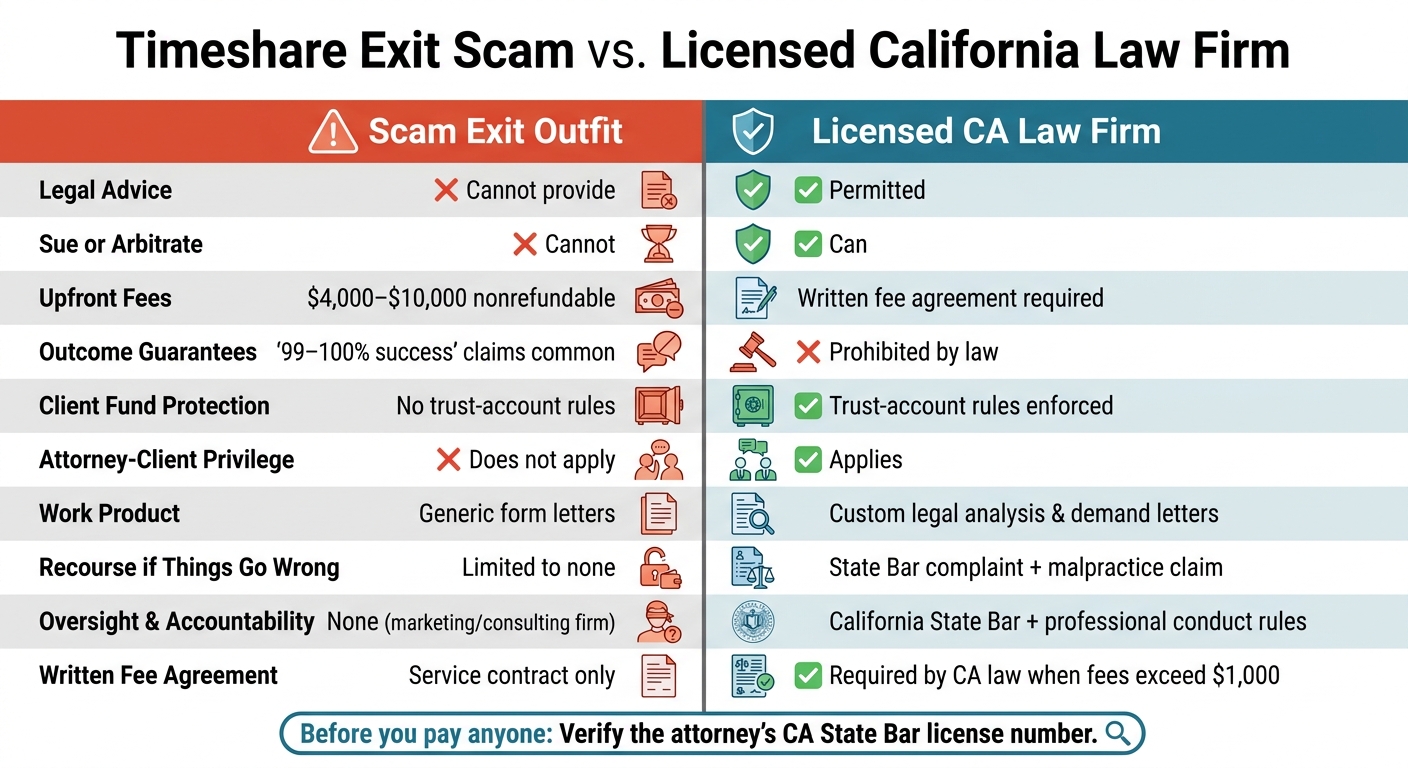
Timeshare Exit Scam vs Licensed CA Law Firm: Key Differences
Licensing, Legal Authority, and Consumer Safeguards
The biggest gap comes down to legal authority. Only a licensed California attorney can give legal advice, speak for you in negotiations, and bring claims on your behalf. A lot of so-called "legal team" pitches never identify an actual licensed attorney or list a State Bar number. That’s not a small detail. It affects oversight, how fees are handled, and whether there’s any clear proof that legal work is being done.
| Feature | Scam Exit Outfit | Licensed Law Firm |
|---|---|---|
| Oversight and accountability | No bar oversight; typically a marketing or consulting business | California State Bar, professional conduct rules, malpractice claims, and formal discipline |
| Legal advice | Not permitted | Permitted |
| Pursue claims, arbitrate disputes, and sue | Cannot | Can |
| Attorney-client privilege | Does not apply | Applies |
| Client fund protections | No comparable trust-account protections | Trust-account rules and other attorney safeguards |
That difference matters in plain, day-to-day ways. A marketing company can make bold claims, send templates, and collect money. A law firm has to follow rules, protect client funds, and answer to the California State Bar.
Fee Risk, Written Contracts, and Proof of Work
The next big split is simple: are you paying for legal work, or just a sales pitch dressed up as help? The FTC’s case against Timeshare Exit Team alleged upfront fees typically ranging from $4,000 to $5,000, sometimes reaching $10,000, while misrepresenting success rates as 99–100%.
| Feature | Scam Exit Outfit | Licensed Law Firm |
|---|---|---|
| Fee structure | Large upfront payment before any work | Written fee agreement; retainer or milestone billing |
| Outcome promises | "100% money-back guarantee" common | Prohibited from guaranteeing results |
| Work product | Form letters | Custom legal analysis, demand letters, and case strategy |
| Refund rights | Heavily conditioned and hard to enforce | Unearned fees must be returned under trust-account rules |
| Recourse if things go wrong | Limited recourse | State Bar complaint and malpractice claim |
A licensed California law firm must use a written fee agreement and handle advance fees under trust-account rules. With a nonlawyer exit outfit, you’re usually signing a service contract, not an attorney engagement agreement. That means far less oversight if the company takes your money and stalls, disappears, or sends little more than form letters.
Conclusion: Safer Steps for California Timeshare Owners
For California timeshare owners, the safest path is pretty simple: check the lawyer, review the fee agreement, and stay away from anyone pushing you to stop making payments.
That last part matters more than many owners think. A sales pitch can sound polished, but paperwork and licensing tell the real story.
Before you sign anything, use this checklist to sort actual legal help from plain old sales pressure:
- Verify the attorney’s license. Use the State Bar of California lookup to confirm the lawyer’s name, bar number, and active status. If a company says an attorney is involved but won’t give you a name and bar number you can check, walk away.
- Get everything in writing. A law firm should give you a written fee agreement that lays out the services, fees, timelines, and what happens to your money. If the written terms don’t match what you were told on the phone or in a meeting, don’t sign until it’s cleared up.
- Don’t stop paying your timeshare. If you stop making payments based only on an exit company’s advice, you could end up in default, collections, foreclosure, and with damage to your credit.
- Reject any promise of guaranteed results. No attorney can lawfully promise an outcome.
If you want a legal review of your contract and options, Aaronson Law Firm offers free consultations for California timeshare owners.
FAQs
How do I verify a California timeshare lawyer?
Check your state bar association’s website to make sure the attorney holds an active California license. You should also look for time spent working in timeshare law, since these cases often deal with contract disputes and consumer protection rules.
Don’t rely on a law firm’s website alone. Look into complaints or disciplinary history through the Better Business Bureau, and make sure the fee structure is spelled out in plain English. If a company offers legal services without a licensed attorney, it’s fraudulent.
Can stopping payments hurt my credit?
Yes. If you stop making timeshare payments, your credit can take a hard hit. That can lead to foreclosure, collection activity, and a steep drop in your credit score.
In most cases, you’re still legally on the hook under the agreement you signed, and the developer may come after you for default. Unless a qualified attorney tells you otherwise, staying current on payments is usually the safer move if you want to protect your finances.
What can a law firm do that an exit company cannot?
Unlike unlicensed exit companies, licensed law firms can formally challenge binding timeshare contracts and represent you in court. That changes the game.
They’re not just making calls or sending emails on your behalf. A law firm can take legal action when needed, whether that means filing a lawsuit, responding with a countersuit, or sending a demand letter that carries more weight.
There’s also a legal duty here that matters. Attorneys have a fiduciary duty to put your interests first. In plain terms, they’re required to act for you, not for the resort, not for a sales team, and not for their own convenience.
Depending on the case, law firms may:
- File lawsuits or countersuits
- Draft legal demand letters
- Negotiate with developers
- Help protect your credit
That kind of legal support can matter a lot when a timeshare dispute turns serious.
Related Blog Posts
- FTC vs. Timeshare Scams: Case Studies
- How Scammers Exploit Timeshare Owners
- Spot Fake Timeshare Exit Companies
- Timeshare Resale Scams: Case Studies