
If someone says they already have a buyer for your timeshare and asks for money first, I would treat it as a scam until proven otherwise.
From what I see in the 2026 complaint record, the pattern is simple: cold contact, “buyer ready” claim, upfront fee, no sale. Reported upfront charges often run from $300 to $3,400, and past cases show losses from millions of dollars across thousands of owners, including many older adults.
Here’s the short version:
- Do not pay upfront fees for a resale, rental, transfer, escrow, taxes, or closing costs
- Watch for pressure tactics, especially same-day payment demands
- Avoid wire transfers, crypto, and gift cards
- Check the company and license status before you reply
- Save every email, text, contract, and payment record
- Report suspicious offers to the FTC, IC3, and your state attorney general
I’d also keep one point in mind: a resale offer does not end your timeshare contract by itself. If the offer is fake, your next step may be to review the contract, not chase the “buyer.”
| Red flag | What it often sounds like | What I’d do |
|---|---|---|
| Unsolicited contact | “We already found a buyer.” | Stop and verify |
| Upfront fee | “Pay $300–$3,400 to close.” | Do not send money |
| Urgent deadline | “You must pay today.” | End the call |
| Hard-to-trace payment | “Wire it” or “send crypto” | Walk away |
| Money-back promise | “Guaranteed sale or refund” | Get proof, then check complaints |
That’s the core takeaway from the 2026 reports: verify first, pay nothing upfront, and keep records.
Complaint Patterns Behind 2026 Resale Scam Reports
The 2026 complaints look a lot alike. It usually starts with an unsolicited call, text, or email. Then comes the pitch: a buyer or renter is supposedly ready to go. After that, the company asks for an upfront fee, often framed as marketing, escrow, or closing costs. The ending is the same too: no sale gets done.
Complaint records across agencies and states show this same loss pattern again and again.
Upfront Fees Are the Most Common Loss Trigger
This is where many people lose money. Scammers may call the charge a marketing fee, an escrow deposit, or a closing cost. The name shifts, but the result stays the same. The owner pays, the sale never happens, and the company either disappears or won’t give the money back.
Reported upfront fees range from $300 to $3,400.
"Never pay for a promise." – Federal Trade Commission (FTC)
The FTC has initiated hundreds of actions over a seven-year period to combat these types of advance-fee resale scams.
Older Owners and Prior Victims Face Repeat-Contact Risk
Older owners, long-term holders, and people who have already paid once often face more pressure. That’s not random. Scammers go after people who want out, have already engaged, or are still waiting on a promised sale.
Once someone responds, the contact often gets more persistent. One reply can open the door to more calls, more messages, and more pressure.
Complaint Trends Follow a Repeating Sequence
Across complaint files, the same sequence keeps showing up: unsolicited contact, a claim that a buyer or renter is ready, an upfront fee, and no completed sale.
The complaints also point to repeat scripts and payment methods, which the next section breaks down.
sbb-itb-d69ac80
Resale Scam Claims and Tactics Most Often Reported in 2026
‘Buyer Ready’ Promises and Inflated Sale-Price Claims
The 2026 reports don’t just show that people were pressured. They also show the exact lines scammers keep using.
A common pitch goes like this: there’s already a buyer ready to go, the owner needs to move fast, and a payment must be made before the transfer can close. The message is built to sound urgent. Scammers often point to rising maintenance fees and a tough open market, then push for money before any sale has happened.
Impersonation, Fake Documents, and Urgent Payment Requests
Some reports also describe impersonation and fake paperwork.
In these cases, scammers send materials that look official and then tie everything to an advance payment. That payment is often described as taxes, closing costs, or administrative requirements. Public warnings in 2026 also keep flagging the same thing: requests for wire transfers and other payment methods that are hard to trace.
Scam Tactics, Payment Methods, and Fee Ranges
These reports tend to fall into a small group of repeat claims and payment demands.
| Tactic | Typical Wording / Claim | Typical Payment Demand | Fee Range (USD) |
|---|---|---|---|
| "Buyer Ready" Promise | "We have a buyer or renter ready to close on your property." | Paid upfront before any sale proceeds. | $300 – $3,400 |
| Upfront Fee Demand | "Taxes and closing fees must be paid in advance to secure the transaction." | Requested via wire transfer or untraceable methods. | $300 – $3,400 |
| Guaranteed Results | "We guarantee a sale within a specific timeframe or your money back." | Used to support a large upfront fee. | $300 – $3,400 |
| Rental Promise | "We can rent out your unused points or weeks immediately." | Advance fee requested before any rental is arranged. | Varies |
| Refund Denial | "Fees are non-refundable once processing begins." | Refund refused when no sale or rental results. | N/A |
Enforcement Actions and Public Warnings That Shape the 2026 Picture
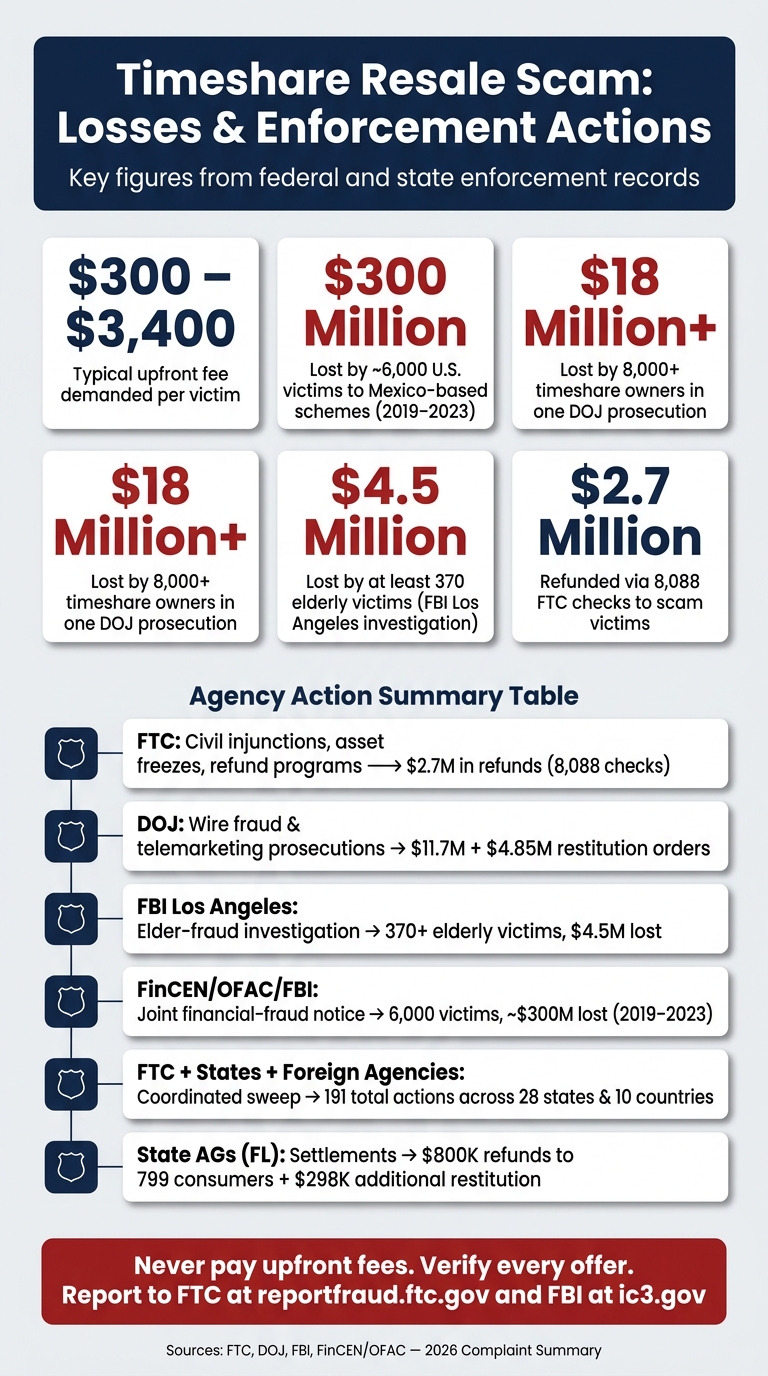
Timeshare Resale Scam Losses & Enforcement Actions: 2026 Data
Federal and State Actions Show Continued Scrutiny of Advance-Fee Offers
Regulators have spent years going after the same advance-fee setup described in 2026 complaints. The “buyer ready” pitch and demand for money upfront keep showing up in case records, and agencies keep taking action against them. That’s why the same warning keeps surfacing across federal and state offices.
The FTC is still the main civil enforcement agency in this area. It has won injunctions, frozen assets, and secured large money judgments against timeshare resale operators. In one case, the FTC mailed 8,088 refund checks totaling nearly $2.7 million to consumers who had paid upfront fees in a timeshare resale scheme.
The DOJ handles criminal prosecutions. In one case involving a U.S.-based resale company, more than 8,000 timeshare owners lost over $18 million. Two defendants were ordered to pay $11.7 million and $4.85 million in restitution, and both received prison sentences lasting several years. In a separate matter, an FBI Los Angeles investigation found at least 370 elderly victims who lost more than $4.5 million, with some people paying hundreds of thousands of dollars over multiple years.
Cross-border fraud has drawn federal attention too. A joint notice from FinCEN, OFAC, and the FBI issued in 2024 said that about 6,000 U.S. victims lost nearly $300 million between 2019 and 2023 to timeshare fraud schemes operating out of Mexico, with some tied to criminal organizations. That number helps explain why federal agencies still treat this as a major threat.
State attorneys general in Illinois, California, Minnesota, and Washington also keep repeating the same message: don’t pay upfront fees, check licenses, and report suspicious offers. Minnesota goes a step further and notes that upfront fees for timeshare exit services are illegal under state law.
Enforcement Actions by Agency and Outcome
The examples below show who acted and what happened.
| Agency | Type of Action | Example Outcome |
|---|---|---|
| FTC | Civil injunctions, asset freezes, refund programs | 8,088 refund checks totaling nearly $2.7 million; a separate 2017 program sent 338 checks totaling more than $319,000. |
| DOJ | Criminal prosecutions for wire fraud and telemarketing fraud | More than 8,000 victims lost over $18 million; two defendants were ordered to pay $11.7 million and $4.85 million in restitution. |
| FBI Los Angeles | Elder-fraud investigation | At least 370 elderly victims lost more than $4.5 million. |
| FinCEN / OFAC / FBI | Joint financial-fraud notice | About 6,000 U.S. victims reported nearly $300 million in losses to Mexico-based timeshare fraud schemes between 2019 and 2023. |
| FTC + states + foreign agencies | Coordinated sweep of travel and timeshare resale scams | 191 total actions, including 3 FTC cases, 83 state civil actions from 28 states, 25 actions from agencies in 10 other countries, and criminal prosecutions of more than 184 individuals. |
| State AGs | Consumer alerts, settlements, and restitution orders | Illinois, California, Minnesota, and Washington all warn about advance fees; Florida settlements produced $800,000 in refunds to 799 consumers and more than $298,000 in additional restitution. |
Taken together, these actions show a clear pattern: the warning signs are well known, the losses can be huge, and agencies at every level keep telling owners to pause before sending money.
What Owners Should Do Next to Cut Risk and Review Legal Options
Basic Steps to Avoid Loss and Document Suspicious Offers
Because 2026 reports keep pointing to advance-fee pitches, owners should treat any unsolicited resale offer with care before paying a dime. The safest move is simple: verify the offer before you act.
Start by searching the company name with terms like "scam", "fraud," and "complaint." Then check whether the agent has a real estate license through the Association of Real Estate License Law Officials (ARELLO) or the state licensing agency where the timeshare is located.
The warning signs match what showed up again and again in 2026 complaints:
- Requests for upfront payment
- Demands for wire transfers, crypto, or gift cards
- Urgent deadlines meant to pressure you
If a caller says a buyer is ready and payment is due today, end the call.
Also, save everything. Keep a file with caller ID records, email threads, copies of contracts or marketing materials, and proof of any payment. If something goes wrong, those records can support complaints to the FTC at reportfraud.ftc.gov, the FBI’s Internet Crime Complaint Center at ic3.gov, and the attorney general in the state where your timeshare is located.
When Contract Cancellation May Matter More Than Resale
If the offer turns out to be fake, the next issue is whether the original contract needs a closer look. A resale does not end the original timeshare contract unless the timeshare company gives a written release. That part trips people up all the time.
So if fees keep climbing, or the original contract may have problems, a contract review may matter more than chasing a resale. It can help protect your credit and deal with liability head-on.
That difference matters because some owners may not need a resale at all. Aaronson Law Firm focuses only on timeshare contract cancellation and can help owners figure out whether rescission applies to their situation.
Conclusion: Key Lessons From 2026 Resale Scam Reports
The 2026 complaint record is consistent: never pay upfront, verify every offer, and document every contact before responding.
FAQs
How do I verify a resale company?
Verify the company on your own through official state sources, not details from the solicitor. Check the real estate license on your state’s real estate commission website and confirm it matches the person who contacted you.
Then look at the company’s physical address, scan for complaint patterns with the Better Business Bureau and your state Attorney General, and call your resort directly. Watch out for upfront fees or guaranteed sales.
What if I already paid an upfront fee?
If you’ve already paid an upfront fee, act fast. You may still be within the rescission or cooling-off period, which is usually 3 to 15 days. If that window is still open, you may be able to cancel without a penalty.
Pull together any paperwork you have, including contracts, receipts, and communication records. Then report the activity to the FTC, the FBI’s IC3, your state Attorney General, or the BBB.
You can also contact Aaronson Law Firm to talk through possible legal options.
Does a resale offer end my timeshare contract?
No. A timeshare resale offer usually does not end your original timeshare contract by itself.
Even if someone “sells” your timeshare to a third party, you usually still remain responsible for the money tied to that contract unless the resort or developer gives you a formal release, or you lawfully rescind or cancel under your contract terms or state law.
Related Blog Posts
- How Timeshare Resale Scams Operate
- Timeshare Scam Trends in 2025
- Avoiding Scams in Third-Party Timeshare Resales
- Timeshare Resale Scams: Case Studies