
Miss a timeshare rescission step and the seller may still chase you for money, fees, and credit damage for up to 7 years. I’d boil this article down to one point: if you cancel on time, your case often turns on proof – the contract, the notice, the mailing record, the refund trail, and your credit file.
Here’s the short version of what matters most:
- I need to check the rescission deadline in both the contract and state law
- I need to send notice to the right address using the required method
- I need to keep certified mail receipts, tracking, and postmarks
- If the seller stalls, I need to push on refunds, billing, collections, and credit reports
- If written disputes fail, I may need complaints, a demand letter, or a lawsuit
These are the 5 main problems covered in the article:
- Hidden cancellation deadlines
- Wrong or incomplete notice address
- Refusal to accept or admit receipt of notice
- Refund delay after a valid cancellation
- Credit harm after cancellation
A few hard facts stand out:
- Many buyers only get 3 to 10 days to cancel
- In Florida, the window is 10 days from the contract date or receipt of the public offering statement, whichever is later
- In Virginia, refunds may be due within 45 days after the seller gets the cancellation notice
- Under federal credit rules, bad marks can stay on a report for 7 years
Quick Comparison
| Problem | What I should do | Proof to keep | Timing issue |
|---|---|---|---|
| Hidden deadline | Compare contract terms to state law and resend notice if needed | Contract, rescission clause, disclosures | The rescission window is short |
| Bad address details | Send notice again using the best listed address and keep mailing proof | Instructions, mailed notice, returned envelope | The postmark date can decide the case |
| Notice refused | Show that I mailed on time | Certified mail receipt, USPS tracking, delivery scans | Mailing on time may be enough |
| Refund not sent | Make a written refund demand and dispute later charges | Bank records, card statements, refund emails or letters | Refund deadlines vary by state |
| Credit damage | Dispute with the bureaus and the company reporting the debt | Credit reports, collection letters, rescission notice | Act as soon as bad reporting shows up |
Bottom line: if I act fast and keep a clean paper trail, I put myself in a much stronger position to enforce a valid cancellation.
sbb-itb-d69ac80
5 Common Rescission Violations That Block a Valid Cancellation
These problems usually start with the contract, the closing packet, or what the seller does after getting notice. The notice itself is often where things go off the rails. Deadline rules, address details, delivery method, and what happens after notice are the four trouble spots that show up most often.
Hidden Cancellation Deadlines
Some developers tuck the rescission deadline into dense contract text or scatter it across separate disclosures. That’s where buyers get tripped up.
A contract might say "calendar days" in one place and "business days" in another. Or it may leave the start date fuzzy. When that happens, a notice sent on time can get painted as late.
Courts may look at a few things here: how easy the rescission language was to spot, whether the developer followed state disclosure rules, and whether the wording could reasonably mislead a buyer.
Wrong or Incomplete Notice Address Details
A seller can challenge a cancellation if the notice went to the wrong address, or if the address listed in the paperwork was incomplete or inconsistent.
This gets messier in deals with several companies involved. You may have a developer, a management company, and a separate finance company. If the buyer isn’t clearly told which company must get the notice, the fight often turns into a basic but messy question: Was the right party notified?
Refusal to Accept or Acknowledge a Timely Notice
Some developers say they never got the cancellation notice even when the buyer has certified mail tracking that shows delivery. Others push back on the delivery method itself. They may say email, fax, or courier service doesn’t count, even when the contract lists those options or the method was otherwise reasonable.
Keep the certified-mail receipt and tracking records. That paperwork can matter a lot. Many state laws treat rescission as effective when the notice is mailed. So if the receipt shows the notice was sent within the allowed window, that can be enough to enforce the rescission, no matter what the developer says happened after delivery.
If the cancellation holds up, the next fight is often about the money.
Refund Delay After a Valid Cancellation
A valid cancellation does not always lead to a fast refund. Buyers often report deposits that never came back, card charges that were not reversed, and billing that kept going after cancellation. Some sellers also keep administrative fees after cancellation, which may violate rescission law.
Refund timing depends on the state. Virginia law, for example, requires payments to be refunded within 45 days after receipt of a cancellation notice. Washington law requires a deposit refund within 10 days if the buyer cancels before signing. If those deadlines come and go with no refund, the delay itself may support a legal claim.
The paper trail matters here. Bank statements, credit card records, and loan documents can show when payments were made and whether they were ever reversed.
When billing keeps going after rescission, the problem can spread into collections and credit reporting.
Credit Harm After Cancellation
Even after a valid rescission notice, the developer or related lender may keep treating the account as open. That can lead to collection letters, continued invoices, and negative credit entries, including charge-offs and collections, all tied to a timeshare the buyer legally canceled.
And that damage doesn’t always stop with the first bad entry. If the account keeps being reported, the credit hit can stretch far beyond the original sale.
Legal Fixes for Each Rescission Problem
Match each problem to the fix below. Move fast, put everything in writing, and keep copies of everything.
Fix the Notice Problem and Preserve the Timeline
If the developer gave you the wrong address, left out key steps, or used deadline language that doesn’t make sense, send a corrected rescission notice right away. Follow the method required in the contract. If you’re not sure what to use, certified mail with return receipt is the safest default.
Your corrected notice should:
- restate that you are rescinding
- include the purchase date and contract number
- attach proof of the first notice
Keep the mailing receipt, tracking records, and return receipt. If an envelope is sent back to you, save that too.
If the seller still rejects the notice, shift right into refund and billing disputes.
Demand Refunds and Stop Improper Billing
If the refund deadline passes and no money shows up, send a written refund demand. State the rescission date, the amount paid, and the refund deadline that has now passed. Send that demand to the company’s cancellation, accounting, and legal contact addresses.
Then save every charge that appears after cancellation. Dispute each one in writing. Ask for written confirmation that the balance is $0 and that billing has stopped.
If charges keep coming, the credit file becomes the next place to push back.
Dispute Credit Reporting and Collections
Pull your credit reports as soon as you think there’s a problem. If the developer or lender still shows the account as past due or in collections after a valid cancellation, that reporting may be wrong.
File written disputes with:
- the credit bureau
- the company reporting the debt
Attach copies of your rescission notice and the credit report showing the error.
When a bureau sends your dispute to the company reporting the debt, that company must investigate and fix information that is inaccurate or can’t be verified. And if you dispute the debt in writing within 30 days of first contact, the collector must pause collection until it verifies the debt.
Save every dispute letter and the bureau’s investigation results. Paper trails matter here. A lot.
If the company still ignores the dispute, move up to formal complaints or legal counsel.
Escalate With Complaints, Demand Letters, or Litigation
If the developer ignores the rescission, won’t refund your money, keeps billing, or continues negative credit reporting after written disputes, it’s time to escalate.
A consumer-protection complaint with your state attorney general or the CFPB may help when there’s a pattern of misleading notice practices or unfair collection behavior.
If the developer still refuses to honor the rescission, an attorney demand letter can add legal pressure and help preserve a record of the dispute. Litigation starts to make more sense when the company keeps pushing after notice, your financial loss is large, or you need relief that informal steps won’t get you.
Aaronson Law Firm handles timeshare rescission disputes, including demand letters, credit reporting issues, and litigation.
The checklist below shows the documents that make these fixes stronger.
Proof Checklist and Violation-to-Fix Table
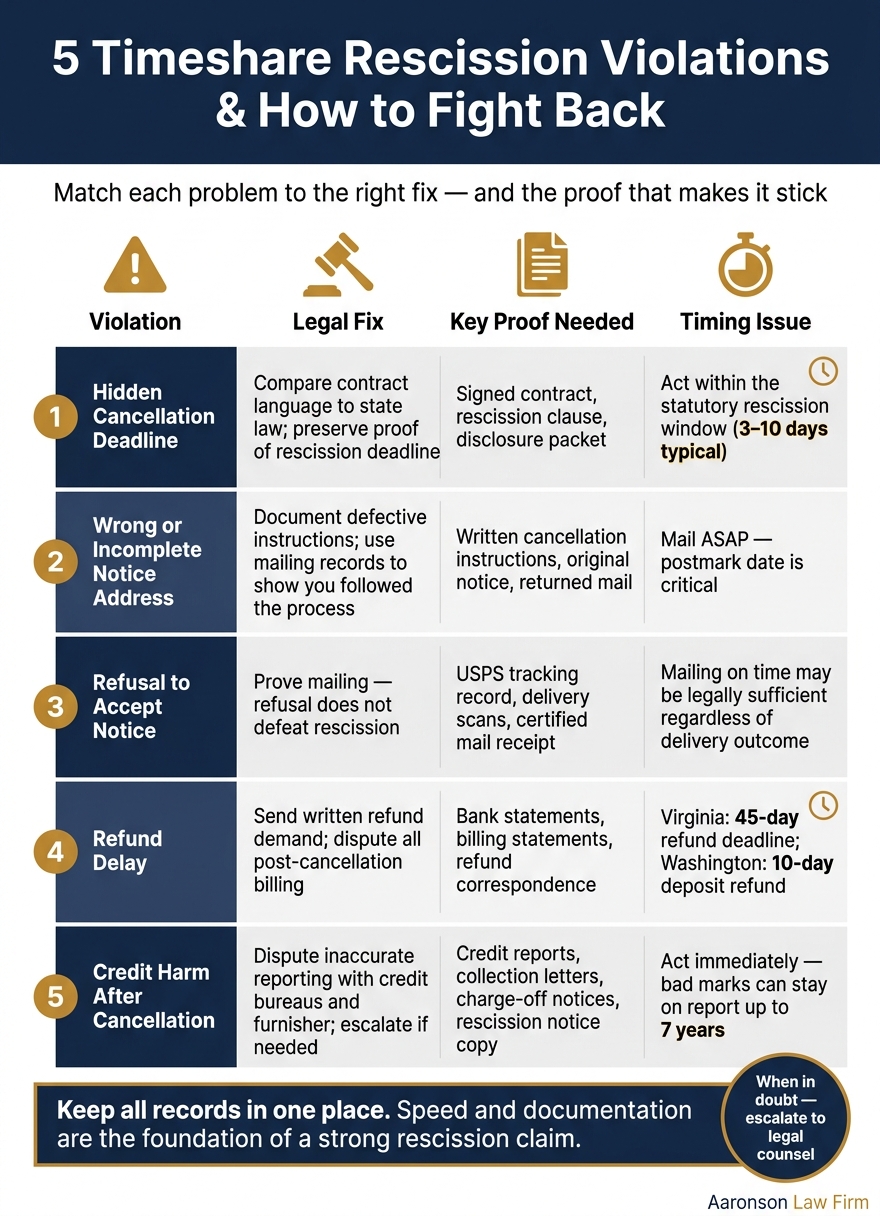
5 Timeshare Rescission Violations: Problems, Fixes & Proof
Documents That Support a Rescission Claim
Use this checklist to prove the five violations above.
A rescission claim can stand or fall based on paperwork. So start there.
The signed contract and rescission clause are the first records to review if you’re dealing with a hidden deadline issue. They show the deadline the seller gave you, the way you were told to cancel, and the address where your notice had to be sent. Put that contract deadline next to your state’s law. If the contract cuts the time short or hides the deadline in fine print, that mismatch can help support your claim.
The disclosure packet and written cancellation instructions show whether the seller gave you a clear and complete process. If the instructions included the wrong address, or left part of it out, that’s on the seller, not on you. Match those papers with the rescission notice you sent, your certified mail receipt, the USPS tracking record, and the tracking history. Hold on to the postmark too. In many rescission cases, the key date is when you mailed the notice, not when the seller got it.
If the seller stalled or flat-out refused to issue a refund, your bank statements, credit card statements, and refund correspondence can show the gap between the date you canceled and the date the money was returned, if it was returned at all.
If your credit took a hit, get your credit reports and keep any collection letters, late payment notices, or charge-off notices sent after your rescission.
Comparison Table: Violation, Legal Fix, Proof, and Timing
The table below lines up each problem with the fastest legal response.
| Violation | Legal Fix | Key Proof Needed | Timing Issue |
|---|---|---|---|
| Hidden cancellation deadline | Compare the contract language to state law and preserve proof of the rescission deadline | Signed contract, rescission clause, disclosure packet | Act within the statutory rescission window. |
| Wrong or incomplete notice address | Document the defective instructions and use the mailing records to show you followed the process given | Written cancellation instructions, original notice, returned mail | Mail as early as possible; the postmark date is critical |
| Refusal to accept notice | Prove mailing; refusal does not defeat rescission | Tracking record, refused or unclaimed delivery scans, mailing receipt | Prove mailing; refusal does not defeat rescission |
| Refund delay | Send a written refund demand and stop billing | Bank statements, billing statements, refund correspondence | Compare the cancellation date to the refund deadline in the contract or state law |
| Credit harm after cancellation | Dispute inaccurate reporting with the credit bureaus and the furnisher; escalate if needed | Credit reports, collection letters, charge-off notices, rescission notice copy | Act promptly after any credit reporting or collection activity appears |
Keep these records in one place so you can tie each violation to the right fix without scrambling for documents later.
Conclusion: Act Fast, Document Everything, and Get Legal Help When Needed
Rescission windows are short. Move right away.
Once you give notice, your next job is proof. Read the rescission clause, confirm the deadline and the correct address, and send written notice by certified mail or whatever method the contract requires. Save the receipt, tracking number, and postmark.
After the notice is mailed, turn your attention to refunds and credit monitoring. Check your credit reports and watch for new charges, late marks, or collection activity.
If the seller still won’t honor rescission, escalate the matter. If notice is rejected, refunds are delayed, or your credit is damaged, Aaronson Law Firm can send demand letters, protect your credit, and pursue litigation.
Strong rescission claims depend on speed and records. That’s the core of enforcing rescission rights.
FAQs
What if I mailed my cancellation on time but used the wrong address?
Sending your cancellation notice to the wrong address can wreck your attempt to cancel, even if you mailed it before the deadline. If the contract lists a specific department or address and you send it somewhere else, the developer may say your notice wasn’t properly delivered.
That’s a big deal because rescission windows are short – often just 3 to 15 days. Move fast. A timeshare attorney can review the contract for noncompliance or disclosure failures that may give you another path to cancel.
How do I prove a timeshare rescission notice was valid?
Keep a clear paper trail. Send your written notice by certified mail with a return receipt requested to the address listed in your contract. That gives you proof of when it was mailed and when it was delivered.
Hold on to copies of your signed cancellation letter, contract disclosures, and mailing receipts too. Some states treat notice as effective when you mail it. Others count it when the seller receives it. Those records can help show you met the legal deadline.
What should I do if my credit is harmed after I cancel?
If your credit takes a hit after a timeshare cancellation, check your credit reports and dispute anything that’s wrong. A rescinded contract is treated by law as if it never happened, which means a developer can’t report it as a default or late account.
An attorney can send formal dispute letters under 15 U.S.C. § 1681 to challenge improper reporting. Aaronson Law Firm also offers credit protection services during the resolution process.
Related Blog Posts
- Fixing a Rejected Rescission Letter
- Timeshare Rescission Laws: Developer Compliance
- Timeshare Cancellation Deadlines by State
- Consumer Rights After Rescission Period Ends