
A wrong bill and a bad ownership fit are two different problems. If one invoice looks off, I would treat it as a maintenance fee dispute. If I want the fees, contract duties, and future bills to stop for good, I would look at a timeshare exit.
Here’s the short version:
- Fee dispute = I challenge a single charge and keep the timeshare
- Timeshare exit = I try to end ownership and stop future fees
- Not paying does not cancel the contract
- If I stop paying, I may face default, collections, and credit damage
- Some card billing disputes may have a 60-day window
- A collection account can stay on a credit report for up to 7 years
If I’m not sure which path fits, I use one simple test:
- If a corrected bill would solve the problem, I dispute the fee
- If a corrected bill would not solve it, I look at exit
Quick Comparison
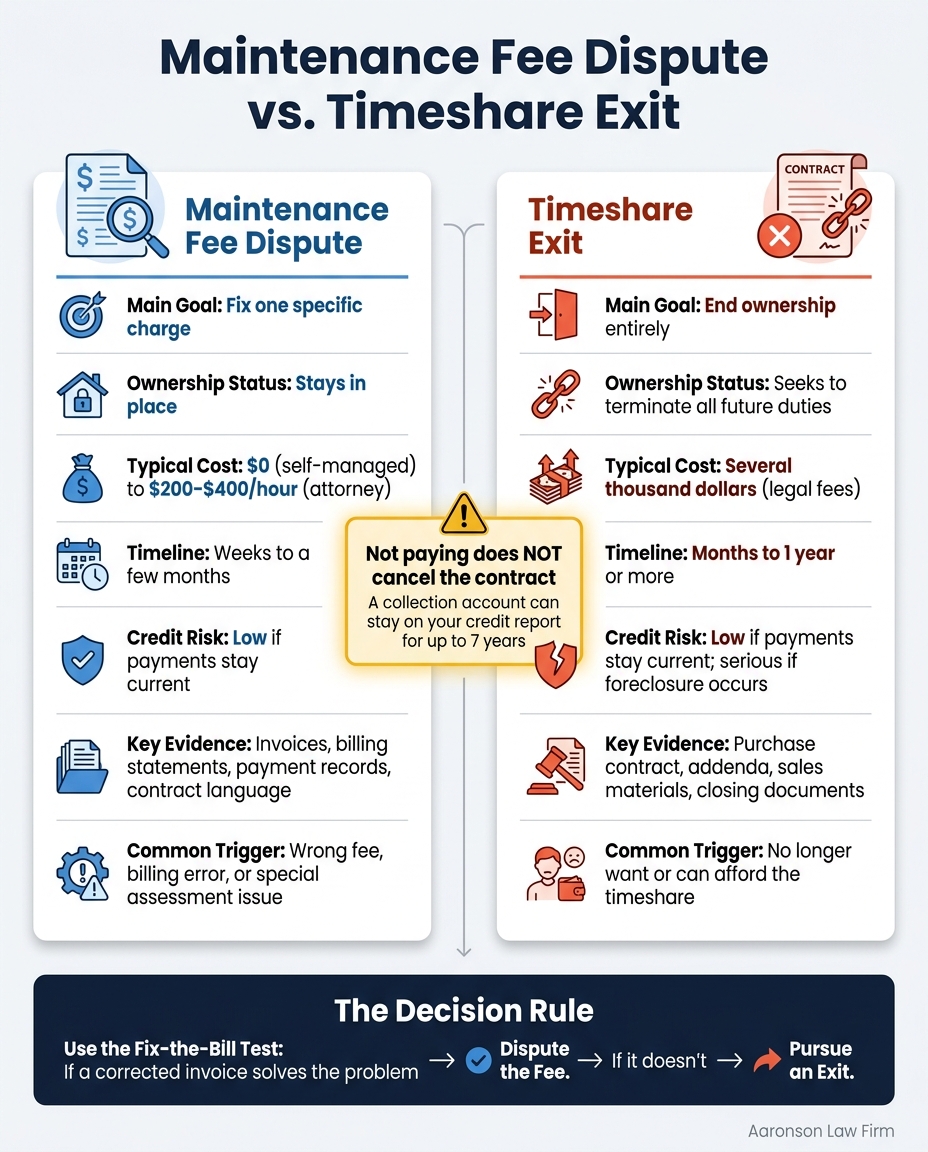
Maintenance Fee Dispute vs Timeshare Exit: Side-by-Side Comparison
| Factor | Maintenance Fee Dispute | Timeshare Exit |
|---|---|---|
| Main goal | Fix one charge | End ownership |
| Ownership status | Stays in place | Tries to stop future duties |
| Cost | Often lower; may be $0 if I handle it myself, or $200–$400/hour with a lawyer | Often higher; legal work may cost several thousand dollars |
| Time | Weeks to a few months | Months to 1 year or more |
| Credit risk | Lower if I stay current | Lower if I stay current |
| Main proof | Bills, payment records, contract terms | Purchase papers, addenda, sales records, closing files |
| Common trigger | Wrong fee, billing error, special assessment issue | I no longer want or can keep the timeshare |
What this comes down to is simple: I need to match the fix to the problem. A billing fight is about the invoice. An exit is about the contract.
sbb-itb-d69ac80
What Each Option Is Built to Do
That distinction matters because these two paths ask for different kinds of proof and lead to different results. At the core, you’re dealing with one of two problems: the charge or the contract.
Maintenance Fee Dispute: Challenge the Charge, Keep the Ownership
A maintenance fee dispute fits when you still want to keep the timeshare, but you think the resort billed you the wrong way or treated you unfairly.
Common red flags include:
- A sudden fee increase
- An undisclosed special assessment
- A charge for a week or unit you do not own
The goal here is pretty narrow. You’re trying to correct, reduce, or reverse the bill. In plain English, you’re telling the resort: follow the contract and the governing documents.
The proof usually comes from paperwork. That often means invoices, budgets, and the contract language lined up against the amount billed.
If part of the bill is not in dispute, those amounts still come due while you still own the interest. Keep those payments current so you do not slip into default while the dispute is still being sorted out.
If the issue is not the bill itself, but the fact that you still own the timeshare, then you’re looking at the next path: exit.
Timeshare Exit: End the Ownership Obligation Entirely
A timeshare exit goes after the contract itself. The point is to end the ownership obligation and stop future maintenance fees, special assessments, taxes, and other related duties.
Common exit paths include rescission, deed-back or surrender, resale or transfer, and attorney-led contract cancellation.
Direct Comparison: How the Two Paths Differ
A fee dispute and a timeshare exit are not the same thing. They differ in purpose, proof, cost, and risk.
| Factor | Maintenance Fee Dispute | Timeshare Exit |
|---|---|---|
| Purpose | Challenge a specific charge while keeping the ownership | End the ownership obligation entirely |
| Typical cost range | Low to moderate; often $0 if self-managed, or $200–$400 per hour if an attorney is involved | Higher upfront; legal fees often run several thousand dollars |
| Timeline | Weeks to a few months | Months to over a year, depending on the process |
| Collections risk | High if payments are withheld during the dispute | Moderate to high if payments stop during the exit process |
| Credit impact | Minimal if kept current; significant if the account goes delinquent | Minimal if kept current; serious if foreclosure or collections occur |
| Key evidence needed | Invoices, billing statements, payment records, and contract language | Purchase contract, addenda, sales materials, closing documents, and records of the sales process |
Put simply, a fee dispute is usually the lower-cost path. A timeshare exit usually costs more at the start, but if it works, it can stop future obligations. That’s the tradeoff.
The biggest gaps come down to:
- Cost
- What you need to prove
- How fast you need to act
Cost, Risk, and Credit Impact
Money is only part of the picture. Risk matters too.
If you withhold payment during a fee dispute, or let payments lapse during an exit, the account can become delinquent. Once that happens, a collection account may show up on your credit report and stay there for up to seven years.
That’s a big deal. Staying current can help limit damage. Falling behind can turn a billing fight into a credit problem.
Proof and Timing Requirements
The proof you need is also different, and so are the deadlines.
| Proof & Timing Factor | Maintenance Fee Dispute | Timeshare Exit |
|---|---|---|
| Core documents | Invoices, payment records, contract billing terms | Purchase contract, addenda, sales materials, closing documents |
| Key deadline | Billing dispute window (often 60 days for some card-related disputes); resort appeal period | Rescission window |
| Proof standard | Billing error or improper charge | Misrepresentation, unconscionable terms, or other legal grounds for cancellation |
| Recordkeeping scope | Single billing cycle or recent history | Entire sales and ownership history |
A maintenance fee dispute often centers on a single charge or billing period. A timeshare exit is broader. You may need paperwork from the original sale, later addenda, and records from the full ownership period.
Timing can also make or break your case. For some card-related disputes, the billing dispute window is often 60 days. For exits, the rescission window is the key cutoff. Miss the deadline, and your options may narrow fast.
Matching the Right Option to Your Situation
Use the fix-the-bill test. If a corrected invoice would solve the problem, dispute the fee. If it wouldn’t, look at exit. That’s the simplest way to match the problem to the right remedy.
Choose a Fee Dispute When the Problem Is the Bill
If the issue is the charge, keep your focus on the invoice. A fee dispute makes sense for owners who still want the timeshare but think something on the bill is wrong. That could mean an improper special assessment, an unexplained sharp increase, or a clerical mistake like being billed for points you don’t own.
The goal here is narrow: correct the charge, enforce the contract terms, and keep the ownership intact.
Choose Timeshare Exit When the Problem Is the Ownership Itself
If the issue is the contract itself, fixing the bill won’t solve it. Rising fees are one of the main reasons owners look for an exit, especially when those charges keep going up year after year.
If you haven’t used the resort in 3+ years, can’t absorb the annual fee, or worry about leaving the obligation to your heirs, correcting one invoice won’t stop next year’s bill from showing up. When the goal is full cancellation, billing relief isn’t enough.
That is especially true if the original sale involved misrepresentation or sales pressure. In that situation, Aaronson Law Firm can help structure a legal exit plan, including demand letters, credit protection, and litigation support.
Use the quick map below to match common situations to the better path.
| Situation | Better Fit | Why |
|---|---|---|
| Received a sudden special assessment that appears to violate the HOA bylaws | Fee Dispute | Specific charge; ownership still wanted |
| Haven’t used the timeshare in 3+ years and cannot absorb the annual fee | Timeshare Exit | Ownership no longer justifies the cost |
| Maintenance fee jumped 35% year-over-year with no explanation or approval process | Fee Dispute | Enforce contractual limits on fee increases |
| Retired on a fixed income and worried about leaving the obligation to heirs | Timeshare Exit | Long-term burden points to cancellation |
| Resort repeatedly misbills for weeks or points you don’t own | Fee Dispute | Billing errors challengeable while keeping ownership |
| The original sale involved misrepresentation or pressure and you want the purchase undone | Timeshare Exit | Goal is rescission, not fee adjustment |
Separate the fee dispute from the exit request in writing.
Conclusion: Identify the Real Problem Before Taking Action
Start with the main issue: Is it the bill, or is it the ownership? That answer shapes the documents you need, what it may cost, how long it may take, and the credit risk involved.
It also tells you which fix fits the problem. A billing error or fee dispute calls for one path. A contract defect or misrepresentation points to another path: exit.
Before you do anything, line up your records with the issue at hand. Pull together your billing documents, contract, and sales materials. The paper trail should show where to go next. If it shows a billing error, dispute the fee. If it points to misrepresentation or a contract defect, pursue an exit. Aaronson Law Firm can review your documents and clarify your next step.
Get your paperwork in order first, then choose the path that matches the problem.
FAQs
How do I know which option fits my situation?
Match your goal to your situation. If you need relief from payments now and want to stop future maintenance fees, contract rescission or cancellation may be the better path. That’s often the case if you’re still inside your state’s 3–15 day rescission window or can point to misrepresentation, high-pressure sales tactics, or contract breaches.
If you can keep paying fees while you wait, a sale or transfer may make more sense. Pull together your contract, maintenance fee statements, and any correspondence, then talk with a timeshare attorney to review your options and help protect your credit.
Should I keep paying while my case is pending?
Yes. Keep paying maintenance fees while your case is pending. Those fees are still legally binding until your contract is formally canceled or the ownership transfer is complete.
If you stop paying, you could face late fees, debt collection, credit damage, liens, and even foreclosure. Staying current helps protect your finances and your credit while your legal counsel works on the cancellation.
What documents should I gather first?
Start with your original timeshare contract, any amendments, the recorded deed if one applies, your account numbers, and the purchase date.
Then pull together the rest of the paper trail: sales documents, written correspondence with the resort or developer, payment records for maintenance fees and any loan, and a timeline of communications, including fee notices.
If you’re pursuing rescission, include the contract’s rescission instructions and copies of any cancellation notice sent by USPS certified mail with return receipt.
Related Blog Posts
- Timeshare Cancellation vs. Resale: Which Option Is Better?
- Understanding Timeshare Maintenance Fees and Legal Rights
- Top 5 Timeshare Maintenance Fee Lawsuits
- Top 7 Timeshare Fee Complaints