
If a timeshare salesperson said one thing but your contract says another, the contract usually wins. But that is not the end of it. In the U.S., buyers may still have a claim if they can show fraud, false statements, missing disclosures, or a repeat sales script.
Here’s the short version:
- Written documents usually control the deal.
- Verbal promises often do not count unless you can back them up.
- Rescission rights are often short, sometimes just 3 to 10 days, depending on state law and the contract.
- Proof matters most: contracts, disclosure packets, fee notices, emails, texts, booking records, and notes from the sales meeting.
- Common conflict points include:
- maintenance fees
- cancellation rights
- booking access
- resale value
- rental income
- exit options
If I were reviewing a timeshare dispute, I would first compare what was promised with what was signed. Then I would check for missing notices, fee language, finance terms, and any pattern showing the same pitch was used on other buyers.
Quick Comparison
| Issue | Written Disclosures | Sales Promises |
|---|---|---|
| Legal weight | Usually stronger | Usually weaker |
| Where it appears | Contract, POS, loan papers, rescission notice | Presentation, calls, emails, brochures |
| Typical message | Fees can increase; limits apply | Costs stay low; booking is easy |
| Best use in a dispute | Shows the paper terms | Helps show misrepresentation if backed by proof |
| What to collect | Signed documents, TILA forms, account records | Texts, emails, ads, notes, witness statements |
Bottom line: I would treat the paperwork as the starting point, then build a file that shows each gap between the pitch and the fine print.
sbb-itb-d69ac80
Disclosures vs. Sales Claims: What Each Side Usually Says
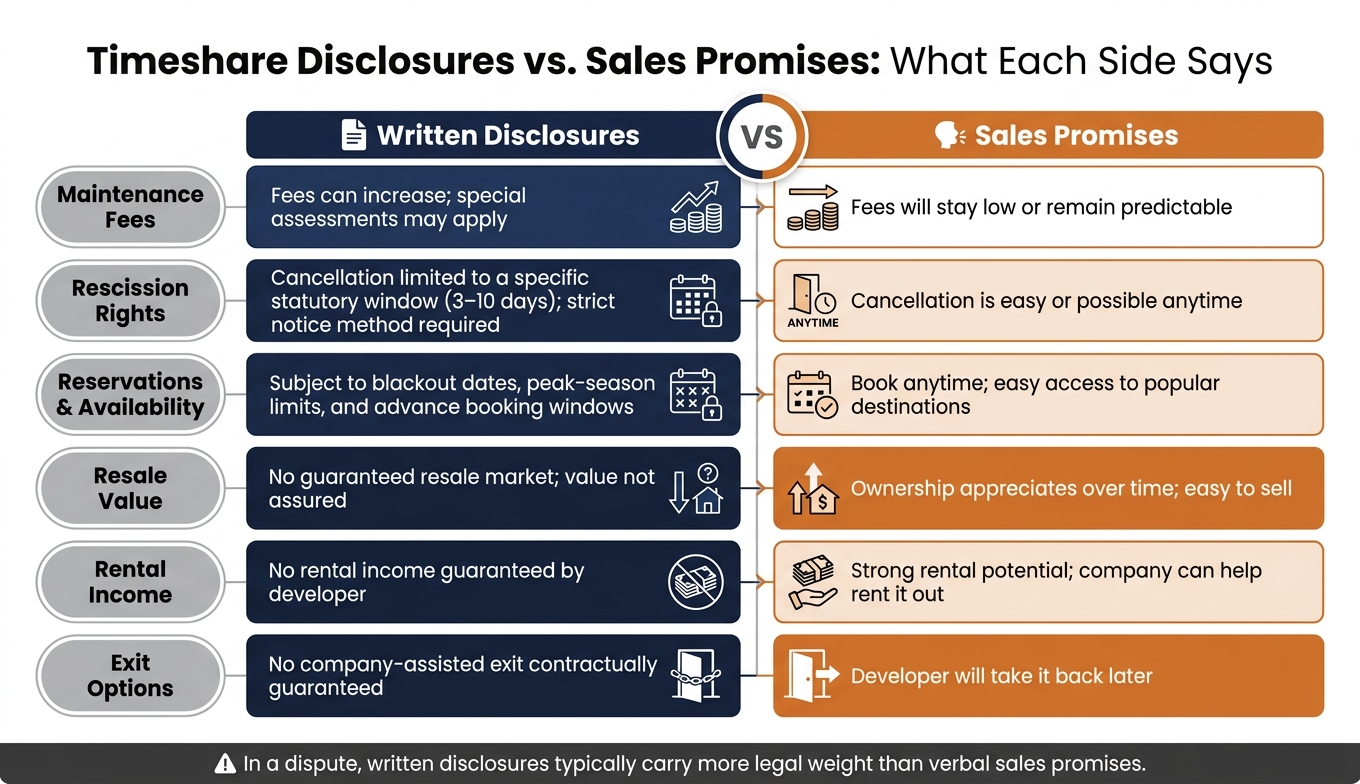
Timeshare Disclosures vs. Sales Promises: What Each Side Says
What the Contract and Disclosures Usually Cover
The contract usually lays out the parts that matter most in plain legal terms: the rescission deadline and how notice must be sent, annual maintenance fees, the developer’s right to increase fees or add special assessments, reservation rules, blackout dates, and financing terms.
Many contracts also include an integration clause. That means the signed paperwork controls the deal, not what was said during the sales presentation.
What Buyers Say They Heard
Buyers often describe hearing something quite different from what shows up in the documents.
Here’s where the gap tends to show up most often:
| Topic | What the Documents Typically Say | What Buyers Commonly Report Hearing |
|---|---|---|
| Maintenance fees | Fees can increase; special assessments may apply | Fees will stay low or remain predictable |
| Rescission rights | Cancellation is limited to a specific statutory window and requires notice by the stated method and deadline | Cancellation is easy or possible anytime |
| Reservations & availability | Subject to reservation windows, blackout dates, peak-season limits, and other usage rules | Book anytime, easy access to popular destinations |
| Resale value | No guaranteed resale market; value is not assured | Ownership appreciates over time; easy to sell |
| Rental income | No rental income is guaranteed by the developer | Strong rental potential; the company can help rent it out |
| Exit options | No company-assisted exit is contractually guaranteed | The developer will take it back later |
Wisconsin consumer protection materials also say sellers cannot misstate resale value or pitch timeshares as financial investments. They also cannot make factual claims that conflict with the written documents.
When the paperwork says one thing and the pitch says another, the next issue is which one controls.
Which Terms Usually Control in a Dispute
When written terms clash with sales claims, courts usually look first at the signed contract. That’s the document judges tend to treat as the main record of the deal.
Why the Fine Print Often Controls
Courts usually treat the signed contract as the controlling record, and sales-pitch statements usually can’t override it.
Two clauses often do a lot of work here:
- An integration clause says the written contract is the full deal.
- A non-reliance clause says the buyer did not rely on sales talk.
Add a signed acknowledgment saying the buyer received and reviewed the required disclosures, and developers often end up with a strong paper trail.
As one court put it:
"Only what is written counts as part of the contract documents."
That rule explains why the written record carries so much weight in a timeshare dispute.
When False Promises Can Still Matter Legally
That said, written terms are powerful, but they aren’t bulletproof. Courts often draw a clear line between a salesperson who oversells and one who makes specific, provably false factual claims.
Claims tied to fraud, negligent misrepresentation, and state consumer protection law can still matter even when integration and non-reliance clauses are in the contract.
Patterns matter too. If multiple buyers report the same promises, that may look less like a one-time mix-up and more like a repeat sales script. When buyers independently describe the same claims – guaranteed rental income, easy resale, or a buyback promise – that can support a deceptive practices claim, and standard disclaimer language may carry less weight.
Material omissions can also weaken the fine print. If a required disclosure leaves out a key fact – such as the practical difficulty of booking peak-season weeks or the full scope of special assessments – that gap may support a statutory claim or a fraud argument, even if the buyer signed an acknowledgment form.
A contract review should flag those omissions. An incomplete disclosure can matter just as much as a missing one. The next issue is whether the disclosure file leaves out facts that matter.
Records That Help Prove a Disclosure-Promise Conflict
When a sales promise doesn’t line up with the paperwork, the next step is simple: build a paper trail that shows the gap. That means comparing each promise to the exact contract term it should match – or noticing that no matching term exists at all.
Core Documents to Collect First
Start with the full set of signed closing documents. That includes the purchase contract, any addenda, the disclosure packet or public offering statement (POS), any rescission notices or cancellation instructions, the promissory note, the security agreement, and any Truth in Lending Act (TILA) disclosures.
Each document does a different job:
- The purchase contract lays out the main deal terms.
- The POS explains the resort setup, owner rights, and risks.
- The financing papers and TILA disclosures show the actual APR, payment schedule, and default costs.
Also pull maintenance-fee notices, annual budget documents, account statements, and any signed receipt, checklist, or similar acknowledgment form showing that disclosures were delivered. Those signed forms can help prove delivery. But they can also show that key details were tucked into a thick stack of closing papers.
Supporting Evidence That Can Back Up Verbal Statements
The written contract shows the deal on paper. Emails, texts, brochures, screenshots, and notes help show how the deal was sold.
Save every email and text message with sales reps or resort staff, and make sure the dates and sender names are visible. It helps to group them by topic, such as cancellation flexibility, availability, cost, or resale value. That way, the pattern is easier to see.
Brochures, pricing sheets, and presentation handouts matter too. Mark each one with the date and location of the sales meeting. If a flyer said there were no hidden fees or that exit options were easy, you can compare that claim straight against contract language that says the opposite. Screenshots of online ads or resort booking portals should show a visible date or timestamp because websites can change fast.
Booking records are easy to miss, but they can be strong proof. If an owner kept getting turned down for the dates or resorts they wanted, that can clash with a salesperson’s claim that the timeshare allowed flexible booking. Payment history can do the same kind of work. Loan statements, resort account statements, credit card statements, bank records, late-fee notices, and collection letters can show the actual money impact compared with what was promised during the pitch.
A handwritten timeline or set of notes drafted shortly after the presentation can also carry weight. Include the date and location, the names and roles of the people who spoke, and what each person said about fees, cancellation, and resale. Notes written soon after the meeting often land better than memories written down much later.
Put together, these records can show whether the sales pitch was a one-off comment or part of a repeat script.
How Owners Can Use Gaps in the Disclosures
Collecting documents is only half the job. The other half is laying them side by side with the sales pitch. The goal is to match each major verbal promise to the written term that should back it up – or flag that no such term appears.
| Area to Check | What Was Promised | What to Look for in Writing |
|---|---|---|
| Cancellation rights | Exit anytime | Rescission period, cancellation instructions, notice requirements |
| Maintenance fees | Minimal, stable dues | Fee formulas, special assessment authority, increase caps |
| Usage and booking | Book whenever you want | Blackout dates, advance booking windows, point expiration rules |
| Resale or exit | Easy to sell or exit | Disclaimers denying investment value or guaranteed buyback |
| Financing cost | Affordable monthly payments | APR, total finance charge, repayment term, default penalties |
If a verbal promise has no written match – or gets flatly contradicted by the fine print – that gap matters. Common examples include missing or unclear cancellation notices, vague fee formulas, and booking limits that never came up during the presentation. That kind of mismatch can help support a cancellation demand or a legal review.
Once that gap is mapped out, the next step is figuring out whether it supports cancellation.
Using Disclosure Gaps in a Cancellation Strategy
A documented gap between what the sales team said and what the contract says can help support a cancellation case. The trick is figuring out which gaps carry legal weight.
What a Legal Review Should Look For
Once the paperwork is side by side, the next step is to find the mismatch that matters most. A legal review usually looks for four red flags:
- Inconsistent written terms: If one document suggests flexible use but another sets hard blackout dates, that conflict can weaken the resort’s claim that the terms were clearly disclosed.
- Missing or defective disclosures: If a rescission notice is missing, dated the wrong way, or delivered late, that may support rescission or consumer-protection claims.
- Misleading fee or financing disclosures: A payment table may spotlight a low monthly amount while downplaying the full loan cost, balloon payments, or rising fees. That can show the buyer didn’t get a fair picture of the financial risk.
- Evidence of a repeat script: When several owners describe almost the same promises, and those promises clash with the written contract, it points to a pattern instead of a one-off mix-up.
These issues matter because they help show whether the buyer got the disclosures the law required.
Key Takeaways for Owners
In most disputes, the signed documents carry the most weight unless the owner can prove fraud, a material omission, or repeated misrepresentation. Still, fraud, repeated misrepresentation, or disclosure failures can cut through the fine print. That’s where the paper trail starts to matter. Save every document, hold onto every message, and move fast if a rescission deadline may still be open.
FAQs
Can I cancel after the rescission period ends?
Yes, it may still be possible.
If the developer didn’t provide the disclosures required by law, left out key facts, gave misleading details, or used fraud or misrepresentation, the contract may be voidable. In some cases, your cancellation window may also be extended.
Timeshare laws vary from state to state, so the fine print matters. A legal professional such as Aaronson Law Firm can review your contract, look for missing disclosures, and check whether there are other grounds to challenge the agreement.
What evidence best proves a false sales promise?
The strongest proof is the paperwork and messages created at or close to the time of the sale. That kind of evidence helps show what you were told and how that compares with what you actually signed.
Useful examples include:
- Dated emails, text messages, brochures, and promotional materials
- Notes written during the presentation or right after it
- Audio recordings, financial records, booking histories, and witness statements
Do disclosure errors make a timeshare contract invalid?
Yes, disclosure errors can make a timeshare contract voidable or even unenforceable.
If a developer leaves out required disclosures, skips material facts, or includes wrong information in documents like the public offering statement, that can break state or federal rules.
And that matters. A disclosure problem may extend your rescission period or give you grounds to void the contract. If that happens, you may be released from financial obligations and may also be able to seek a refund.
Related Blog Posts
- How Courts Handle Deceptive Timeshare Sales
- Mandatory Disclosure Rules in Timeshare Contracts
- Timeshare Disclosure Laws: What Sellers Must Reveal
- Timeshare Developers’ Financial Disclosure Rules