
A missed disclosure can change the cancellation deadline – or keep it open. In this 25-state review, I see cancellation periods from 72 hours to 15 days, with many states starting the clock only after the buyer gets the public offering statement or other required papers.
Here’s the short version:
- I’m comparing 25 states plus D.C.
- I’m looking at 4 rules in each one:
- cancellation window
- seller disclosures
- how cancellation notice must be sent
- what a buyer may claim if disclosures are missing, late, false, or unclear
- In many states, a disclosure mistake can delay the start of the rescission period
- In some states, buyers may still seek rescission, damages, attorney’s fees, civil penalties, or refunds after the normal deadline
- Deadlines vary a lot:
- 72 hours in Indiana
- 3 business days in Kansas, Kentucky, and Massachusetts
- 5 days in many states
- up to 15 days in Alaska and D.C.
Bottom line: I’d treat the disclosure packet and notice rules as just as important as the deadline itself. A buyer can lose rights by sending notice the wrong way. But a seller can also lose defenses by skipping required disclosures.
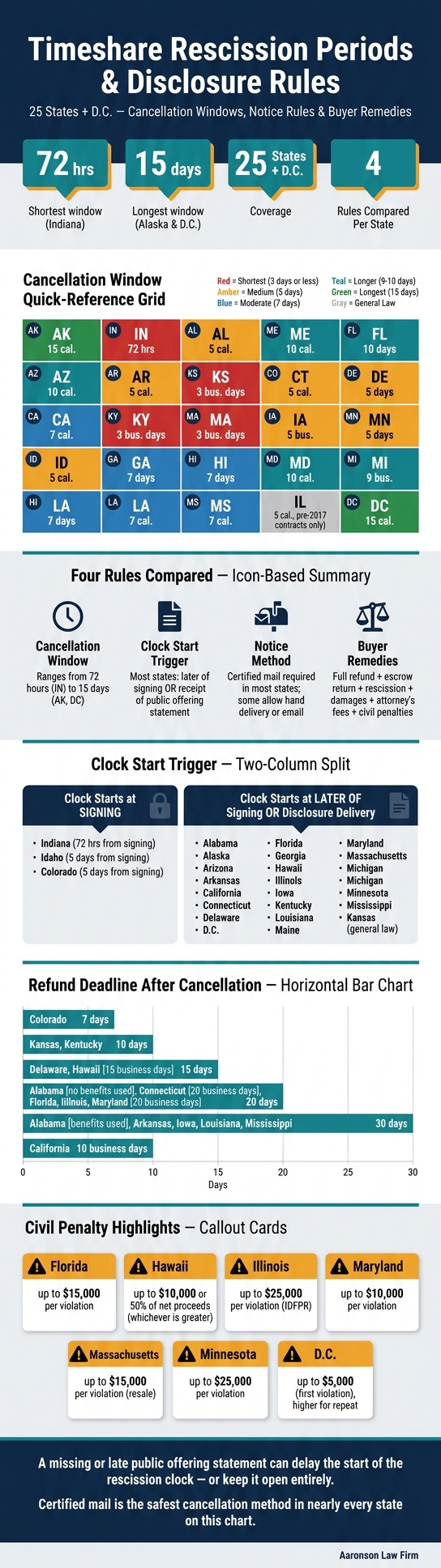
Timeshare Cancellation Windows by State: 25-State Disclosure & Rescission Chart
Quick Comparison
| What I compare | Why it matters |
|---|---|
| Cancellation window | Shows how long a buyer has to cancel |
| Start date trigger | Tells whether the clock starts at signing or only after disclosures are delivered |
| Notice method | Some states require certified mail or other written delivery rules |
| Buyer remedies | Can include full refunds, escrow return, rescission, damages, penalties, and attorney’s fees |
A few patterns stand out. Certified mail shows up again and again. Many states require bold or conspicuous cancellation language near the signature line. And several states tie refunds to short deadlines like 7, 10, 15, 20, or 30 days after notice.
If you’re comparing state rules, this chart works best as a fast side-by-side guide to the deadline, the required papers, the notice steps, and the buyer’s remedies.
sbb-itb-d69ac80
1. Alabama
Alabama timeshare sales are governed by Ala. Code Title 34, Chapter 27, Article 3 and Real Estate Commission rules. One big theme runs through these rules: buyers must get key disclosures before they sign.
That matters more than it might seem at first. In Alabama, disclosure problems can affect both when a buyer can cancel and what refund the buyer can claim.
Rescission Window
Alabama gives buyers 5 calendar days to cancel a timeshare contract after signing.
There’s one small wrinkle: if the fifth day lands on a Sunday, that day does not count. This cancellation right also cannot be waived.
Disclosure Requirements
Before a buyer signs, the seller must provide a public offering statement.
The contract also has to include the cancellation language and explain how the buyer can send notice. On top of that, sellers must keep signed, dated proof of delivery.
If the cancellation terms are missing or misstated, that’s a disclosure violation. And if disclosures are missing or inaccurate, the buyer’s cancellation rights may stay in place longer and refund duties may still apply.
Notice Rules
To cancel, the buyer must send written notice by certified mail, return receipt requested, to the seller’s contract address.
A phone call, verbal statement, or other oral notice does not count.
Buyer Remedies
Here’s how the refund rules work:
| Scenario | Refund Rule | Deadline |
|---|---|---|
| No benefits used | Full refund of all payments and return of negotiable instruments | Within 20 days of notice |
| Benefits used | Refund of amounts beyond pro rata use | Within 30 days of notice |
| Seller does not refund | Statutory violation | Buyer may seek enforcement |
For certain timeshare plans, Alabama also requires all funds received to stay in escrow during the 5-day cancellation period.
If a buyer thinks disclosures were missing, or the seller wrongly refused a refund, the buyer can file a complaint with the Alabama Real Estate Commission or the Alabama Attorney General’s Office.
2. Alaska
Alaska gives timeshare buyers 15 calendar days to cancel a purchase for any reason.
Rescission Window
That 15-day period starts when the buyer receives the public offering statement, not when the contract is signed.
So if someone signs first and gets the disclosure packet later, the deadline can start on the date that packet is delivered. That detail matters more than most buyers think. A signed contract may feel final, but under Alaska law, the clock is tied to the disclosures.
Disclosure Requirements
Alaska timeshare sellers must give buyers a public offering statement that spells out key terms, including:
- the buyer’s ownership interest
- use restrictions
- maintenance fees
- assessments
- exchange or management details
Sellers also have to explain the rescission period during the sales presentation and provide the paperwork needed to cancel.
Leave out recurring fees or other material terms, and that can trigger disclosure issues. If the disclosures are late or incomplete, the rescission clock may not start until the buyer gets them.
Notice Rules
Cancellation must be sent by written notice. Buyers can use hand delivery or prepaid U.S. mail to the seller or the seller’s agent for service of process.
Oral notice does not count.
Buyer Remedies
That timing rule shapes the buyer’s remedy. If the buyer cancels within the 15-day window, the contract is void and the seller must return the buyer’s payments.
Late or missing disclosures can extend cancellation rights or back other legal remedies. Buyers should keep:
- the contract
- the disclosure packet
- payment records
- proof of delivery
3. Arizona
Arizona gives timeshare buyers 10 calendar days to cancel a purchase agreement for any reason. The countdown starts the day after the buyer signs the contract. Weekends and holidays still count. A developer can give a longer cancellation period in the contract, but that extra time has to be stated clearly.
Rescission Window
The deadline is midnight on the tenth calendar day after signing.
In 2019, HB 2639 changed Arizona’s rescission period from 7 days to 10 days. It also added stronger disclosure rules about fees and risk, including a direct warning that timeshares are not investments.
Disclosure Requirements
Before the sale, developers must deliver the public report. That report has to cover the purchase price, maintenance fees, assessments, financing terms, usage rights, reservation systems, exchange rights, and management and operations details.
Arizona also requires a separate disclosure document that the buyer must initial and sign. It must state the 10-day cancellation right, warn that timeshares are not investments, and give an estimate of first-year costs. That estimate must include the maximum assessment amount and assessments from the prior three years.
The rescission notice must also appear conspicuously in the purchase agreement, immediately before the buyer’s signature line. If that language is hidden, buried, or missing, it may lead to a disclosure violation.
Under A.R.S. § 32-2197.09, a buyer can rescind any sale made before a public report is issued, or if the report was never delivered at all. A contract with blank spaces at the time of signing is also voidable at the buyer’s option.
Notice Rules
Cancellation must be in writing and sent to the address listed in the purchase agreement for rescission notices. The notice counts when it is sent.
Certified mail with return receipt requested is the safest way to send it. Keep copies of the cancellation letter, the contract, and the mailing receipt.
Buyer Remedies
A timely rescission voids the contract and requires a full refund from escrow. If no public report was delivered, the buyer may rescind for up to three years. Untrue statements or material omissions may also support damages, fees, and costs.
Arizona’s rules make one thing plain: if the seller misses key disclosures, the buyer may get more time to rescind and more ways to recover.
4. Arkansas
Arkansas ties the cancellation period to when the buyer gets the required disclosures, not only to the date the contract was signed.
Rescission Window
Buyers in Arkansas get 5 calendar days to cancel a timeshare purchase. If day 5 lands on a Saturday, Sunday, or legal holiday, the deadline moves to the next business day.
There’s one detail that matters a lot here: the countdown does not begin until the buyer receives both:
- oral and written notice of the right to cancel
- the public offering statement
Until the buyer gets the public offering statement, the contract stays voidable.
Disclosure Requirements
The seller has to provide a public offering statement before or at closing. That statement must include key facts, such as the developer’s identity and address, a description of the accommodations, any liens or encumbrances, financing terms, insurance details, and any pending lawsuits.
Arkansas also requires a conspicuous cancellation notice printed immediately above the buyer’s signature line. On top of that, the Arkansas Real Estate Commission may require some disclosures to appear in boldface type.
Recordkeeping matters too. Developers must keep complete records for 3 years so the Commission can inspect them. Those records include sales contracts, closing statements, credit disclosure information, and an executed copy of the required Important Notice form.
If the offering materials contain false or misleading statements, that counts as a disclosure violation.
Notice Rules
To cancel, the buyer should send written notice to the address listed in the contract. In-person delivery works only if the paperwork allows it.
Certified mail with return receipt requested is the safest move. It gives the buyer proof that the notice was sent and received. If notice goes to the wrong address, or is sent in a way the contract does not allow, the buyer can lose the right to cancel even if the deadline has not passed.
Buyer Remedies
If the buyer cancels on time, the contract becomes void, and the seller must refund all payments within 30 days after getting the cancellation notice.
If the public offering statement was inaccurate, or the contract had material defects, the buyer may have up to 4 years from the contract date to seek rescission or damages. Willful violations of the Time-Share Act can also support punitive damages and attorney’s fees.
5. California
California regulates timeshares under the California Vacation Ownership and Time-Share Act of 2004, found in Business and Professions Code §§ 11210 et seq. In California, the right to cancel is tied directly to when the buyer gets the public report.
Rescission Window
Buyers have 7 calendar days to cancel. That 7-day period starts on the later of:
- the date the buyer signs the contract
- the date the buyer receives the required public report
So if the public report shows up late, the cancellation period starts late too.
Disclosure Requirements
The disclosure package sits at the center of both the deadline and the buyer’s remedy.
Before a sale can happen, the developer must get a public report from the California Department of Real Estate (DRE) and give it to the prospective buyer. The report must disclose material facts, including accommodations, component sites, annual maintenance fees, separately billed taxes, and exchange program details. The seller must also state that reservations are subject to availability and that specific accommodations are not guaranteed.
The purchase contract must include a clear cancellation statement near the buyer’s signature line. It also has to say where written notice of cancellation should be sent. A Notice of Cancellation Rights form, RE 615 or an equivalent form, must be attached to the face page of the public report.
Public reports stay valid for 5 years. If there is a material adverse change, an amended report is required, and that can start a new 7-day rescission period.
If the deal was negotiated mainly in Spanish, Chinese, Tagalog, Vietnamese, or Korean, the developer must give the buyer a translated copy of the contract before the rescission period begins.
Notice Rules
Cancellation must be sent in writing to the address or fax number listed in the contract. The notice counts when it is sent, not when it is received. Certified mail is a smart way to create proof of mailing.
Buyer Remedies
If the public report is missing or inaccurate, the buyer’s rights may go beyond the standard 7-day window.
A timely rescission requires a full refund. That refund must be returned within 10 business days after notice is given, or after funds become available, whichever is later. Any waiver of the rescission right is void. Material misstatements or omissions can also support broader enforcement and restitution remedies.
6. Colorado
Colorado gives buyers a short 5-day cancellation window, but it also comes down hard on sellers that skip required disclosures. Timeshare sales are regulated under Colo. Rev. Stat. § 6-1-703 and the Colorado Consumer Protection Act (CCPA). And those rules don’t just cover new sales. They also apply to resale transfer contracts.
Rescission Window
Buyers have 5 calendar days to cancel after signing the contract. The deadline runs until midnight on day 5, and the seller can’t waive or strip away that right.
Disclosure Requirements
Before closing, the seller has to provide the public offering statement and a bold-print rescission notice immediately before the buyer’s signature line. That notice must say the buyer’s right to cancel can’t be waived and lasts at least 5 calendar days.
If that notice is missing, the seller may face a deceptive trade practice claim under the CCPA.
Colorado also bars sellers from making false statements about:
- Investment value
- Resale or rental value
- Exchange conditions or availability
- The buyer’s legal right to cancel
Colorado also ties the timing of a cancellation notice to how the buyer sends it. That detail can make or break whether a notice is on time.
Notice Rules
Notice sent by mail is effective when postmarked. Notice sent by email or other electronic means is effective when sent. Notice delivered by hand is effective when received at the seller’s business.
Buyer Remedies
The seller must return any down payment or deposit within 7 days after receiving notice. If the buyer paid by check and the check hasn’t cleared yet, the refund is due within 7 days after it clears.
If the seller drags its feet, that late refund is itself a deceptive trade practice under the CCPA. That can support damages, restitution, civil penalties, and attorney fees.
Resale transfer contracts get extra scrutiny. If a resale transfer contract fails to meet the statute, it is voidable for up to one year after signing. Missing public offering statements, missing bold-print notices, or false statements about fees, usage rights, or resale value can support rescission and CCPA remedies for up to one year in resale transfer contracts.
7. Connecticut
Connecticut ties a buyer’s cancellation rights to both the signing date and the delivery of the disclosure materials. That matters more than it might seem at first glance. If the disclosure statement arrives late, the cancellation period doesn’t start when the contract is signed. It starts on the later of those two events.
Rescission Window
Buyers have 5 calendar days to cancel. The deadline is midnight on the fifth day after the later of contract delivery or receipt of the disclosure statement.
Calendar days include weekends and holidays. The right to cancel cannot be waived. And if the property’s state law gives the buyer more time, that longer period may apply. Still, Connecticut sets a floor of five days.
Disclosure Requirements
Before signing, the developer must provide the written disclosure statement and obtain the buyer’s written acknowledgment that it was received.
There’s another point here that can easily get missed. If the approved disclosure statement is materially different from the proposed version, the buyer gets a second chance to cancel. That is a separate rescission trigger, not just paperwork cleanup.
Buyer Remedies
Missed disclosures or changed disclosures can affect both refund timing and rescission rights. If a buyer cancels in a valid way, the cancellation is without penalty. The developer must refund all payments and return any negotiable instruments.
The refund is due within 20 business days after notice, or five days after cleared funds are received, whichever is later.
Those kinds of violations may also support rescission after the standard deadline has passed. If disclosure rights were violated after the cancellation window closed, Aaronson Law Firm can assess whether statutory violations support termination.
8. Delaware
Delaware regulates timeshare sales under the Campground Resorts Membership and Vacation Time-Sharing Plans Sales Act, located in Title 6, Chapter 28, Subchapter II of the Delaware Code. In Delaware, the cancellation deadline depends on when the buyer gets the required disclosures.
Rescission Window
Delaware gives buyers 5 days to cancel a timeshare contract. That 5-day period starts when the buyer receives the public offering statement. If the seller never provides that statement, the deadline may never start at all.
Disclosure Requirements
Before the sale or at the time of sale, the seller must give the buyer both a public offering statement and a seller’s disclosure statement. These documents need to include material details about the timeshare, such as:
- The nature of the interest
- The property’s location
- The plan’s type and duration
- Fees
- Liens or encumbrances
- Financing terms
If the timeshare is part of a common-interest community, Delaware also requires the public offering statement to spell out the number and identity of units where timeshares may be created, the total number of timeshares that may exist, the minimum length of any timeshare interest, and the way timeshares may affect association assessment liens.
The contract must also state, prominently and in bold, that the buyer has an unqualified right to cancel and that this right cannot be waived. If the seller uses prize or promotional offers to bring in buyers, extra written disclosures are required there too. If those disclosures are missing, that can affect when the cancellation period starts.
Notice Rules
To cancel, the buyer must send written notice by certified mail to the address listed in the contract. The cancellation takes effect when the notice is mailed, not when the seller reads it. So it makes sense to keep a copy of the notice and the proof of mailing.
Buyer Remedies
If the buyer cancels on time, the seller must return all payments within 15 days, including credit card credits. Missing disclosures, missing cancellation language, or refusing to honor a timely cancellation may violate Delaware consumer protection law. Buyers can also file a complaint with the Delaware Department of Justice Consumer Protection Unit.
9. District of Columbia
In the District of Columbia, timeshare sales are governed mostly by the D.C. Condominium Act. If there’s a problem with disclosures or a fight over a buyer’s right to cancel, the CPPA can also come into play. In plain English, the disclosure packet does a lot of the heavy lifting here. It helps set the cancellation deadline and shapes what a buyer can ask for if the seller gets it wrong.
Rescission Window
The big trigger is delivery of the public offering statement. Buyers in D.C. get 15 calendar days to cancel. That period starts on the later of:
- the date the contract is signed
- the date the buyer receives the current public offering statement
Disclosure Requirements
The seller has to provide a current public offering statement in the Mayor’s prescribed form. That statement must clearly spell out the 15-day cancellation right and include key facts about the deal, such as:
- project and unit details
- the purchaser’s interest
- common expenses
- assessments
- the total number of timeshare estates
- projected assessments for each timeshare estate
- seasonal differences in assessments
- expenses the developer pays at first but later shifts to owners
Notice Rules
Send the cancellation notice in writing by certified mail. Keep proof of mailing. That paper trail can matter if the seller later claims the notice never arrived.
Buyer Remedies
If the seller fails to meet those disclosure duties, the buyer may have the right to cancel and may also bring enforcement claims. Under § 42-1902.09, disclosure violations or a wrongful refusal to honor a cancellation can support damages, injunctions, class relief, and attorney’s fees.
The CPPA also gives the Attorney General room to act. That can include injunctions, restitution, economic damages, and civil penalties of up to $5,000 for a first violation, with higher penalties for repeat violations.
If the disclosures are incomplete, or if the cancellation language is unclear, that can also strengthen a rescission challenge.
10. Florida
Florida’s rules under Chapter 721 of the Florida Statutes – the Florida Vacation Plan and Timesharing Act – are detailed and very much aimed at buyer protection.
Rescission Window
In Florida, the clock does not run from signing alone. The 10-day cancellation period starts on the later of:
- the date the buyer signs the contract
- the date the buyer receives the last required disclosure
That detail matters. A buyer might sign first and get the final paperwork later, and in that case, the later date controls. Weekends and holidays still count.
This cancellation right also can’t be waived. And if a closing happens before that 10-day period ends, the deal is voidable at the purchaser’s option.
Disclosure Requirements
The developer must file and deliver a public offering statement. The cancellation notice also has to appear in conspicuous type.
If that cancellation language is missing or hard to follow, that can support rescission.
Notice Rules
Florida is strict about notice. Cancellation must be in writing and sent by certified mail within the 10-day period.
If the buyer mails the notice, the postmark date controls. In plain English, what matters is when it was mailed, not when the developer says it arrived.
Buyer Remedies
That timing rule shapes the remedy. If resale disclosure rules are violated, the contract may be void, and the buyer may be entitled to a full refund.
After a valid cancellation, the developer must return all payments within:
- 20 days of the purchaser’s written demand, or
- 5 days after the purchaser’s payment clears,
whichever is later.
Florida also gives buyers more than one path when resale disclosure rules are ignored. Those violations can be treated as unfair and deceptive trade practices, with civil penalties of up to $15,000 per violation.
And if a developer refuses to honor a timely, documented rescission notice, the buyer may have claims for rescission, damages, and attorneys’ fees.
11. Georgia
Georgia regulates timeshares under O.C.G.A. Title 44, Chapter 3, Article 5.
Rescission Window
Georgia gives buyers 7 days to cancel, not counting Sundays or legal holidays. The clock starts on the later of two dates: the day you sign the contract or the day you receive the public offering statement.
That detail matters. If the seller didn’t hand over the required public offering statement, the deadline can shift.
This cancellation right can’t be waived. The contract also has to include the required cancellation language in bold, and it must state the exact date when the rescission period ends.
Disclosure Requirements
Before signing, or at the time of signing, the developer must give the buyer a public offering statement. That statement needs to cover the project description and location, the ownership interest being sold, fees and assessments, maintenance charges, the management structure, and exchange program details.
The buyer must also sign an acknowledgment showing receipt of that statement. Those disclosures don’t just inform the sale. They also shape the way the buyer must cancel.
Notice Rules
Cancellation must be in writing and sent to the address listed in the contract. Use certified mail or another method you can verify, and keep proof that you sent it.
Buyer Remedies
If the buyer cancels on time, the contract is void and the buyer gets a full refund of all payments made, with no penalty.
If the developer failed to follow the disclosure or rescission rules, the contract may be voidable. In cases involving knowing or willful violations, Georgia law may also allow damages, punitive damages, and attorney’s fees.
12. Hawaii
Hawaii regulates timeshares under Hawaii Revised Statutes Chapter 514E (Time Sharing Plans). Here, disclosure rules don’t just add fine print. They help decide when a buyer can cancel and whether the sale holds up at all.
One thing makes Hawaii stand out: the cancellation right is mutual. In plain English, both the purchaser and the developer get a 7-day mutual cancellation right for both purchaser and developer. And that 7-day clock starts on the later of two dates:
- the date the contract is signed
- the date the buyer receives the disclosure statement
Rescission Window
The disclosure statement is the trigger for timing and enforcement. If the buyer gets the disclosure after signing, the 7-day period starts then, not earlier.
Hawaii also says a cancellation notice counts when it is mailed or delivered, not when the developer gets it. That point matters. A buyer doesn’t lose the right just because the notice arrives later.
The contract must also include bold, capital-letter rescission language above the signature line. On top of that, it must include a Notice of Mutual Right of Cancellation Period form. If either piece is missing, that may point to a statutory violation.
Disclosure Requirements
Before signing, or at the time of signing, the seller must give the buyer a written disclosure statement. That statement has to cover key facts, including:
- the developer’s name and address
- the location of the timeshare units
- the plan manager’s identity and responsibilities
- the primary plan documents
- any transfer restrictions
- whether the plan is an ownership plan or a use plan
The disclosure must also explain the 7-day rescission right. It must say that violations of Chapter 514E can make the sale voidable at the purchaser’s election.
At signing, sellers must tell buyers about the cancellation right both orally and in writing. They also have to provide a completed cancellation form.
Money matters too. Funds and negotiable instruments collected during the 7-day rescission period must stay in escrow with a qualified bank, savings and loan association, trust company, or licensed escrow depository.
Notice Rules
To cancel, the purchaser must mail or deliver written notice to the address listed in the contract. The notice becomes effective when mailed or delivered, not when received.
Buyer Remedies
Once a buyer cancels in a valid way, the developer must issue a full refund within 15 business days of the developer’s receipt of notice. Sales materials must be returned within 15 business days.
Disclosure failures can change the whole picture. If the seller leaves out required disclosures, refuses to honor a valid cancellation, or makes material misrepresentations, the sale may become voidable. Those acts can also be treated as an unfair or deceptive trade practice under Hawaii consumer protection law.
That can expose the developer to civil penalties of up to $10,000 or 50% of net proceeds from the sale, whichever is greater.
13. Idaho
Idaho regulates timeshare sales under Idaho Code § 55-1804A. The state gives buyers a short period to back out of the deal.
Rescission Window
Idaho gives purchasers 5 calendar days to cancel a timeshare contract without cause and without penalty. The countdown starts on the date the contract is signed. So if you sign on March 1, your deadline is 11:59 p.m. on March 6.
Disclosure Requirements
Because that deadline is tight, the disclosure packet matters a lot. Before or at the time of sale, the developer – called the "subdivider" under Idaho law – must give the buyer a public offering statement.
That statement must spell out the key facts about the timeshare, including:
- Purchase price
- Maintenance fees
- Special assessments
- Taxes
- Use rights
- Any limits on reservations or access
The contract must also state the rescission right in boldface type on the signature page. It also needs to include the subdivider’s address for sending cancellation notices.
Notice Rules
To cancel, the buyer must send a written notice of cancellation to the subdivider. Idaho law allows personal delivery or certified mail. The notice must be sent by 11:59 p.m. on day 5.
Buyer Remedies
If the developer does not provide the required public offering statement, the contract may be voidable. That can give the buyer a path to cancel and recover all payments made. In some cases, that may also include interest and attorney’s fees.
Idaho law also makes clear that rescission for material misrepresentation or fraud does not waive a buyer’s right to seek damages in a separate claim. Sellers and brokers who break disclosure rules may also face administrative sanctions, including fines and license discipline.
14. Illinois
Illinois used to regulate timeshare sales under the Real Estate Timeshare Act of 1999 (765 ILCS 101). That law still matters for pre-2017 contracts. So while Illinois follows the same general disclosure-and-deadline setup seen in other states, this section applies only to older deals.
Rescission Window
The 5-day cancellation period started on the later of:
- the date the buyer signed the contract
- the date the buyer received the public offering statement
The buyer had until midnight of the fifth calendar day to cancel.
Disclosure Requirements
That deadline depended on delivery of the public offering statement. Illinois required the developer to give the buyer a public offering statement with material information about the timeshare plan, such as the property location, fees, assessments, use restrictions, exchange and reservation charges, and management arrangements.
The contract also had to list the name and mailing address for cancellation notices. On top of that, it had to include a clear and conspicuous notice of the buyer’s 5-day right to cancel.
Illinois law also barred sellers from misrepresenting material facts. That included overstating amenities, claiming specific increases in value, or misstating exchange rights.
Notice Rules
The buyer had to send a written cancellation notice by hand delivery or certified mail, return receipt requested, to the address listed in the contract. The notice had to be in writing and clearly state that the buyer was canceling.
Mailing the notice before midnight on day 5 was enough. It did not have to arrive by that deadline.
Buyer Remedies
If the buyer canceled the right way, the developer had to refund all payments, minus benefits received, within 20 calendar days after notice or after funds cleared, whichever came later.
If the public offering statement was never delivered, the cancellation period may never have started. That can matter a lot, because it may support rescission even after the stated deadline.
Disclosure violations could also lead to action by regulators. The Illinois Department of Financial and Professional Regulation (IDFPR) can impose fines of up to $25,000 per violation, along with reprimand, probation, suspension, or revocation. Buyers may also be able to bring claims under the Illinois Consumer Fraud and Deceptive Business Practices Act, including attorney’s fees in the right cases.
15. Indiana
Indiana regulates timeshares under Indiana Code Title 32, Article 32, Chapter 3. That same law also covers camping club memberships. The statute requires written disclosures and gives buyers a short cancellation period.
Rescission Window
Indiana uses a disclosure-first setup, but the cancellation clock starts when the buyer signs. Purchasers get a 72-hour right to cancel after signing, not counting Sundays and legal holidays. That right cannot be waived.
Disclosure Requirements
The cancellation right must appear in boldface on the first page of the timeshare contract and above the signature line. The contract also needs to include instructions for canceling. On top of that, the developer must provide a separate cancellation form for the buyer to use.
That placement isn’t just a detail. Indiana also links cancellation rights to the way notice is delivered.
Notice Rules
Cancellation must be made in written notice by mail, telegram, or personal delivery.
- Mail is effective when it is postmarked.
- Telegrams are effective when sent.
- Hand delivery is effective when delivered to the developer’s business or to the designated escrow agent.
Use certified mail if you want a clear mailing record.
Buyer Remedies
Indiana treats timeshare disclosure and rescission violations as deceptive acts under its consumer protection laws. That means the Attorney General can seek injunctions, restitution, and civil penalties.
16. Iowa
Iowa ties the cancellation timeline to when the buyer gets the required disclosure packet. That detail matters. If the paperwork shows up late, the clock starts late too.
Rescission Window
Iowa gives buyers 5 business days to cancel a timeshare purchase.
That 5-day period starts on the later of these two dates:
- the date the contract is signed
- the date the buyer receives all required written disclosures
So if a developer hands over the contract first but does not provide the full disclosure package at the same time, the cancellation period does not begin until those materials are delivered. A developer can give buyers more time, but cannot cut the period below 5 business days.
Disclosure Requirements
Developers must file a current property report with the state real estate commission and give that report to buyers within 10 days after the purchase agreement is signed.
The report must include:
- the project name and location
- the developer’s business address
- a description of the timeshare program
- fees and charges, including maintenance fees, taxes, and special assessments
- any liens or encumbrances on the property
Iowa also has strict cover-page rules. The cover page must display four bold or capitalized warnings, in the largest type on the page, telling buyers to read the report, stating that the state has not endorsed the project, and making clear that cancellation rights exist.
If the timeshare includes an exchange program, extra disclosures are required too. Those must explain how points or trading rights work, what fees apply, and the practical limits on availability. In plain English: buyers should be told not just what the program promises, but how it works in day-to-day use.
Notice Rules
Cancellation must be made in writing and delivered to the developer within the 5-business-day period.
If the notice is mailed, it counts as timely if it is postmarked by the last day of the rescission period. Certified mail is a smart move because it gives you a dated paper trail and tracking. The notice should include the contract date, the unit or interval number, and the buyer’s full name.
Buyer Remedies
If the disclosures are missing, incomplete, or misleading, the buyer’s cancellation rights may be extended or preserved. And if a developer makes a false or misleading statement of fact in the required disclosures, or leaves out a material fact that could reasonably affect the buyer’s decision, the buyer may rescind the contract and seek damages.
After a valid cancellation, the seller must refund all payments within 30 days of receiving notice. If that refund does not arrive on time, or if the buyer believes the disclosures were incomplete or deceptive, the buyer can file a complaint with the Iowa Attorney General’s Consumer Protection Division.
17. Kansas
Kansas works a little differently from most states on this chart. It does not have a state law written just for timeshares. Because of that, timeshare fights in Kansas usually get handled under general real estate law, door-to-door sales rules, and the Kansas Consumer Protection Act (KCPA).
Rescission Window
If the timeshare sale counts as a door-to-door sale under Kan. Stat. § 50-640, the buyer gets 3 business days to cancel. That period starts when the agreement is signed and lasts until midnight of the third business day.
Disclosure Requirements
With only a short cancellation window, the wording in the contract matters a lot. Door-to-door sales contracts must spell out the buyer’s right to cancel, the deadline, and the steps for canceling. They must also include the seller’s name and the address where the cancellation notice should be sent.
If that language is missing or misleading, the buyer may have grounds to challenge the deal under the KCPA.
Notice Rules
The cancellation has to be in writing and delivered to the seller within the 3-business-day window. In plain English, don’t rely on a phone call. Send the notice by certified mail with return receipt, state that you are canceling, and identify the contract.
Buyer Remedies
If the seller leaves out the required cancellation language or refuses to honor a timely rescission, the buyer may have claims under the KCPA. Those claims can include actual damages, civil penalties, and attorney’s fees.
If the buyer cancels properly, the seller must return all payments within 10 business days. Once the 3-day period ends, a buyer may still try to seek rescission or termination based on material misrepresentation or deceptive practices under the KCPA.
That difference matters as the chart moves into states that do have timeshare-specific disclosure laws.
18. Kentucky
Kentucky has timeshare laws that give buyers a 3-business-day rescission period and require written cancellation disclosures. The main sections are KRS 367.397 and KRS 367.4771.
Rescission Window
Kentucky uses a short cancellation window. Buyers get 3 business days after signing to cancel without penalty.
That said, the fine print matters here. If the seller leaves out the required cancellation language or other required disclosures, the buyer’s right to cancel can stay open until the seller fixes the issue and complies with the law.
Disclosure Requirements
With only three business days to act, the contract language isn’t just paperwork. It can make or break a buyer’s rights.
Kentucky law says the contract must include a conspicuous written notice of the buyer’s right to cancel. The seller must also give the buyer a public offering statement. That statement needs to explain key points about the timeshare, including:
- The nature of the timeshare interest
- Recurring fees
- Use restrictions
- The managing entity
If those disclosures are missing or misleading, especially on fees, availability, or other material terms, that can support rescission.
Notice Rules
To cancel, the buyer must send written notice to the address listed in the contract or disclosure statement. Kentucky requires that notice to be sent by certified mail with return receipt requested.
Buyer Remedies
If the buyer cancels the right way and within the allowed time, the seller must terminate the contract and refund all payments within 10 days of notice.
If the required disclosures were missing or materially inaccurate, Kentucky law may also allow extended rescission rights, recovery of amounts paid, and in some cases, attorney’s fees and costs. A valid cancellation means the deal ends without penalty and the refund must be sent on time.
19. Louisiana
Louisiana timeshare rules fall under the Louisiana Timesharing Act (Title 9, Civil Code–Ancillaries, Part II-A). If you buy a timeshare here, you get 7 calendar days to cancel the contract with no penalty.
Rescission Window
That 7-day period starts on the later of two dates: when you sign the contract or when you receive the POS. If the POS shows up late, your right to cancel can stretch out for as long as one year after delivery.
Disclosure Requirements
This is why the POS matters so much. It’s the main disclosure document tied to your cancellation rights.
The purchase contract must include a clear cancellation notice right before the signature line. That notice has to explain the 7-day cancellation right, that cancellation must be made in writing, and that any attempt to waive that right is unlawful.
Sellers also have to provide a public offering statement with full disclosure of all material facts before or at the time of sale. And if they use promotional materials, those materials must clearly say they are soliciting timeshare sales.
Resale deals add another layer. Before signing, resale sellers must disclose required documents, expenses, unpaid assessments, and any liens or judgments. If they don’t, the buyer can choose to void the contract.
Notice Rules
Your cancellation notice must be in writing and sent to the address listed in the purchase documents. Certified mail with return receipt is the safest route. Keep it simple: say that you rescind the contract and identify it by date or contract number.
Buyer Remedies
If the seller fails to meet these duties, the buyer may have more than a basic cancellation claim.
A valid cancellation requires a refund of all payments, minus any benefits actually received. The seller must send that refund within 30 days after getting the cancellation notice, or within 5 days after the developer receives cleared funds, whichever is later.
Louisiana escrow rules also keep developer funds off-limits during the rescission period. And if a buyer wins under broader consumer protection law, they may recover up to twice their pecuniary loss, plus costs and reasonable attorney’s fees.
If a buyer gets a final money judgment against a developer, Louisiana law also requires notice to the Louisiana Real Estate Commission (LREC).
20. Maine
Maine uses a disclosure-linked cancellation rule, and the deadline is 10 calendar days. The main statute is Title 33, §592.
Rescission Window
In Maine, the cancellation period does not start just because the contract was signed. It starts when the buyer gets the required disclosure. More specifically, the buyer has 10 calendar days to cancel without penalty, measured from the later of:
- the date the contract is signed
- the date the required disclosure statement is received
That timing point matters. If the disclosure shows up after signing, the 10-day period starts then.
Disclosure Requirements
Before the sale or at the time of sale, the developer must give the buyer a current written statement. That statement must include the required cancellation notice, explain how the buyer can cancel, and say plainly that cancellation comes without penalty and that any deposit will be refunded in full.
If that statement is not delivered, or if the cancellation language is left out, that failure may violate the Maine Unfair Trade Practices Act (5 M.R.S. § 207).
Notice Rules
To cancel, the buyer must send written notice to the developer by hand delivery or prepaid U.S. mail. The contract or disclosure statement must list the address for cancellation notices.
A simple paper trail can save a lot of stress later. Buyers should keep:
- a copy of the cancellation notice
- proof of mailing or delivery
Buyer Remedies
If the buyer cancels on time, they are entitled to a full refund of all payments, with no penalty. If the required disclosures were not given, the buyer may also have a basis to seek rescission and repayment under the Maine Unfair Trade Practices Act.
21. Maryland
In Maryland, the cancellation clock doesn’t always start on the day you sign. It starts only after the last of these events happens: signing the contract, getting all required disclosure documents, or the unit becoming ready for occupancy. Timeshares in the state are governed by the Maryland Real Estate Time-Sharing Act (Md. Code Real Property Title 11A), which gives buyers a 10-calendar-day right to cancel.
Rescission Window
Maryland’s 10-day rescission period runs from the latest of three dates:
- the date the purchaser signs the contract
- the date the purchaser receives all documents required by the public offering statement
- the date the timeshare unit is ready for occupancy
That means missing documents can change the deadline. It’s not just a paperwork slipup. The buyer’s right to cancel cannot be waived, and no closing may occur until the rescission period has ended.
Disclosure Requirements
Maryland requires the developer to provide a public offering statement before or at signing. That statement must cover key deal terms, including price, financing, maintenance fees, special assessments, usage rights, and resale restrictions.
The contract must also clearly state that the buyer has a right to cancel. It must include the address and the method for sending written notice of cancellation.
Notice Rules
To cancel, the buyer must send written notice to the developer by midnight on day 10. If the notice is mailed, it counts based on the postmark date. If it’s sent another way, it becomes effective when it reaches the developer’s principal place of business.
Certified mail with return receipt can help prove the notice was sent on time.
Buyer Remedies
If the buyer cancels in time, the developer must issue a full refund within 20 business days after demand, or within 5 days after the buyer’s check clears, whichever is later.
If the developer closes the deal before the rescission period ends, the buyer may void the purchase for up to one year after the cancellation window expires.
For other violations, including missing disclosures or misleading sales statements, buyers may also have claims under the Maryland Consumer Protection Act. That law allows restitution, civil penalties of up to $10,000 per violation, and attorney’s fees.
22. Massachusetts
Massachusetts timeshares are governed by Mass. Gen. Laws ch. 183B. This law lays out the rules for disclosures, cancellation, and what buyers can recover if a seller misses those rules.
Rescission Window
In Massachusetts, buyers get 3 business days to cancel after signing the contract. This cancellation right can’t be waived, and the contract must show it clearly. The deadline also turns on whether the disclosure packet was delivered on time.
Disclosure Requirements
Before a buyer is bound to the deal, the developer must provide a public offering statement. That statement needs to cover key details about the timeshare, including:
- The property
- The type of interest and how long it lasts
- Management
- Assessments
- Maintenance fees
- Taxes
- Liens or encumbrances
- Use or exchange rights
It also must include boldface cancellation language, explain how deposits will be held in escrow, and state that the deed or notice of lease or license must be recorded to protect the purchaser’s interest.
Buyer Remedies
If the disclosure packet is missing or arrives late, Massachusetts gives buyers more than the usual right to cancel.
If the developer does not deliver the public offering statement at least 5 business days before the deed, lease notice, or license is delivered, the purchaser may recover 10% of the sales price, plus other remedies allowed by law.
Disclosure violations may also support claims under the Massachusetts Consumer Protection Act (Ch. 93A). That law allows actual damages, double or treble damages for willful or knowing misconduct, and attorney’s fees.
Resale service providers that do not follow Massachusetts disclosure rules can face civil penalties of up to $15,000 per violation.
23. Michigan
Michigan doesn’t have a separate timeshare law on its own. Instead, timeshare rules are tied to the Michigan Condominium Act (Chapter 559), along with other property and consumer-protection laws. The state uses the same disclosure-first setup many others use, but there’s a catch: the 9-business-day cancellation period doesn’t start until the buyer gets all required documents.
Rescission Window
Michigan gives buyers 9 business days to cancel.
That period starts when the buyer receives the full set of required disclosures, not when the contract is signed. The right to rescind can’t be waived, and the contract must state that right clearly.
Disclosure Requirements
Before the 9-business-day period can begin, the developer has to deliver a complete disclosure package.
That package should explain things like:
- The property
- The buyer’s interest
- Management
- Use rules
- Reservation limits
- Blackout periods
- Exchange programs
Condominium records may also need to establish and document the time-share units.
Once those disclosures are delivered, the buyer’s cancellation notice has to be sent on time and to the right address.
Notice Rules
To cancel, the buyer must send written notice to the address listed in the contract and identify the contract and purchase date. Send it by certified mail, return receipt requested.
A mailed notice counts as timely if it is postmarked by the last day of the 9-business-day period.
If the deadline is missed, or if the disclosure package was defective, rescission rights may still stay in place, and the buyer may also have consumer-protection claims.
Buyer Remedies
If a seller ignores a valid rescission notice, refuses a refund, or does not provide the required disclosures, Michigan buyers may have a few paths they can use.
These may include:
- Rescission of the agreement and return of all consideration
- Consumer-protection claims under the Michigan Consumer Protection Act for actual damages and attorney’s fees
- Defenses to collection or foreclosure attempts
Buyers who think there was a disclosure violation can also contact the Michigan Attorney General Consumer Protection Team.
24. Minnesota
Minnesota timeshare sales fall under Minn. Stat. ch. 83. Here, disclosure problems don’t just matter in the background. They directly control when the cancellation period starts, and in some cases, whether it has started at all.
Rescission Window
Minnesota uses a disclosure-based rule, and it’s strict about it. A buyer gets 5 days to cancel, but that 5-day period starts only after the buyer actually receives both of these items:
- a legible copy of the signed contract
- the public offering statement
If one document is missing, hard to read, or delivered late, the cancellation clock has not started. That’s a big deal.
The buyer’s right to cancel is unconditional and cannot be waived. Any contract language that tries to strip out that right is invalid under Minn. Stat. § 83.28.
Disclosure Requirements
Because the deadline depends on receipt, the disclosure packet sits at the center of the whole process. Before the rescission period can begin, the seller has to deliver the required public offering statement.
That statement must include key facts such as:
- unit identifiers
- the number and duration of timeshares
- lien effects
- whether the interest is fixed or variable
- governing documents
- exchange details
The contract also has to state the cancellation right in boldface. If that notice is missing or unclear, the rescission period stays open until proper notice is given.
Notice Rules
The buyer should send written notice to the contract address by certified mail, postage prepaid, within the 5-day period. In Minnesota, rescission by mail is effective when the notice is deposited, not when the seller receives it.
Keep the certified mail receipt. If a dispute pops up later, that receipt can do a lot of heavy lifting.
Buyer Remedies
If the seller fails to meet those disclosure duties, the buyer’s cancellation right and refund claim stay open. A bad disclosure can keep rescission alive past the usual deadline.
Buyers may recover:
- all consideration paid
- interest
- costs
- reasonable attorney’s fees
The Attorney General may also seek injunctions, restitution, and civil penalties of up to $25,000 per violation under Minn. Stat. § 8.31.
25. Mississippi
Mississippi timeshare sales are regulated by the Mississippi Real Estate Commission (MREC). Before a developer can market a timeshare plan, MREC requires registration. And in this setup, disclosures matter a lot because they can directly affect a buyer’s right to cancel.
Rescission Window
Mississippi gives buyers 7 calendar days to cancel a timeshare contract.
That 7-day period starts on the later of these two dates:
- the day the buyer signs the purchase contract
- the day the buyer receives the public offering statement (POS)
So if the buyer signs first and gets the POS later, the clock does not start running until the POS is actually delivered.
Disclosure Requirements
Before the buyer signs, the developer must provide a POS. That statement has to cover key details, including the developer, the property, the type of interest being sold, fees, assessments, liens, financing terms, and the rescission notice.
Mississippi also has rules for promotional offers tied to timeshare solicitations. Those offers must disclose the connection to the timeshare, along with prize details and any conditions attached.
The state also bars sellers from claiming that a timeshare will go up in value or work as an investment. If disclosures are missing or misleading, the buyer’s cancellation rights may last longer.
Notice Rules
To cancel, the buyer must send written notice that clearly states the intent to cancel. That notice must go to the developer at the address listed in the contract.
Using certified mail or another trackable delivery method is the smart move. The rescission right cannot be waived or shortened.
Buyer Remedies
If disclosures are missing, wrong, or misleading, the buyer may also have fraud or consumer-protection claims under Mississippi law.
A timely cancellation requires a full refund. The developer must return all payments within 30 days after receiving the cancellation notice. During the rescission period, buyer funds must be held in escrow with an approved depository.
There is another point worth noting: if the POS materially differs from the final approved version, that may create an extra cancellation right under MREC rules.
Buyers who were misled about fees, usage rights, or investment potential may also have claims under Mississippi fraud and consumer protection laws. Those claims can support rescission, damages, and, in some cases, punitive damages and attorney’s fees.
Buyers can also file complaints with the MREC, and the agency may impose administrative penalties on developers that fail to follow the rules.
FAQs
What if I never got the disclosure packet?
If you never got the required disclosure packet, that may be a violation of state law. And it can change when the cancellation period starts – or whether it starts at all.
Ask for copies of everything you were supposed to receive. Then send a written cancellation notice to the correct address using an approved method, such as certified mail with return receipt. Paper trails matter here.
Don’t rely on verbal claims. If the company refuses to cooperate, or if you think you missed the deadline, you may still have grounds for rescission or other legal claims.
Can I still cancel after the deadline?
Yes, it may still be possible.
If the developer didn’t give the disclosures required by law, or gave information that was incomplete or misleading, your cancellation period may be longer than expected. In some cases, you may also have grounds to challenge the contract based on fraud or misrepresentation.
These issues can vary from state to state, and the legal details aren’t always simple. Because of that, it may help to talk with Aaronson Law Firm for a free review of your contract and your legal options.
What happens if I sent notice the wrong way?
If you send your cancellation notice the wrong way, your attempt to cancel the contract may not hold up legally. Many timeshare contracts require a specific delivery method – often certified mail with return receipt requested – so you have proof that the notice was sent.
If you don’t follow those instructions, or you send the notice to the wrong address, the developer may reject the cancellation. If you’re worried about that, Aaronson Law Firm can review your situation and explain what legal options you still have.
Related Blog Posts
- How Disclosure Timing Affects Timeshare Buyers
- State Laws on Developer Rescission Obligations
- Hawaii Timeshare Disclosure Checklist
- Timeshare Developers’ Financial Disclosure Rules