
If license and disclosure papers are missing in a timeshare sale, I may have a path to cancel, file a complaint, or seek money back. The issue is simple: if I do not know who sold the timeshare, whether they were allowed to sell it, and what the contract actually required, I cannot check the deal before signing.
Here’s the short version:
- I should get the seller’s legal name and contact details
- I should get the salesperson’s name and license details
- I should get the governing documents and the public offering statement
- I should check the rescission notice, fees, and payment terms before signing
- I should save copies, compare them with state records, and log what was said at the sales pitch
- If facts were left out, I may have claims for rescission, damages, or a state regulatory complaint
A missing disclosure does not void a contract by itself. But if the missing item involves a license, cancellation rights, fees, or other material facts, it can change the legal picture fast.
What I’d focus on first:
- Missing license number
- No clear legal seller listed
- No rescission notice
- Public offering statement not delivered
- Fees or assessments left out or downplayed
- Sales pitch that does not match the contract
Quick Comparison
| Issue | What I should look for | Why it matters | What I can do |
|---|---|---|---|
| Salesperson license gap | Missing name, license number, or role | I cannot confirm authority to sell | Check state database and save proof |
| Developer disclosure gap | Missing legal name, address, affiliates, or history | I cannot review the company behind the deal | Compare contract papers with state filings |
| Contract notice gap | Missing rescission notice or public offering statement | My cancellation rights may be affected | Save the signed packet and note delivery dates |
| Cost disclosure gap | Missing maintenance fees, special assessments, exchange fees, or finance charges | The true cost may be higher than the pitch suggested | Compare written terms with what I was told |
| Misrepresentation issue | Sales promises missing from the contract | The omission may support a legal claim | Build a dated evidence file for legal review |
Some states give buyers extra rights when sellers leave out required facts. The article points to examples in Washington, Montana, North Carolina, Iowa, and Texas, which shows how state law can change the result. That is why I would document the problem right away and get state-specific legal advice before more fees add up.
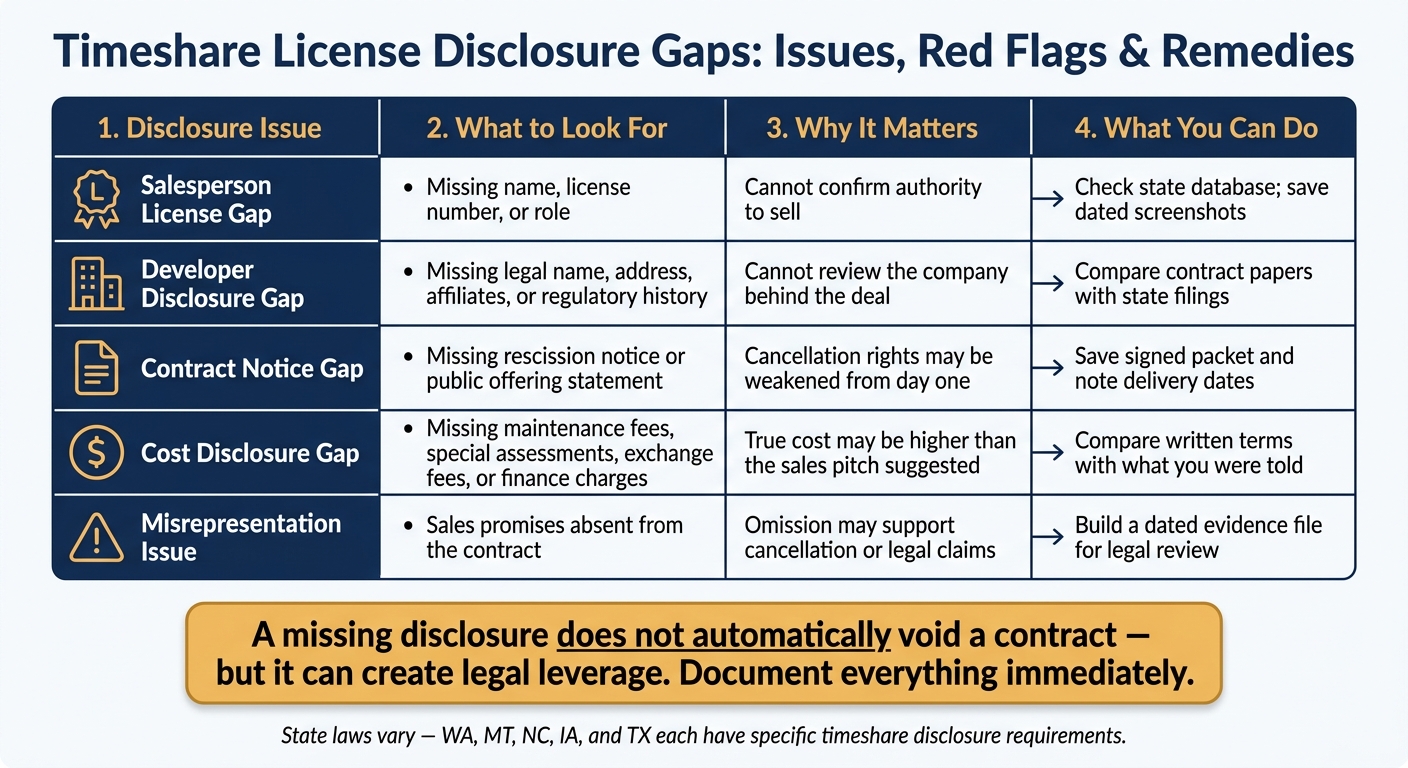
Timeshare License Disclosure Gaps: Issues, Red Flags & Remedies
Common License Disclosure Problems in Timeshare Transactions
Missing disclosures in timeshare deals usually land in three buckets: seller credentials, developer background, and contract notices. The gaps that show up most often involve license details, developer history, and notices the law says must be in the paperwork.
Missing Salesperson License Details and Unclear Credentials
A common problem is simple but serious: buyers never find out whether the person giving the sales pitch is a licensed broker, a sales agent, or a developer representative. That label matters because it affects what authority the person has and how a buyer can check it.
In Washington, a timeshare salesperson who is also a licensed real estate broker or salesperson must disclose, in writing, the capacity in which they are acting. If that written disclosure is missing, the buyer has no clear way to confirm authority or credentials. In practice, this often means missing license numbers or marketing pieces that use vague titles without naming the legal seller – a material omission.
These gaps often show up next to thin or incomplete developer records.
Incomplete Developer Background and Regulatory History
Disclosure documents often leave out the developer’s full legal name, address, affiliates, and ownership details. Montana, for example, requires disclosure of the developer’s official name and address, the names of parent companies or affiliates, and the names and addresses of directors and officers. North Carolina goes a step further and requires a statement of any civil, criminal, or disciplinary actions material to the timeshare program.
That kind of history can change how a buyer sees the deal. A developer with past consent orders, sanctions, or consumer complaints presents a different level of risk – but only if those facts are disclosed. Without them, buyers can’t check registration records or look into past enforcement actions.
The next thing to review is the contract itself, especially whether it includes every required notice and each cancellation right.
Contracts That Leave Out Required Notices or Material Facts
Missing cancellation notices are some of the most serious omissions in timeshare contracts. If a rescission notice is not there, or if the required public offering statement was never delivered, the buyer’s right to get out of the agreement may be weakened from day one.
The problem isn’t limited to cancellation rights. Some contracts also leave out fees or play them down, including:
- annual maintenance assessments
- special assessments
- exchange fees
- financing costs
Meanwhile, the sales pitch may lean hard on affordability or flexibility. If the written contract says one thing and the presentation suggested another, that omission may support cancellation or misrepresentation claims.
Once buyers spot these gaps, they should keep the full packet and compare it against state records.
sbb-itb-d69ac80
How Buyers Can Document Missing or Incomplete Disclosures
Once you spot missing license details, save proof right away. Don’t wait. If the seller updates the paperwork later, you want a clear record of what was missing at the time of sale.
Review the Disclosure Package and Purchase Contract Line by Line
Pull together the full paper trail: the contract, disclosure packet, public offering statement, addenda, and any summary sheets. Then compare those documents against the sales pitch and any required notices.
Start with the basics. Make sure each document names the seller correctly. Then check for licensing details, including the required license number and the name and license number of the salesperson or broker who handled the deal. Also confirm that the cancellation notice is there, easy to spot, and clearly states the rescission period and how notice must be sent.
Fees and buyer obligations deserve extra attention. Look at what the written documents say about fees, maintenance charges, exchange programs, or promised rental income. Then compare that with what you were told during the presentation. If the numbers don’t line up, that’s a problem. Same goes for anything that got a lot of attention in the sales talk but barely shows up in the contract – or doesn’t appear at all.
Keep dated copies of every version of the contract and disclosure documents, including addenda and summary sheets. Even small edits between versions can matter later.
If something is missing, save the documents before the seller changes them.
Verify Licenses Through State Regulators and Compare the Records
Check your state regulator’s public database to confirm license status and any discipline history. If the salesperson’s name, license number, or status doesn’t match the sales paperwork, that’s strong proof of a disclosure gap.
Search by both name and license number. Save dated screenshots or PDFs of the results. Then match those records against the names and numbers listed on your contract and business cards. If a supposed licensed salesperson doesn’t appear in the database – or if the license was expired or suspended on the date of sale – document that carefully.
Keep those database records with the rest of your contract and disclosure file.
Build a Written Evidence File for Legal Review
Put everything in one file and sort it by type:
- Contracts
- Disclosures
- Communications
- Marketing materials
- Payment records
Next, make a chronological log in a simple document or spreadsheet. List the key dates: the presentation, contract signing, delivery of the public offering statement and exhibits, and any follow-up messages. For each entry, note who was there, what was said about licensing or cancellation rights, and what the written documents show.
Save all emails and text messages, along with headers that show the sender and date. Download portal documents. Save screenshots of key pages. If someone made verbal promises, write them down right away with the date and the speaker’s name.
This file becomes the backbone of any legal review. It gives counsel what they need to assess rescission, complaints, or damages.
That record is what supports the legal review in the next step.
Legal Remedies That May Follow When Required Information Is Left Out
Once you’ve built that record, the next job is figuring out which remedies the missing disclosures may support. Use your evidence file to review possible claims under state timeshare laws, consumer protection statutes, and contract law.
Contract Cancellation, Rescission, and Damages
In many states, a developer’s failure to provide required disclosure documents – or material gaps in license disclosures – may support a request to cancel or rescind the purchase contract.
Rescission puts both sides back where they were before the deal. That usually means the buyer gets a refund, and future timeshare duties come off the table.
If rescission isn’t available, or doesn’t fully cover the loss, damages may still help recover part of the money lost. Buyers may seek damages when a disclosure failure leads to financial harm, including:
- deposits
- down payments
- loan payments made under incomplete disclosures
- maintenance payments made under incomplete disclosures
Some statutes also allow statutory or treble damages, plus attorney’s fees.
For example, Iowa allows contract voiding for false, misleading, or omitted material disclosures. Texas treats required disclosure failures as deceptive acts, but it carves out minor errors or omissions that do not support cancellation after the rescission period.
Regulatory Complaints and Possible License Discipline
A private claim isn’t your only path. You can also file a complaint with the state real estate commission or timeshare regulator.
These agencies may review contracts, ads, disclosures, and licensing records. Depending on what they find, they may issue fines, reprimands, consent orders, or license suspension or revocation.
Regulatory action usually does not cancel the contract by itself. But an official finding that disclosure rules were broken can help your civil case and put more pressure on the other side during settlement talks.
When a Missing Disclosure Becomes Misrepresentation Under the Law
Sometimes the same omission supports more than one claim. A missing license disclosure stops looking like a simple paperwork issue when it leaves out a material fact – something a reasonable buyer would see as important.
That can include omitted details about:
- fee structures
- assessments
- usage rights
- exchange terms
- rescission rights
Leaving out those points may support UDAP claims or fraud-by-concealment claims. To move forward, buyers usually need to show a duty to disclose, a material omission, reliance, and financial harm. Those facts shape the legal review of rescission, complaints, and damages.
Working With Timeshare Counsel and Key Takeaways
Once your evidence file is together, the next move is legal review. A lawyer can look at the record and decide whether the omission may support rescission or some other claim. At the same time, deadlines and payment duties do not pause while you sort this out.
How Aaronson Law Firm Can Review Disclosure-Related Cancellation Issues
Aaronson Law Firm reviews timeshare disclosure gaps to assess cancellation options. The firm offers a free consultation. Depending on the facts, counsel may send a demand letter, deal with financing problems, or file suit if the developer refuses to settle.
Bring the full file to the consultation. That gives counsel a clean way to compare the written disclosures against the sales record. Bring the contract, disclosure packet, acknowledgments, marketing materials, and license search results showing expired, suspended, or unlisted credentials. Those documents help counsel test the disclosure failure against what state law required.
Key Points to Remember Before Taking Action
After counsel reviews the file, stay focused on two things: deadlines and proof. Four points matter most:
- Required disclosures exist to protect buyers. They are not optional paperwork.
- A missing license disclosure may point to a larger compliance problem, not just a clerical mistake.
- Documentation should start right away, while details from the sales presentation are still fresh.
- A state-specific legal review is needed before deadlines expire or more fees add up.
A missing disclosure does not automatically void a contract. But when the failure involves licensing, material facts, or rescission rights, it can create legal leverage. That only works if the problem is documented and reviewed fast, before deadlines pass and fees grow.
FAQs
Can I cancel if disclosures were missing?
Yes, it may be possible if the required timeshare disclosures were missing or incomplete. If those documents weren’t provided on time, your cancellation or rescission rights may last longer. In some cases, the contract may even be voidable.
The cancellation period often begins on the later of these two dates:
- The date you signed the contract
- The date you received the required disclosures
In most cases, you need to send written notice using the method listed in the contract or required by state law. And don’t skip the paper trail. Keep proof of mailing so you can show when the notice was sent.
What documents should I save first?
Save your full contract, public offering statement, and complete disclosure packet first.
Also keep:
- Payment records
- Proof of delivery for any notices
- Your account or member numbers
- Notes from all sales interactions, especially any verbal promises that clash with the written materials
That last part matters more than many people think. If a salesperson said one thing, but the paperwork says another, your notes can help show the gap.
How do I verify a timeshare salesperson’s license?
Search your state’s professional regulation database using the salesperson’s name or license number. In Florida, for example, you can review online records through the Department of Business and Professional Regulation.
If you spot discrepancies or missing disclosures, Aaronson Law Firm can help you review the issue, document possible compliance gaps, and look at your options for rescinding your timeshare agreement.
Related Blog Posts
- How Disclosure Timing Affects Timeshare Buyers
- Timeshare Disclosure Laws: What Sellers Must Reveal
- Hawaii Timeshare Disclosure Checklist
- Timeshare Developers’ Financial Disclosure Rules