
If you want to cancel a timeshare, the deadline and the mailing rules can decide everything. In these six states, the rescission window runs from 5 to 10 days, and the start date can be either the day you sign or the later of signing and getting the required disclosure papers.
Here’s the short version:
- Florida: 10 days, later of signing or last required disclosure
- California: 7 days, later of signing or public report
- Nevada: 5 days, usually starts at signing
- South Carolina: 5 days, later of signing or disclosure, with a Sunday extension
- Arizona: 10 days, starts at signing
- North Carolina: 5 days, later of signing or public offering statement
In most cases, I would treat these four points as the whole game:
- How many days you get
- What date starts the clock
- Where and how you must send notice
- What the contract says about cancellation
One missed step can sink a cancellation. A letter sent to the wrong address, a bad count on the deadline, or weak proof of mailing can turn a valid cancellation into a fight.
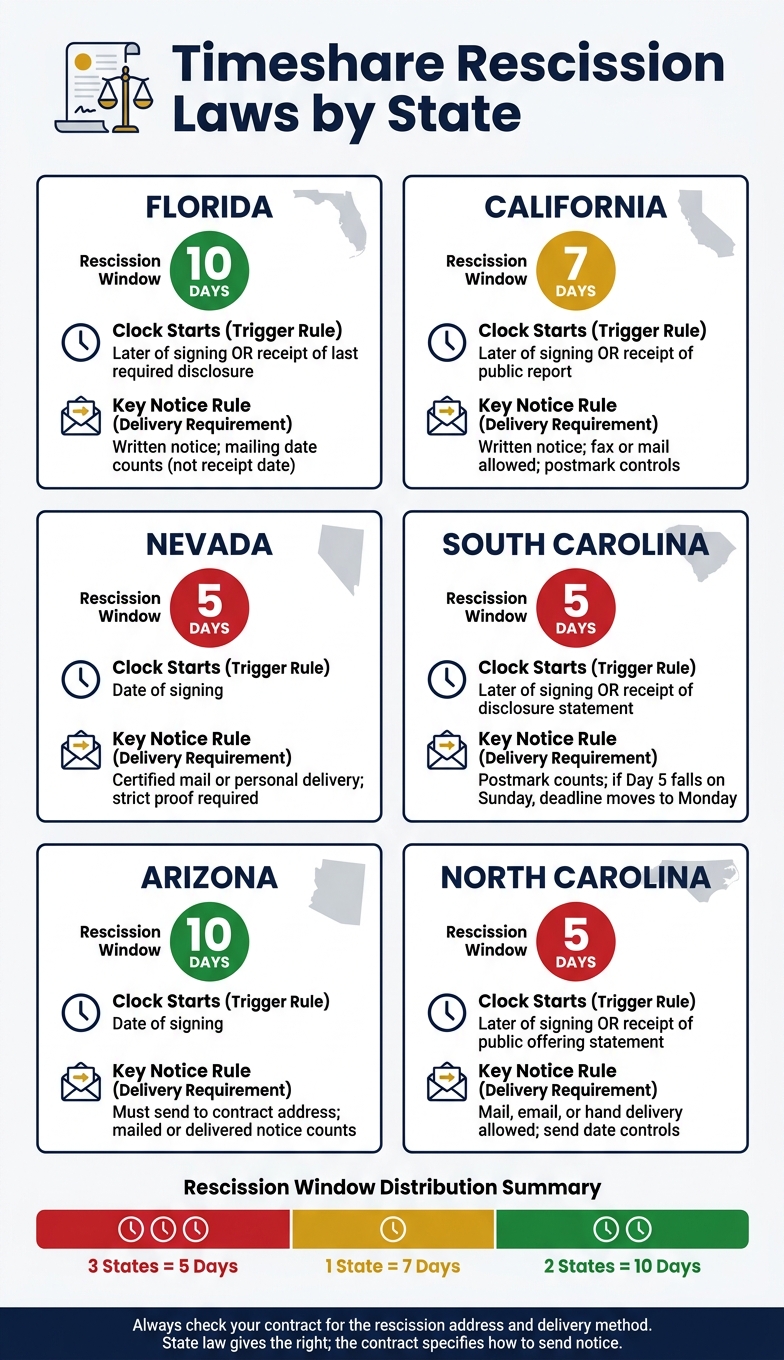
Timeshare Rescission Laws by State: Deadlines, Triggers & Notice Rules
Quick Comparison
| State | Deadline | Clock Starts | Notice Point |
|---|---|---|---|
| Florida | 10 days | Later of signing or last required disclosure | Written notice; mailing date counts |
| California | 7 days | Later of signing or public report | Written notice; contract may allow mail or fax |
| Nevada | 5 days | Signing date in most cases | Fast delivery and proof matter a lot |
| South Carolina | 5 days | Later of signing or disclosure | Postmark can count; Sunday rule applies |
| Arizona | 10 days | Signing date | Must send to the listed address; mailed or delivered notice counts |
| North Carolina | 5 days | Later of signing or public offering statement | Mail, email, or hand delivery allowed if you can prove send date |
A few numbers stand out right away: three states give only 5 days, two give 10 days, and one gives 7 days. That gap changes how fast I would draft and send the letter.
The big takeaway is simple: state law gives the right to cancel, but the contract often tells you where to send the letter and what delivery method to use.
sbb-itb-d69ac80
1. Florida Timeshare Rescission Rules
Rescission deadline
Florida gives timeshare buyers 10 calendar days to cancel a new purchase contract. The rescission period ends at midnight on day 10. Weekends and holidays still count, so the calendar keeps moving.
When the clock starts
Florida follows a later-of rule. That means the 10-day period starts on the later of these two dates:
- The day you sign the contract
- The day you receive the last required disclosure document
If the final documents show up after signing, the clock starts on the day you receive them. That detail can make a big difference.
Notice and delivery requirements
To cancel, you must send written notice to the address listed in the contract. In Florida, the notice takes effect on the mailing date, not the date the developer gets it.
That’s why certified mail with return receipt requested is usually the safest move. It gives you clean proof of when you mailed the notice.
Required contract language
Florida requires clear cancellation language in the contract. It must state:
- The 10-day right to cancel
- The requirement to cancel in writing
- The contract address for sending notice
- That any waiver of the cancellation right is invalid
That last point matters. If a sales rep asks you to sign away your cancellation rights, Florida law says that waiver is not valid.
Florida is a good example of how the deadline, the start date, and proof of mailing can all shape a rescission letter. The next state sections change those rules in different ways.
2. California Timeshare Rescission Rules
Rescission deadline
California gives timeshare buyers 7 calendar days to cancel. The deadline runs until midnight on day 7, and yes, weekends and holidays still count.
When the clock starts
California follows a later-of rule. That means the 7-day period starts on whichever of these happens last:
- The day you sign the timeshare contract
- The day you receive the public report and required disclosure documents
That date controls when your rescission letter must be sent. So if the public report shows up after you sign, your cancellation deadline shifts with it.
There’s one more wrinkle. If a later material change leads to an amended public report, you get a new 7-day period starting on the day you receive that amended report.
Notice and delivery requirements
Your cancellation has to be in writing and sent to the address or fax number listed in the contract. The rescission letter also needs to follow the delivery method named in the contract.
California treats fax as a valid way to send notice, and the notice counts when transmission is confirmed. If you mail it, keep the postmark and a copy of the letter. That proof can make all the difference, especially since the deadline is tied to the later of signing or receiving the disclosures.
Required contract language
California requires timeshare contracts to clearly spell out your cancellation rights and explain how to send notice. In many cases, this language appears in bold or ALL CAPS near the signature block.
Any attempt to waive the rescission right or cut the 7-day period short is void and unenforceable. And if the rescission is done the right way, all money paid must be returned.
Nevada changes the deadline and notice rules again, which makes the next comparison just as important.
3. Nevada Timeshare Rescission Rules
Nevada cuts the rescission window down again and puts more weight on proof.
Rescission deadline
Nevada gives timeshare buyers 5 calendar days to cancel. The window ends at midnight on the fifth calendar day.
That gives buyers very little room to wait around. Your letter needs to be written and sent fast, and your proof needs to line up with Nevada’s tight deadline.
When the clock starts
The 5-day period starts on the day you sign the contract.
If the contract ties rescission to delivery of the public offering statement, track that delivery date separately. That detail can matter if the contract links your cancellation rights to both events.
Notice and delivery requirements
Nevada is strict about both the format of the notice and the proof behind it. In plain English, how you send the letter matters just as much as what the letter says.
Use a delivery method that shows when you sent it:
- Personal delivery directly to the developer
- Certified mail, return receipt requested
- Overnight delivery with tracking and proof of delivery
Send the letter to the exact address listed in the contract’s cancellation clause. Not a general office. Not a sales center address unless the contract says so. Use the precise address in the agreement.
Keep copies of:
- The signed letter
- The mailing or delivery receipt
- The tracking record or delivery confirmation
Required contract language
Nevada requires the cancellation rights to appear in the contract in at least 12-point bold type. That language controls what your rescission letter should match.
So don’t get fancy here. Check the contract for the stated cancellation notice and follow that wording closely. Think of it like filling out a form: the closer your letter tracks the contract language, the less room there is for an argument later.
Any waiver is unenforceable, and the contract is voidable by the buyer. The developer must return all payments within 20 days of receiving a valid rescission notice.
South Carolina uses a different deadline trigger and disclosure structure.
4. South Carolina Timeshare Rescission Rules
South Carolina keeps the rescission window short, but the timing rules are a little different. Timeshare buyers get 5 days to cancel. And if day 5 lands on a Sunday, the deadline moves to Monday.
Rescission deadline
The cancellation window is 5 days. If the fifth day falls on a Sunday, the deadline shifts to Monday. That small timing rule can matter a lot when you’re counting days in a hurry.
When the clock starts
South Carolina uses a later-of trigger. The 5-day period starts on whichever happens later:
- the date you sign the contract
- the date you receive the required disclosure statement
That means the clock does not always start on signing day.
Notice and delivery requirements
Your cancellation needs to be in writing and sent to the seller’s contract address. South Carolina allows certified mail, return receipt requested, or another delivery method that gives proof the notice was delivered.
If you mail the notice, the postmark controls, as long as the seller receives the letter. If you use another delivery method, the notice takes effect when it reaches the contract address.
Required contract language
South Carolina requires the contract to give clear notice of the 5-day cancellation right, the Sunday rule, the mailing address, and the fact that the right cannot be waived or shortened. The statute describes this as a "nonwaivable five-day pre-closing right to cancel."
When you draft your rescission letter, include:
- your name
- contract number
- purchase date
- the seller’s exact legal name
- a direct statement that you are canceling the agreement
If the contract says something different from state law, state law controls.
Arizona changes the trigger rules again, so the next section moves from Sunday timing to disclosure-based deadlines.
5. Arizona Timeshare Rescission Rules
Arizona keeps the timing simple, but it’s still strict about where you send the notice and how you send it. Buyers get 10 days to cancel a timeshare purchase agreement for any reason.
Rescission deadline
Your deadline ends at midnight on day 10, and that includes weekends and holidays.
When the clock starts
The 10-day period starts when you sign the purchase agreement. If the required notice is missing or unclear, the sale may not comply with Arizona law.
Notice and delivery requirements
Your cancellation has to be in writing and sent to the address listed in the purchase agreement or public report. The notice counts when it’s mailed or delivered, so the send date matters.
Use:
- Certified mail with return receipt requested
- Personal delivery with written acknowledgment
Keep copies of the letter, mailing receipt, and tracking record. In Arizona, the delivery method can make or break your rescission if there’s a dispute about timing or receipt.
Required contract language
Arizona law says the purchase agreement and public report must clearly disclose the buyer’s cancellation rights. That includes the 10-day cancellation window and the address where the cancellation must be sent.
If the contract gives you a longer cancellation period, that longer period controls as long as it’s disclosed in the documents. If the disclosure language is missing or incomplete, the sale may be noncompliant. In some cases, a noncompliant sale may create a separate rescission right for up to three years.
That’s why the first thing to check is the contract and public report before you draft the letter.
6. North Carolina Timeshare Rescission Rules
North Carolina gives timeshare buyers 5 calendar days to cancel a purchase agreement without penalty. You count those five days from the trigger date, and that detail matters because the state allows more than one way to send your notice.
When the clock starts
The 5-day period starts on the later of two dates: the day you sign the contract or the day you receive the public offering statement and other required documents.
Here’s how that plays out. If a developer gives you the contract on June 1, but you don’t get the public offering statement until June 3, your deadline runs until midnight on June 8.
Notice and delivery requirements
Your cancellation notice must be in writing. North Carolina allows you to send it by mail, electronic mail, or hand delivery. The key date is the date you send it, not the date the developer reads it. That’s why proof matters.
The North Carolina Real Estate Commission recommends certified or registered mail so you have a clear mailing record. If you cancel by email, save delivery confirmations and any read receipts. If you hand-deliver the notice, ask for a dated written acknowledgment. In plain English: the paper trail matters just as much as the words in the notice.
Required contract language
North Carolina law says timeshare contracts must include a bold, conspicuous cancellation notice right before the buyer’s signature block:
"UNDER NORTH CAROLINA LAW, YOU MAY CANCEL YOUR TIMESHARE PURCHASE WITHOUT PENALTY WITHIN FIVE DAYS AFTER SIGNING YOUR CONTRACT. TO CANCEL YOUR TIMESHARE PURCHASE, YOU MUST MAIL, ELECTRONICALLY MAIL, OR HAND DELIVER WRITTEN NOTICE OF YOUR DESIRE TO CANCEL YOUR PURCHASE TO [name and address of project]."
Your rescission letter should track that language closely. State clearly that you are exercising your right under North Carolina law. Any attempt to waive that right is void, and the developer cannot legally close the transaction before the rescission period ends.
How State Rules Affect Letter Drafting and Delivery
State rules shape three parts of a rescission letter: what you say, where you send it, and how you show it was sent. In plain English, the letter has to line up with both the state’s deadline and the contract’s notice section.
That changes the nuts and bolts of the letter. The same right to cancel can call for different wording, different dates, and different proof.
| State | Window | Trigger | Key Letter Guidance |
|---|---|---|---|
| Florida | 10 days | Later of signing or receipt of all required documents | Include both the signing date and the document-receipt date |
| California | 7 days | Later of signing or receipt of the public report | State the public report receipt date if it controls the deadline |
| Nevada | 5 days | Execution of the contract | Mail or deliver immediately and keep proof |
| South Carolina | 5 days | Later of signing or receipt of the disclosure statement | Note both dates; if day 5 falls on a Sunday, the deadline moves to Monday |
| Arizona | 10 days | Signing the purchase agreement | Use the contract’s rescission address and delivery method |
| North Carolina | 5 days | Later of signing or receipt of the public offering statement | State both dates and use a method that proves the send date |
Once you know the timing rule, keep the letter short, plain, and exact.
What every rescission letter should include
No matter the state, every rescission letter needs the same core details. Include all buyer names exactly as they appear on the contract – including middle initials, suffixes, and every co-buyer. Add the contract or account number, the purchase date in a clear U.S. format, and a direct description of the property or membership.
Then say you are canceling in plain terms. For example:
We hereby exercise our statutory right to rescind and cancel this timeshare purchase.
Also ask for a full refund of all amounts paid. If you know the amount, include it.
When to cite state law and when the contract takes priority
Use the statute to show that you have the right to cancel. Then use the contract for the mailing address and delivery steps.
That split matters. Send the letter to the rescission address listed in the contract, not the sales office. Follow the notice section exactly for delivery details, and rely on the statute for the right itself.
Delivery methods that create a paper trail
USPS Certified Mail with return receipt gives the clearest proof. You get a mailing receipt, a tracking number, and signed delivery confirmation. Overnight courier services can also work well because they create time-stamped delivery records and usually require a signature.
Keep these records together:
- A copy of the signed letter
- The mailing receipt
- The tracking record
If the developer later says the letter was late or never arrived, those records do the talking.
Common drafting and mailing mistakes
The biggest mistake is sending the letter to the wrong address. That usually means the resort’s sales office instead of the address listed under Notices or Rescission in the contract.
A close second is waiting until the last day to send it. That is risky in 5-day states like Nevada, South Carolina, and North Carolina, where one late mailing can blow the deadline.
Other mistakes show up all the time: vague wording instead of a direct cancellation statement, leaving out one co-buyer’s name, or not stating the refund amount. In states where the deadline runs from the later of signing or disclosure, buyers also often forget to list both the signing date and the receipt date. That gives the developer room to argue about when the clock started.
If the deadline or notice address is fuzzy, legal help may be the safest next move.
Pros and Cons of Each State Rescission Framework
Each state handles rescission a little differently. The big variables are time, start date, and notice rules. That changes three practical things for a buyer: how fast the letter needs to go out, which date sets the deadline, and what kind of proof can back it up if there’s a dispute.
| State | Window | Main Advantage | Main Risk |
|---|---|---|---|
| Florida | 10 days | More time to review documents and consult an attorney | Buyers may delay drafting until the final days, misjudging postmark cut-offs |
| California | 7 days | "Later-of" trigger protects buyers if the public report arrives late | Buyers may be unclear on which date – signing or report receipt – controls the deadline |
| Nevada | 5 days | Clock starts at signing, so the deadline is unambiguous | Late paperwork does not extend the window |
| South Carolina | 5 days | Sunday exclusion rule prevents a buyer from losing a full day to a weekend | Short window leaves little room to spot the correct mailing address in the contract |
| Arizona | 10 days | Longer window tied to signing gives buyers a clear, fixed deadline | Delayed disclosure delivery may not extend the window |
| North Carolina | 5 days | "Later-of" trigger provides a small buffer if the public offering statement arrives after signing | Five days passes quickly; same-day drafting and mailing is often required |
Longer rescission periods
Florida and Arizona give buyers more breathing room. That sounds good, and often it is. But more time can also tempt people to wait too long, then rush at the end and miss a mailing or postmark cutoff.
Shorter rescission periods
A 5-day window gives you almost no room to pause. If the contract has a cancellation clause, it needs attention the same day the buyer signs.
Later-of-signing-or-disclosure triggers
This is where things get tricky. The hardest part often isn’t counting the days. It’s showing when the clock actually started. If the deadline depends on signing or disclosure receipt, buyers should keep a clear record of the receipt date, because that date may control the whole timeline.
Required contract cancellation language
Even when the deadline looks simple, the contract still matters. It usually tells the buyer where to send the notice and what format to use. In most states, rescission rights must appear in bold, conspicuous notice near the signature line. That notice helps buyers spot the cancellation right and follow the contract’s instructions, while state law decides whether the right exists at all. Still, conspicuous notice does not solve fights over proof.
When Buyers May Need Legal Help
Even a well-written rescission letter can still fall apart on timing or delivery. That’s the part that trips people up.
When the deadline is close, three things matter most:
- the trigger date
- the delivery method
- proof that you sent it
If your rescission deadline is only a day or two away, and you’re not sure about the deadline, the trigger date, or how the notice must be delivered, don’t wing it. That’s when an attorney can step in, confirm the deadline, review your draft, and check what proof you’ll need if the developer later says they never got it.
If a developer rejects your notice as invalid or late, the dispute may call for a formal demand. A timeshare attorney can review the contract, disclosure documents, rescission letter, and proof of mailing or delivery. Then the attorney can send a formal demand letter that cites the state law that applies.
If the deadline has already passed, the issue changes. At that point, it’s no longer about rescission. It becomes a matter of possible contract-based claims. Buyers may still have claims tied to misrepresentation, undisclosed fees, or failure to disclose cancellation rights.
At that stage, legal review matters because the facts can shape which remedy is still on the table. Aaronson Law Firm focuses only on timeshare cancellation matters and offers free consultations, demand letters, credit protection, and litigation support.
Conclusion
Across Florida, California, Nevada, South Carolina, Arizona, and North Carolina, the main takeaway is simple: deadlines and delivery rules decide what happens next. There’s no one-size-fits-all rescission letter. State law gives you the right to cancel, and the contract tells you how that notice has to be sent.
Once you understand that setup, the rescission letter should be short and precise. Before you send it, check the deadline, the trigger date, the notice address, the delivery method, and any identifying details the contract asks for.
Use a trackable mailing method, such as USPS Certified Mail with Return Receipt, and keep copies of everything:
- the contract
- the rescission letter
- the mailing receipt
- the delivery confirmation
If the statute and the contract seem to say different things, don’t guess the deadline. If the trigger date, delivery rule, or contract language is unclear, get legal help before time runs out. And if a developer rejects your notice or the deadline has already passed, Aaronson Law Firm focuses only on timeshare cancellation matters and offers free consultations, demand letters, credit protection, and litigation support.
FAQs
How do I count the rescission deadline correctly?
First, identify the trigger date. In most cases, that’s the later of:
- the day you signed the contract
- the day you received all required disclosure documents
Next, check whether your state counts calendar days or business days. Look at the contract’s “Right to Cancel” section and review the law in the state where the property is located, since that state’s rules control.
What if my contract and state law conflict?
If your contract and state law conflict, state law usually controls. That said, read both with care. Your contract may still include procedural steps that sit on top of state rules.
If the contract’s rescission terms are vague, incomplete, or inconsistent, state law usually sets your rights and protections. If you’re not sure where you stand, talk to a legal professional to confirm your rights and help make sure your notice is submitted correctly.
What proof should I keep after sending my rescission letter?
Keep a complete paper trail showing your rescission notice was sent the right way and before the deadline.
Save your signed and dated letter, any attachments, your certified mail receipt and tracking number, plus the return receipt or delivery confirmation. If you also sent it by fax or email, keep those confirmations too.
Put everything in one place, including notes from any phone calls, in case a dispute comes up later.
Related Blog Posts
- What to Include in a Rescission Letter to Developers
- Rescission Period vs. Cancellation Rights
- How State Laws Impact Rescission Letter Requirements
- Timeshare Cancellation Deadlines by State