
Most timeshare resale problems come down to three things: transfer rules, fee traps, and sales claims that do not match the contract.
If I had to boil this article down fast, it would be this:
- Many timeshares sell for very little on the resale market
- Owners often face ROFR, approval rules, and delinquency blocks
- Maintenance fees keep building until a transfer is fully accepted
- Some resale and exit firms charge $3,000 to $10,000 upfront and still do not finish the job
- Public complaint data and court cases show the same pattern over and over
The legal side is not the same in every state, but the trouble spots look similar. Florida focuses on written fee disclosures, escrow, and proof the transfer is done before payment. North Carolina requires written contracts, limits advance fees, and gives owners a 5-day cancellation window. Other states, like Wisconsin and New York, put more focus on resale-value claims and weak disclosures.
Here are the big takeaways in plain English:
- State law sets the floor: written contracts, disclosures, payment timing, and cancellation rights
- Contract terms can still block a sale: especially ROFR, transfer approval, and unpaid-fee blocks
- Complaint trends are consistent: false value claims, big upfront fees, no buyer, no sale, no refund
- Enforcement has been large: one FTC sweep included 191 actions, and court orders reached into the tens of millions of dollars
- Owners need records: contracts, bylaws, account statements, emails, ads, and sales notes all matter
Quick Comparison
| Topic | What it usually means for owners |
|---|---|
| State resale laws | Set rules on disclosures, contracts, cancellations, and when money can be collected |
| Resort contract terms | Can stop a transfer even when a buyer is ready |
| Upfront-fee resale or exit firms | Often the source of money loss and failed exits |
| Complaint data | Shows repeat issues, not one-off mistakes |
| Owner action steps | Gather records, match facts to rules, then file complaints or get legal review |
Bottom line: if you were told resale would be easy, but the contract or resort later blocked the transfer, that gap is where many disputes start. This article explains where those problems show up in the law, in contracts, and in complaint records.
sbb-itb-d69ac80
State Law Sets the Basic Rules for Resales and Transfers
State law is the first place to look in any timeshare resale or transfer. It sets the ground rules for what resale companies must put in writing, what they need to disclose, and when they can take payment.
The details change from state to state. But the same themes come up again and again: written disclosures, timing of payment, and proof that the transfer actually happened. And when those rules are weak or ignored, the same problems tend to pop up in complaints – blocked transfers, early fees, and deals that never seem to finish.
Florida and North Carolina as Key Examples
Florida’s Chapter 721 is pretty direct. Before taking any money, a company has to give the owner a written breakdown of fees. That includes third-party charges and when each amount is due. Payment can’t be collected until the transfer is complete and the owner gets written proof of transfer, including the recorded document and the transferee’s contact information.
There’s another guardrail too: advance funds must be kept in escrow. And if a company violates Florida’s resale advertising statute (§721.205), that conduct is treated as a deceptive act under the state’s Deceptive and Unfair Trade Practices Act.
North Carolina’s Chapter 93A also goes step by step. It covers transfer services, including exit and cancellation services, and it requires written agreements. A resale contract should identify the timeshare, the program, and the managing entity. It also needs to include any known assessments or delinquency issues.
The formatting rule is unusually specific: agreements must use 12-point type. Owners also get a cancellation right. They may cancel transfer-service agreements through midnight of the fifth day after signing, and notice counts on the date it is sent. North Carolina also bans advance listing fees and limits advance fees for resale services.
When companies skip these rules, the fight often turns into one of two things: a transfer denial or a fee dispute.
How Other States Handle Misleading Resale Claims
Some states focus harder on sales talk that goes too far.
New York regulatory guidance says disclosures should make a few things plain: the resale market may be limited or may not exist at all, resale value is uncertain, and many real estate brokers will not list timeshares. That’s a blunt message, but it matters. A seller may hear big promises on the phone, then hit a wall when trying to resell.
Wisconsin takes aim at false or misleading statements about a timeshare’s investment or resale value. Claims that a timeshare will go up in value, draw guaranteed buyers, or lead to a quick profitable sale without a reasonable basis can violate Wisconsin law.
These rules tend to matter most when a transfer stalls, fees get charged too soon, or the disclosures leave out key facts.
Table: State-by-State Resale Rule Comparison
| Rule Area | Florida (Ch. 721) | North Carolina (Ch. 93A) | Wisconsin |
|---|---|---|---|
| Written contract required | Yes – resale advertising and transfer-service agreements must be in writing | Yes – written agreements are required, and resale contracts and advertising agreements must use 12-point type | Yes – purchase contracts and disclosure statements are required |
| Mandatory disclosures | Written descriptions of all fees and costs, including third-party amounts, and when they are due | Timeshare, program, managing entity, and any known assessment or delinquency disclosures | Disclosure statements and purchase-contract disclosures are required |
| Advance fee limits | Advance funds must be held in escrow; payment cannot be collected until the transfer is fully completed and documented | Advance listing fees are banned; advance fees for resale services are restricted | False or misleading claims about resale or investment value are prohibited |
| Cancellation rights | Advance funds must be held in escrow, and payment cannot be collected until the transfer is complete and documented | Owners may cancel transfer-service agreements through midnight of the fifth day after signing; notice is effective on the date sent | Cancellation rights are required in purchase contracts |
The complaint record shows where these rules start to fail in day-to-day use.
Contract Terms Often Decide Whether a Resale Can Happen
State law sets the baseline. But in many resale deals, the contract is what decides whether the transfer goes through.
That means the purchase agreement, declaration, bylaws, and club rules can all stand in the way. A resale that looks simple on paper can turn into a contract dispute fast.
Right of First Refusal, Transfer Approval, and Delinquency Blocks
Three contract tools come up again and again when a resale stalls: right of first refusal (ROFR), transfer approval rules, and delinquency blocks.
ROFR lets the developer step in and buy back the interest at the same price offered by a third-party buyer. Many large resort systems use ROFR in resale deals. Florida law says ROFR clauses must be disclosed in the contract, but many owners don’t grasp how much control that gives the developer until the sale is already moving and the developer uses it.
When that happens, the outside buyer is out, and the sale falls apart. That’s why ROFR is often the first flashpoint in a transfer dispute.
Transfer approval adds one more hurdle. Many contracts and association bylaws say the association or developer must formally approve a resale before it takes effect. That approval often depends on an estoppel certificate that lists balances, assessments, fees, and violations. If debt shows up late, the deal can die on the spot.
Delinquency blocks are even more direct. Many contracts and declarations ban a transfer unless the account is fully current. For owners already behind on maintenance fees, this creates a rough bind: they can’t afford to catch up, but the association won’t process the transfer until they do. Unpaid assessments can also stop the deal and push buyers away.
How Restrictive Contract Language Drives Owner Complaints
These terms sit behind many resale complaints. The same problems show up over and over:
- Transfer denials: the association rejects the buyer or finds a balance the owner didn’t expect.
- Informal transfers: quitclaim deeds or other informal exit methods don’t work without the required approval, so the original owner stays on the hook.
- Unexpected fees at closing: the estoppel shows special assessments or transfer fees that stop the sale.
What makes this so frustrating is simple: these limits often aren’t explained in plain language at the point of sale.
Yes, the contract language exists. But it’s often buried in the declaration or bylaws, and the sales presentation usually doesn’t walk buyers through what it means for resale. So the owner only feels the weight of those terms later, when there’s finally a buyer lined up and the transfer process starts. At that point, clauses that sat quietly in the paperwork become very real barriers.
Those same barriers show up again in complaint data and enforcement actions. The next section looks at how they appear in those records.
Complaint Data and Enforcement Actions Reveal Repeated Patterns
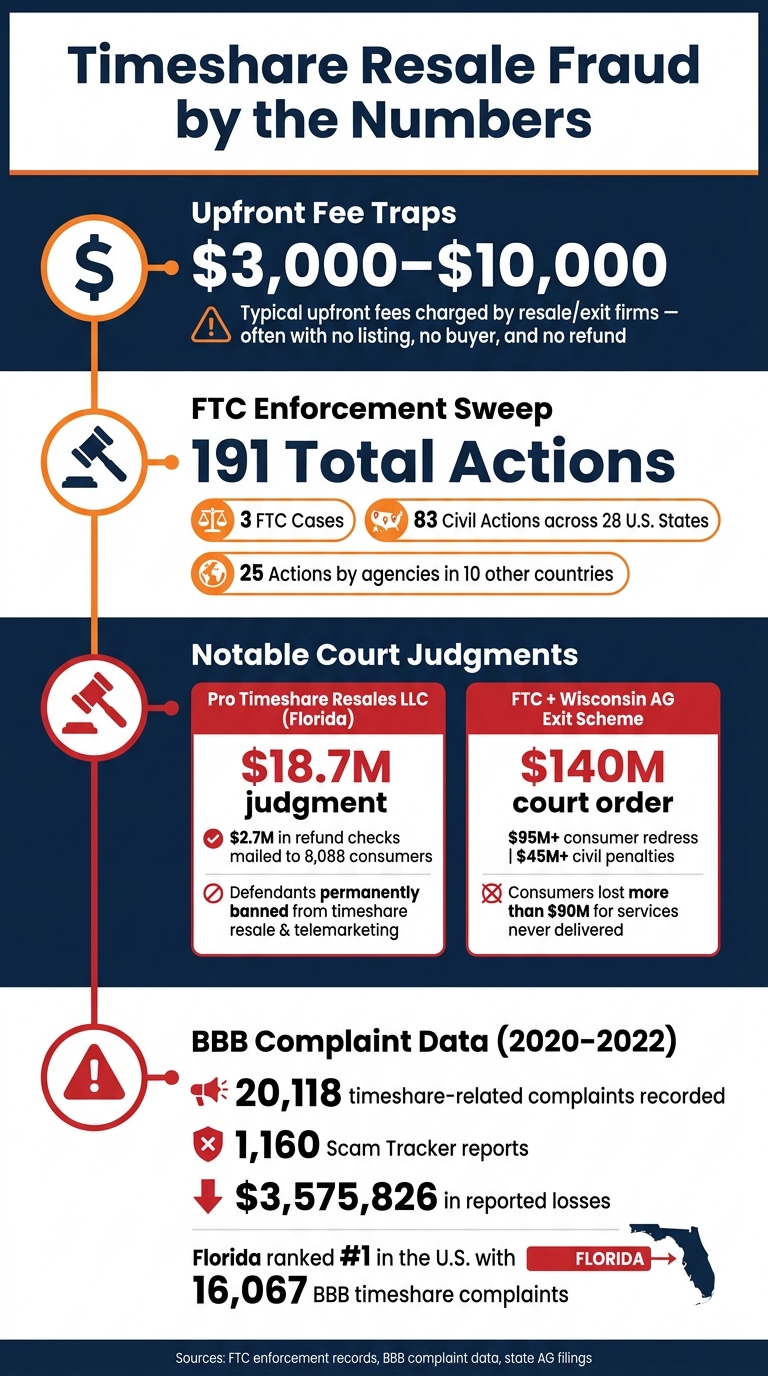
Timeshare Resale Fraud: Key Stats, Complaint Trends & Enforcement Data
Those contract barriers don’t just show up in sales documents. They also keep surfacing in public complaints and enforcement records. The story is pretty consistent: owners are told they’ll have room to resell, but when they try to get out, contract-controlled transfers and fee demands stop them cold.
Common Complaint Themes: Value Claims, Upfront Fees, and No Listing, No Offers, No Sale
Across FTC materials, state attorney general investigations, and BBB complaint files, the same three themes show up again and again.
- False claims about resale value, including made-up buyers and guaranteed prices
- Large upfront fees between $3,000 and $10,000
- No listing, no offers, and no sale
For many owners, rising maintenance fees make the pressure worse. That leaves them more exposed to aggressive sales tactics. And when the exit fails, the original fees are still gone.
The table below pulls those repeat complaint patterns into one place.
Recent Government Actions Against Resale and Exit Misconduct
Enforcement actions show what happens when those complaints move from consumer reports to court filings.
A major FTC crackdown led to 191 actions: 3 FTC cases, 83 civil actions in 28 states, and 25 actions by agencies in 10 other countries.
In a Florida-based resale scheme involving Pro Timeshare Resales LLC, a federal court imposed an $18.7 million judgment and permanently banned the defendants from timeshare resale and telemarketing after they promised a sale or deed transfer that never closed. Because they couldn’t satisfy the judgment, the defendants gave up about $3.4 million in assets, including homes, vehicles, and jewelry. The FTC then mailed 8,088 refund checks totaling nearly $2.7 million to affected consumers.
In a separate exit scheme, the FTC and Wisconsin Attorney General alleged that consumers lost more than $90 million for services that were never delivered. A federal court later ordered one key operator to pay $140 million, including over $95 million in consumer redress and more than $45 million in civil penalties, and permanently barred him from marketing similar services.
Table: Complaint Trends and Public Enforcement Findings
| Complaint Category | Core Issue | Owner Harm | Documenting Agency or Source |
|---|---|---|---|
| False claims about resale value or guaranteed buyers | Misrepresented resale potential at point of sale | Owner pays fees expecting a sale that never occurs | FTC enforcement complaints, state AG consumer alerts |
| Large upfront fees with no service delivered | Vague service agreements, no measurable milestones | $3,000–$10,000 lost with no listing, no offers, no refund | FTC, BBB complaint profiles, state AG settlements |
| Ignored refund requests | Money-back guarantee claims with fine-print conditions that eliminate refund rights | Owner cannot recover fees despite written promises | BBB Scam Tracker, FTC case records |
| Sham or harmful transfers | Exit companies transferring deeds to shell LLCs or insolvent third parties | Original owner remains liable; credit damage from subsequent default | FTC enforcement actions, state AG litigation |
| Fee pressure used to rush sales | Escalating assessments and delinquency threats exploited to rush decisions | Owner signs under pressure, pays fees, stays trapped | FTC materials, BBB vacation/timeshare studies |
BBB data from 2020 through 2022 recorded about 20,118 timeshare-related complaints, plus 1,160 Scam Tracker reports reflecting $3,575,826 in losses. Florida ranked first in the United States for timeshare-related BBB complaints, with 16,067 filings.
What Owners Can Do When Resale Rules and Contracts Work Against Them
Records to Gather Before Filing Complaints or Seeking Legal Review
The same contract terms that make resale hard also shape the proof that matters most.
Before you contact a regulator or attorney, gather your full paper trail and sort it in date order. Start with your purchase agreement, public offering statement, and the resort’s governing documents – the declaration, bylaws, and rules. Read together, those records show what resale and transfer rights you were given and whether those limits were clearly disclosed when you bought.
Then pull in the rest of the file: resale or transfer correspondence, including emails, portal screenshots, denial notices, and notes from phone calls. Add your fee schedules and account statements so the cost over time is clear. If a salesperson told you resale would be easy or pushed the timeshare as a strong investment, hold onto any marketing materials or sales presentation notes you still have.
That side-by-side record matters. It lets a regulator or lawyer compare what you were told during the sale with what the contract actually says.
Complaint Channels, Contract Review, and When Legal Help May Be Needed
Once your records are in order, tie the complaint to the rule that may have been broken.
Use your state AG for deceptive sales practices and upfront-fee exit scams. Use state real estate/timeshare regulators – such as Florida’s Bureau of Timeshares or the North Carolina Real Estate Commission – for licensing violations and improper resale advertising. Use ReportFraud.ftc.gov for interstate deceptive practices. Use the CFPB for financing, servicing, or collection issues.
Sometimes filing complaints still doesn’t fix the core problem. If you can’t find a workable resale or transfer path, or you can’t keep up with the costs, it may be time for a close contract review by counsel focused on timeshare matters. If the contract language and the sales pitch don’t line up with the resale limits you were later shown, get legal review before paying another fee.
Aaronson Law Firm can review whether restrictive transfer clauses, undisclosed resale barriers, or misleading sales claims may support rescission or other remedies. Free consultations and legal support may also help if collections are already affecting your credit.
Conclusion: Key Legal and Complaint Trends to Remember
Most resale problems trace back to three things: disclosure failures, transfer restrictions, and upfront fees. In plain English, many disputes come down to what you were told, what the contract allows, and how much money gets demanded along the way.
Before paying any resale broker or exit company, take a few basic steps:
- Verify licensing
- Check BBB and state AG complaints
- Require a written contract with clear performance terms
If the facts suggest the restrictions were not properly disclosed, or that sales claims were misleading, a careful legal review – not another fee payment – is the better next step.
FAQs
Can I sell my timeshare if I still owe fees?
Yes, but you’re still legally on the hook for maintenance fees, special assessments, and loan payments until the ownership transfer is officially final.
A resale does not automatically cancel your contract or what you owe. If you stop paying while the resale is in progress, your credit may take a hit. Aaronson Law Firm may help you look at whether contract cancellation makes more sense for your situation.
What is ROFR and how can it block my sale?
ROFR means Right of First Refusal. In plain English, it means a timeshare owner has to offer the property to the developer or the homeowners association (HOA) first, using the same terms offered by an outside buyer.
So if you line up a buyer, the developer or HOA usually gets a set window, often 30 days, to decide whether it wants to buy the timeshare instead. If it says yes, your deal with that buyer stops there.
How do I spot a risky resale or exit company?
Watch for red flags like upfront fees, random calls or emails saying a buyer is already lined up, and any push to make a decision on the spot. In most cases, legitimate companies get paid a commission after the sale closes, not before.
It also helps to vet the company on your own. Look up reviews, search for complaints, and contact your resort directly to see whether it has an official deed-back or exit program before you bring in a third party.
Related Blog Posts
- State Laws on Timeshare Resale Restrictions
- Timeshare Resale Scams: Case Studies
- Consumer Protection Laws for Timeshare Resales
- Timeshare Resale Scam Reports: 2026 Summary