
If a timeshare company contacts me first and asks for personal or banking details, I treat it as a red flag. In many scams, the first goal is not to help me exit or sell a timeshare. It is to get my ID, payment data, login details, or a fast e-signature.
Here’s the short version:
- I verify the company on my own using a bill, contract, or the resort’s official website.
- I do not share bank logins, one-time codes, full card numbers, or my full Social Security number.
- I stop the conversation if I hear pressure, secrecy, or same-day payment demands.
- I ask for documents first, including the contract, fees, and privacy terms.
- I save records and watch my accounts if I already shared data.
The numbers show why this matters. In 2022, the FTC and Wisconsin Attorney General sued companies tied to an alleged $90 million timeshare exit scam. In 2013, the FTC and partners took action against 191 resale operations that had taken more than $18 million from owners.
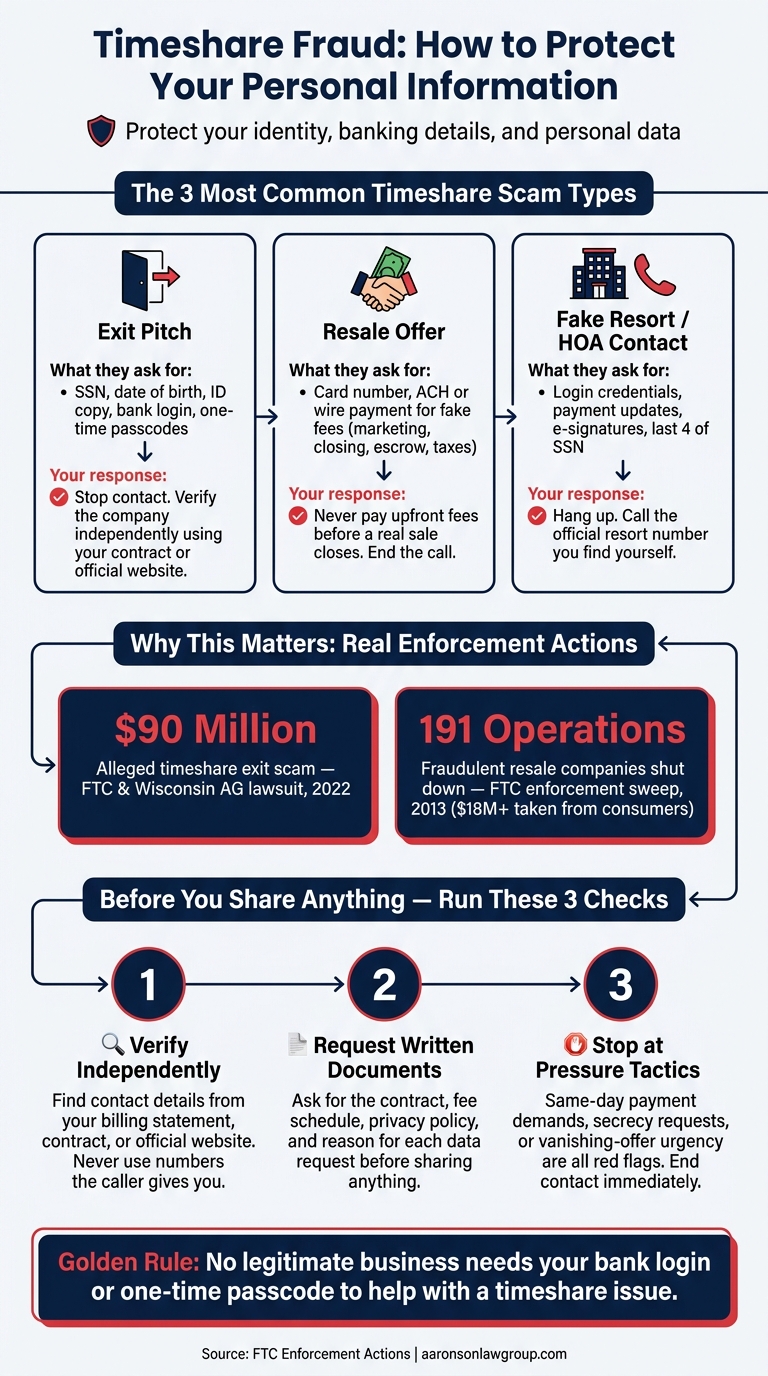
Timeshare Scam Types: What They Ask For & How to Respond
Quick take
Timeshare fraud often shows up in three forms:
- Exit offers asking for ID, banking data, or passcodes
- Resale offers asking for upfront fees before any sale happens
- Fake resort or HOA contacts pushing “verification” or e-signature requests
The safest move is simple: share less, verify first, and stop when the request gets too personal or too rushed.
| Scam type | What they usually ask for | My response |
|---|---|---|
| Exit pitch | SSN, date of birth, ID copy, bank info | Stop and verify the company |
| Resale offer | Card, ACH, or wire payment for fake fees | Do not pay before a real sale closes |
| Fake resort/HOA contact | Login details, payment updates, e-signatures | Call the official number I find myself |
If I remember one rule, it’s this: no real business should need my bank login or one-time code to help with a timeshare issue.
sbb-itb-d69ac80
How scammers collect personal information in common timeshare schemes
Scammers usually move in steps. First, they ask for simple "verification" details. Then they push for the kind of information that can do real damage. That’s the pattern in many timeshare scams.
Exit pitches that ask for banking and identity details
Fake exit companies often make first contact out of the blue. It might be a call, text, email, or social media message. The pitch sounds simple: they say they can cancel your timeshare fast and promise a guaranteed outcome. Then they ask for personal details to "qualify" you or get the paperwork started.
That request can include:
- Your Social Security number
- Your date of birth
- A copy of your ID
- Payment card details
- Bank login details or one-time passcodes
That last part is where things get dangerous. A company that reaches out first and then asks for banking access or passcodes is not just asking for paperwork. It’s asking for the keys.
In 2022, the FTC and Wisconsin Attorney General sued companies tied to an alleged $90 million timeshare exit scam.
Resale scams follow the same playbook, just with a different hook.
Resale offers that demand payment data before any sale occurs
With resale scams, the story changes. The caller says a buyer is already waiting and ready to purchase your timeshare. Sometimes they even promise an above-market price. It sounds like easy money. Then comes the catch: you need to pay certain fees before the sale can move forward.
Those charges may be framed as:
- Marketing fees
- Closing costs
- Escrow fees
- Taxes
- Transfer costs
In cross-border schemes, often involving Mexico, scammers may tack on international transaction taxes or certificate costs that the buyer supposedly can’t pay directly. One payment leads to another. Then another. The money is usually sent by card, ACH, or wire, and the sale never happens.
In a 2013 enforcement sweep, the FTC and its partners took action against 191 fraudulent travel and timeshare resale operations that had taken more than $18 million from consumers trying to sell their timeshares.
Some scammers skip the fake buyer story and pretend to be someone tied to your resort or HOA.
Owner update calls, fake resort contacts, and e-signature traps
These scams can be tougher to spot because they sound normal. The caller may seem like someone you should hear from anyway. Fraudsters spoof caller ID so the call looks like it came from the resort or from a familiar area code. They may say they’re from owner services, the HOA, or accounting. To sound convincing, they sometimes mention real account details.
Then the "verification" starts. They ask for your full name, address, date of birth, the last four digits of your Social Security number, or updated payment details to prevent an interruption.
Email versions work the same angle in a different format. The message links to a portal that looks like a real resort or HOA site, but the scammer controls it. Once you’re there, you’re asked to upload ID documents, answer security questions, or type in login credentials.
Some scams go one step further with e-signature links. The goal is speed. They want owners to sign before they slow down and read. Those documents can approve third-party access, reroute refunds, or set up recurring charges. A lot of owners sign without checking the fine print or confirming who actually controls the account.
Once a request turns sensitive, stop. Verify it before you reply. Before sharing anything, confirm the company first and treat the first request for sensitive data as a red flag.
Steps to take before sharing any personal or financial information
Pause before you reply to any unexpected timeshare contact. This matters most after exit pitches, resale offers, and owner update calls. Before you respond, run through three simple checks.
Verify the company using contact details you find on your own
Use only contact details you confirm on your own. Pull them from your billing statement, your contract, or the resort’s official website that you type directly into your browser. You can also check business addresses and licensing through state business and licensing records.
Then call the official number and ask two direct questions:
- Is the person who contacted you actually affiliated with the company?
- Is the email domain or phone number they used legitimate?
Once you’ve verified that, read the written terms before you share anything sensitive.
Ask for written documents before discussing money or identity details
Before you share more than basic contact information, ask for:
- a written contract
- a clear fee schedule
- a privacy policy
- a written explanation of why each specific piece of information is needed
Read everything offline and without pressure.
Pay close attention to fees, refund terms, cancellation rights, and data-use terms. If someone makes promises on the phone but the written terms say something else, the written terms control.
Stop when you hear pressure, secrecy, or same-day payment requests
Urgency is a red flag. Same-day payment requests, pressure to keep the matter secret from your resort, or claims that an offer will vanish should all tell you the same thing: stop and verify everything on your own.
If anyone asks you to wire money right away, pay with a prepaid card, or hand over bank login credentials before a sale is final, end the contact on the spot.
If the pressure keeps coming, stop the conversation and save the emails, texts, voicemails, or documents for review.
How to limit what you share during timeshare communications
Once you’ve verified who you’re dealing with, the next step is simple: share less. Even in a valid exchange, only give the details needed for that one task.
Never share full financial accounts, login credentials, or one-time passcodes
Do not share full card numbers, CVV or security codes, bank logins, full Social Security numbers, login credentials, or one-time and verification codes. Those details can lead to unauthorized charges, identity theft, or account takeover.
If someone asks for that kind of information, treat it as a red flag. A normal request shouldn’t require handing over the keys to your account.
Share only the minimum needed after independent verification
Even in a verified interaction, less is better. For a balance check, your name, contract number, and the last four digits of a payment method should be enough. If the request goes past the task at hand, it’s too much.
Also, don’t sign or send:
- Blank authorizations
- Broad powers of attorney
- Voided checks
Hold off until you have a written agreement in hand.
Use safer communication habits
Scammers often rely on fake links, so how you send information matters just as much as what you send. If you’re using resort portals, emailed forms, or payment requests, type web addresses directly into your browser, stay off public Wi‑Fi, use passwords that aren’t reused elsewhere, and turn on two-factor authentication.
Paper records matter too. Shred old contracts, statements, and receipts instead of tossing them in the trash. And if you need to send contract copies to a verified legal service, black out any details that don’t relate to that specific request before sending.
When to document the contact, monitor accounts, and get legal help
Keep records and watch for fraudulent use of your information
If a suspicious contact got past your first check, it’s time to move from prevention to damage control.
If a timeshare contact seems suspicious, document it right away. Write down the date, time, claimed company name, what they asked for, and whether they demanded payment. Save emails, texts, screenshots, call logs, contracts, and receipts in one folder so nothing slips through the cracks.
If you shared sensitive data, act fast to limit access. If you gave out logins, one-time passcodes, or banking details, contact your bank and card issuers immediately. Change your passwords and ask about account monitoring or card freezes.
Then keep a close eye on your accounts. Review bank and card statements every week for 60 to 90 days. Set alerts for:
- Large charges
- International charges
- Online purchases
- New-payee charges
You should also pull your credit reports at AnnualCreditReport.com and place a fraud alert or credit freeze if you shared a Social Security number or other sensitive identity data.
Consider a legal review if a company is pressuring you for sensitive data
If a company is pushing you to sign, pay upfront fees, or hand over sensitive identity details, stop there and get a legal review.
This matters even more when the written contract doesn’t match what was promised over the phone or in person. The same goes if the company is threatening credit damage or legal action to keep you moving.
A timeshare-focused attorney can review the documents and communications you’ve saved, look at whether the company’s conduct may be deceptive or unfair, and explain what to do next without making the situation worse.
How Aaronson Law Firm may help owners during timeshare disputes
If the contact involves disputed obligations or continued pressure, legal review is the next step.
If you’re dealing with suspected fraud, unwanted contract obligations, or repeated pressure from a third-party exit or resale company, Aaronson Law Firm focuses only on timeshare-related legal matters. The firm can:
- Review your contracts and documents
- Send legal demand letters that challenge deceptive practices
- Address credit protection concerns tied to disputed timeshare charges
- Provide litigation support when needed
Free consultations are available, which gives you a chance to understand your options before you commit to any next step.
FAQs
How can I tell if a timeshare company is real?
Verify the company’s physical address and contact details. Then confirm that it’s properly licensed or registered in your state. It also helps to check reviews, complaints, and the company’s Better Business Bureau standing.
You should also search the company’s name with terms like “scam” or “complaint.” If the business makes claims about your resort, confirm them with the resort directly by using its official phone numbers.
Watch for red flags like:
- high-pressure tactics
- unclear business details or contract terms
- large upfront payment demands
What information should I never share?
Never share sensitive personal or financial information with people or companies you haven’t verified, especially if they contact you out of the blue.
That means you should not give out your Social Security number, bank account details, or credit card information to anyone who says they can help with a timeshare exit or resale. You should also avoid risky payment methods like wire transfers or prepaid cards, because those payments are often irreversible.
What should I do if I already gave a scammer my details?
Act fast. Stop contacting the company, stop any more payments, and call your bank or credit card issuer right away. Ask them to dispute the charges, block future auto-payments, or try a wire recall.
Then pull together your contracts, receipts, emails, and call logs. Report the fraud to the FTC, the FBI’s Internet Crime Complaint Center, and your state attorney general.
You may also want to look into a free consultation with Aaronson Law Firm.
Related Blog Posts
- 7 Warning Signs of Timeshare Contract Fraud to Watch For
- How Timeshare Resale Scams Operate
- Timeshare Scam Trends in 2025
- Avoiding Scams in Third-Party Timeshare Resales