Timeshare fraud often crosses state lines, which is why both federal and state agencies may work the same case. If you paid an upfront fee for a resale or exit promise, the best next steps are simple: stop payment, save every record, and report the scam to the FTC, IC3, and the right state attorney general offices.
Here’s the short version:
- Federal agencies deal with scams tied to interstate calls, email, websites, wire transfers, and mail fraud.
- State agencies handle local complaints, state consumer law claims, and civil action against companies hitting residents in their state.
- Shared complaint systems help agencies match reports by phone numbers, domains, bank accounts, and sales scripts.
- Common scams include fake resale offers, fake buyer claims, and exit companies asking for large upfront fees.
- Past cases show the scale: one resale case involved 8,000+ victims and more than $18 million in losses; another case alleged more than $90 million taken from consumers.
What I’d take from this article: one complaint may look small by itself, but when agencies combine reports from many states, it can help build a much larger case. That’s why early reporting matters.
If you think you were targeted, focus on three things first:
- Stop sending money
- Gather contracts, emails, receipts, screenshots, and bank records
- File reports in the right places
A quick breakdown:
| Who to contact | What they usually handle |
|---|---|
| FTC | Deceptive resale and exit offers, fraud patterns across the U.S. |
| FBI / IC3 | Internet fraud, telemarketing, wire transfers, interstate scam activity |
| State Attorney General | State consumer law issues, local complaints, civil enforcement |
I’d sum up the article this way: federal-state partnerships help turn scattered timeshare complaints into cases that can lead to injunctions, restitution, settlements, or prison time. For consumers, the message is simple: don’t trust upfront-fee promises, check the company before paying, and report fraud as soon as you spot it.
Which Agencies Handle Timeshare Fraud Cases
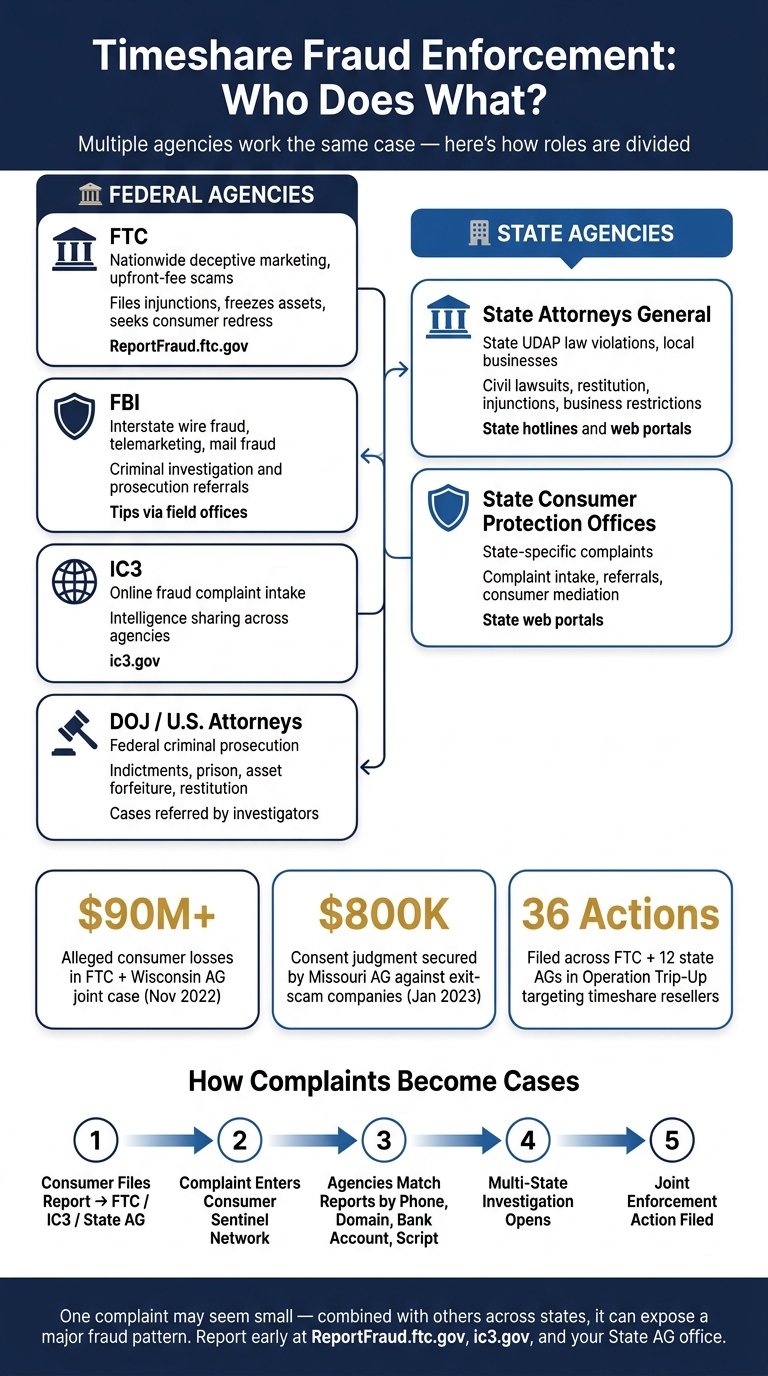
Who Handles Timeshare Fraud? Federal vs. State Agency Roles Explained
Timeshare fraud cases are split between federal and state authorities based on the conduct involved. In plain English, that means more than one agency may touch the same scam. The FTC, FBI, DOJ, and state attorneys general each deal with different parts of the pattern.
Federal Agencies: FTC, FBI, IC3 Reporting, and DOJ Enforcement
The FTC is the main federal agency for timeshare resale and exit scams. It goes after deceptive marketing, false promises about resale or cancellation, and companies that take large upfront fees without doing what they said they would do.
The FTC can seek injunctions, freeze assets, and get redress for victims. In November 2022, the FTC and the Wisconsin Attorney General jointly sued Consumer Law Protection and related companies, alleging they used deceptive timeshare-exit pitches to take more than $90 million from consumers, mostly older adults.
The FBI handles interstate, wire, and mail-fraud schemes. If a scam crosses state lines or uses phones, email, bank transfers, or the mail, the FBI may step in. IC3 collects online complaints and shares patterns across agencies. That helps investigators connect the dots when the same company or sales pitch shows up in many reports. DOJ prosecutes federal crimes such as wire fraud, conspiracy, and money laundering.
State Attorneys General and State Consumer Protection Offices
State attorneys general often receive the first consumer complaints. They investigate deceptive practices under state Unfair or Deceptive Acts and Practices (UDAP) laws and file civil lawsuits seeking restitution and injunctions.
In January 2023, Missouri’s Attorney General secured an $800,000 consent judgment against companies that failed to release consumers from timeshare agreements as promised.
State enforcement often steps in when the conduct hits residents in one state or involves local businesses. State consumer protection offices collect complaints and refer cases to the attorney general when enforcement makes sense. Some states have also passed specific timeshare resale accountability laws, which give regulators tools aimed at this market beyond general consumer protection statutes.
Agency roles at a glance:
| Agency | Jurisdiction | Reporting Function | Typical Enforcement Action |
|---|---|---|---|
| FTC | Nationwide consumer protection | ReportFraud.ftc.gov | Federal lawsuits, injunctions, and redress |
| FBI | Interstate / multi-state criminal cases | Tips through field offices or IC3 | Criminal investigation, referral for prosecution |
| IC3 | National reporting portal | ic3.gov online complaint form | Complaint intake and intelligence sharing |
| DOJ / U.S. Attorneys | Federal criminal cases | Cases referred by investigators | Indictments, prison, restitution, asset forfeiture |
| State Attorneys General | State-specific conduct and businesses | State hotlines and web portals | Civil suits, restitution, business restrictions |
| State Consumer Protection Offices | State-specific | Complaint intake, referrals | Administrative or civil enforcement support, referrals, consumer mediation where available |
These roles overlap in practice. That’s why complaint sharing and joint investigations matter so much.
sbb-itb-d69ac80
How Federal and State Agencies Work Together
Once each agency’s job is clear, the next piece is seeing how they link separate complaints into one case.
Federal and state agencies share fraud reports, trade evidence, and split up cases based on scope. That turns scattered complaints into coordinated enforcement. When complaints are pooled, agencies can spot active scams sooner and warn more people before more money is gone.
Complaint Sharing, Referrals, and Multi-State Investigations
Complaint data is the backbone of this process.
When a timeshare owner files a report with the FTC at ReportFraud.ftc.gov, that complaint goes into the Consumer Sentinel Network. The system pulls together complaints from the FTC, IC3, state attorneys general, and other partners. FTC and IC3 complaint systems also help analysts connect reports using details like a phone number, alias, payment processor, bank account, domain, or even the same sales script.
As similar complaints show up across state lines, agencies can open multi-state investigations and coordinate subpoenas for call records, bank records, and corporate files. That shared record is what turns separate complaints into one enforceable case. The sooner owners report a scam, the sooner agencies can connect the pattern across states.
Joint Enforcement Actions Against Repeat Scam Models
The same call centers, domains, and payment paths that appear in complaint data often point to repeat scam models.
These cases often involve:
- Advance-fee recovery schemes
- Deceptive resale pitches
- False guaranteed buyer claims
- Misleading timeshare exit services
These operations tend to use the same outreach channels again and again, which is why complaints often come in from owners across many states.
One example is Operation Trip-Up. In that effort, the FTC and 12 state attorneys general combined complaint data and enforcement intelligence to file 36 actions against travel-related scams, including timeshare resellers that charged fees from $200 to more than $4,000. By pooling complaint data and evidence, agencies were able to expose scams that a single office could have missed.
Fraud Schemes Agencies Target and the Prevention Tools They Use
Common Timeshare Scam Patterns
The same scam patterns agencies go after in enforcement cases are the same ones consumers should spot as early as possible.
The most common one is the resale scam. Someone calls and says they already have a buyer. They promise a fast sale, then ask for an upfront fee. They may call it a title search, appraisal, processing fee, or closing cost. But the sale never happens, and the buyer never shows up.
In August 2024, the Illinois Attorney General warned residents that scam companies may hide advance fees under those exact labels. Minnesota also warns that wire transfers, payment apps, and reloadable money cards carry a lot of risk in these deals.
Exit-related scams use a similar script. A company says it can cancel your timeshare, get you released, or permanently end your timeshare duties. The pitch often comes through telemarketing or a seminar. Then the company asks for thousands of dollars upfront, gives little detail about how the cancellation will happen, and may even tell you to stop paying your resort.
What Agencies Tell Consumers to Check Before Paying
Agencies agree on one thing: legit resellers get paid after closing. If a company wants money upfront, that’s a warning sign no matter what name it puts on the fee.
Before you pay anyone, check a few basic things first:
- Verify licensing: See whether the company has an active real estate license in the state where your timeshare is located.
- Review complaint history: Search the company name along with "scam" or "complaint", and check your state attorney general’s office.
- Contact your resort first: Ask whether it has an internal exit or deed-back program.
- Demand a written contract: Compare the contract to the sales pitch. If they don’t line up, walk away.
The Georgia Attorney General has also warned that a request to wire money overseas is a major fraud signal, especially if the company says it is U.S.-based.
If warning signs show up after you have already paid or signed, the next move may be legal review.
When Legal Help May Be Relevant
If you have already signed, paid, or are dealing with collections, it may make sense to talk with a timeshare attorney. Aaronson Law Firm focuses on timeshare contract cancellation and offers free consultations, demand letters, credit protection, and litigation support.
What to Do if You Suspect Timeshare Fraud
Preserve Records and Stop Additional Payments
At the first sign of fraud, stop sending money. Then contact your bank or credit card issuer right away to dispute recent charges, ask for a wire recall if you sent a transfer, or block future automatic payments if that’s still possible. Time matters here. The faster you move, the better your shot at limiting added charges and loss.
At the same time, pull everything into one place:
- Contracts
- Emails and texts
- Call logs
- Receipts
- Bank statements
- Screenshots
- A one-page timeline with dates and dollar amounts
That file becomes your paper trail. You’ll use it when you submit complaints.
Report to the Right Agencies in the Right Order
Once your records are saved, file complaints with the agencies most likely to act on what happened.
| Agency | Best For | Where to File |
|---|---|---|
| FTC | Nationwide fraud patterns, deceptive practices | ReportFraud.ftc.gov |
| FBI IC3 | Internet, telemarketing, or wire-transfer fraud | ic3.gov |
| State Attorney General | Local and multi-state civil enforcement | Your home state and the state where the company is based |
After that, file with the state attorney general offices that apply to your case. If the issue also involves a loan or recurring billing, submit a CFPB complaint at consumerfinance.gov/complaint.
Conclusion: The Role of Coordinated Enforcement
These complaints matter for a simple reason: agencies compare reports across states. State attorneys general can bring civil actions, negotiate settlements, and work with other states when the same people or companies operate across state lines. One complaint on its own may seem small. Put together with others, it can help show a fraud pattern.
The best move is to act early: stop payments, save records from the start, and report through the right channels in the right order. If you signed, paid, or are dealing with collections, get legal review. Aaronson Law Firm offers free consultations, legal demand letters, credit protection, and litigation support for timeshare contract cancellation.
FAQs
Can more than one agency handle my case?
Yes. More than one agency can work on a timeshare fraud case at the same time.
Federal agencies often step in when the issue crosses state lines or affects people across the country. State attorneys general usually handle consumer protection matters within their own states.
Because each agency has a different job and different legal power, they may look into separate parts of the same case. In more complex disputes – especially those tied to contracts or money you still owe – a lawyer can help you work through these channels and protect your rights.
Should I report the scam if I only lost a small amount?
Yes. Even if you only lost a small amount, it still makes sense to report the scam. Those reports help federal and state agencies spot patterns of misconduct.
A report to the FTC or your state Attorney General can support larger investigations, help hold fraudulent companies accountable, and help protect other people from the same deceptive practices.
What if the company is in another state?
If a timeshare company is based in another state, both federal and state laws may protect you.
At the federal level, agencies like the Federal Trade Commission deal with issues that cross state lines, such as deceptive sales tactics and telemarketing fraud. That matters because many timeshare disputes don’t stay neatly within one state.
For state-level rules, look at the laws in the state where the property is located. That’s usually where you’ll find details on things like:
- cancellation periods
- disclosure requirements
You can also check that company with that state’s Attorney General or its real estate regulatory agencies. If you’re dealing with an out-of-state contract, Aaronson Law Firm can help with interstate timeshare contract issues.
Related Blog Posts
- FTC Role in Timeshare Regulation
- CFPB vs. FTC: Who Handles Timeshare Complaints?
- Federal Anti-Fraud Laws vs. State Laws: Key Differences
- Timeshare Resale Scams: Case Studies