
Timeshare bills would not limit fee hikes, but they would force clearer cost disclosures, set firmer notice rules, and give buyers more time to cancel.
If you own a timeshare – or are thinking about buying one – here’s the short version: annual maintenance fees went from about $1,090 in 2020 to $1,480 in 2024, or about 8% per year, while U.S. inflation was about 4.9% per year. The new bills aim at the part owners struggle with most: surprise costs, weak notice, and hard exits.
Here’s what I’d focus on:
- One upfront disclosure listing purchase price, maintenance fees, special assessments, and other recurring charges
- Clear fee-change terms showing which charges can change, how they are figured, and when notice must be sent
- A 14-day cancellation period after signing
- Clear exit information on buyback, deed-back, or resale paths
- FTC enforcement, so the rules are not just words on paper
Right now, most laws focus on process, not price. In plain English: resorts usually must tell owners about fee changes, but they usually do not face a federal limit on how much fees can go up. That leaves many owners dealing with maintenance fees, special assessments, late charges, interest, and even liens in some states.
| Issue | What happens now | What the bills would do |
|---|---|---|
| Fee increases | No federal cap | Still no cap |
| Upfront cost disclosure | Often split across many documents | One disclosure before signing |
| Notice of fee changes | Varies by state or contract | More set rules on timing and detail |
| Cancellation | Usually 3 to 15 days by state | 14 days nationwide under the proposal |
| Exit options | Often hard to find or unclear | Must be spelled out in the contract |
My takeaway: these bills are mostly about making costs and exit terms easier to see before and after the sale. They would help future buyers more than current owners, since they would not rewrite old contracts. But for anyone facing fee pressure now, the big issues are still notice rights, rescission windows, and legal exit options.
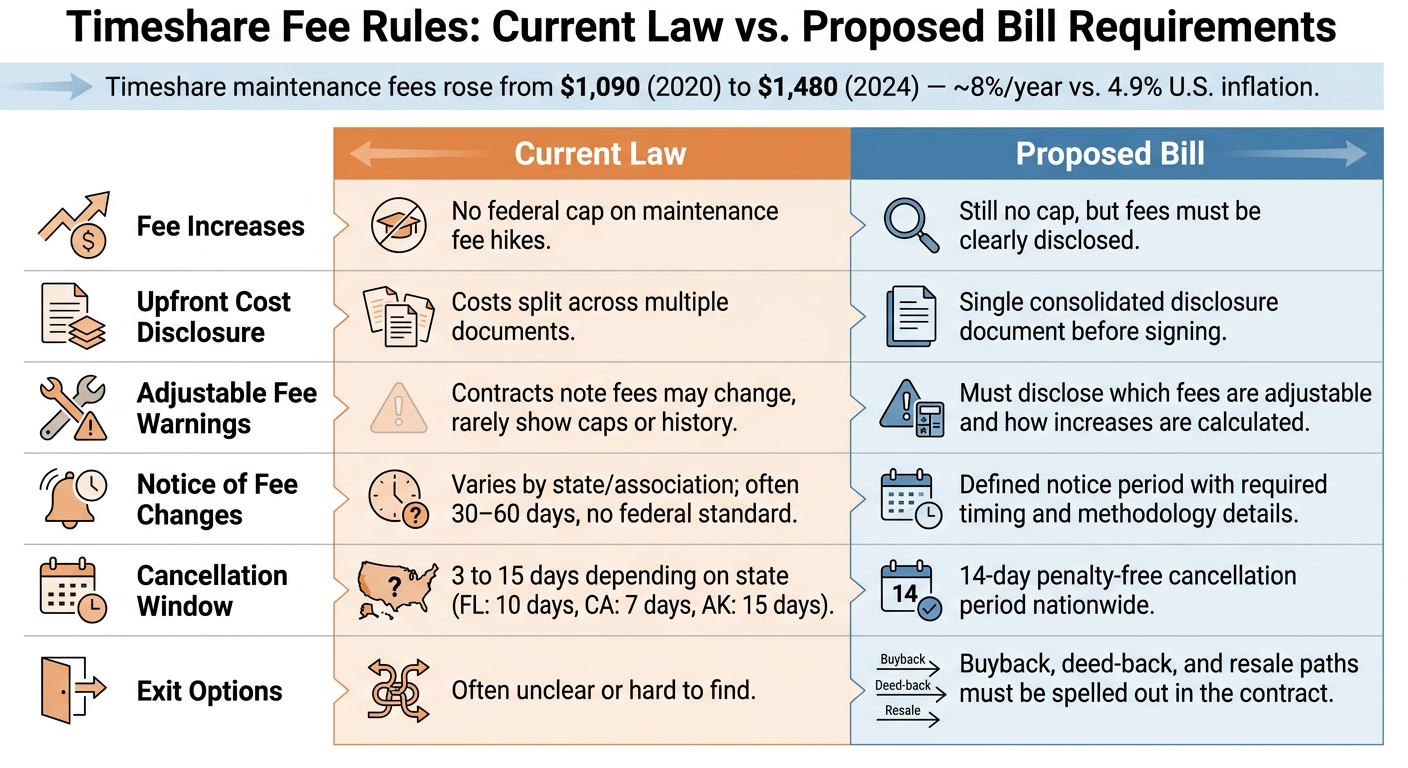
Timeshare Fee Rules: Current Law vs. Proposed Bill Requirements
1. What the Consumer Bills Would Change
The Timeshare Transparency Act (S.3502) would push timeshare sellers to give buyers clearer, more consistent disclosures. Alongside other bipartisan efforts, the biggest shift starts before anyone signs: buyers would see the key costs and terms in a more direct way.
Single-document disclosure of purchase and maintenance costs
Right now, timeshare costs are often spread across a stack of paperwork. You might find the purchase agreement in one document, the public offering statement in another, and the fee schedule somewhere else. That makes it easy to miss the full picture.
Under the proposed federal reforms, all upfront and recurring costs would need to appear in one disclosure document attached to every timeshare agreement. Before signing, buyers would see an itemized list of:
- the purchase price
- annual maintenance fees
- special assessments
- other recurring charges
New York already uses a Schedule A page that lists those same costs for each unit. The federal proposal would apply that kind of clarity across the country instead of leaving buyers to deal with a state-by-state patchwork.
The bills also deal with what happens after the purchase, especially when fees start changing.
Rules on adjustable fees and notice timing for increases
The bill doesn’t stop at the first disclosure. It also covers fee changes after the sale.
Timeshare contracts would need to spell out each fee that the company can change and explain what notice owners will get, including when that notice must be sent. Resorts would have to disclose which fees are adjustable, how increases are calculated, and how much advance notice owners will get before a new charge kicks in.
Washington already requires sellers to disclose current dues and the formula used for changes. Under the federal proposal, that level of detail would become the national starting point. The FTC would also get direct authority to enforce these rules when developers don’t meet them.
Another issue sits right next to rising fees: how owners can leave the contract.
Exit rights and cancellation periods under proposed reforms
The bill also takes aim at one of the most common owner complaints: limited ways out.
Timeshare agreements would have to clearly document available exit paths, such as developer buyback programs, deed-back options, or resale assistance. The goal is simple: owners should know, in plain terms, how they can end ownership.
The proposal would also create a 14-day penalty-free cancellation period starting on the signing date. During that window, a buyer could cancel without penalty. These rules respond to owners who say they were never told how hard it could be to get out, or how fast costs might climb.
That would expand current state rescission windows, which usually run from 3 to 15 days depending on the state. For example:
- Florida allows 10 calendar days
- California allows 7 days
- Alaska allows 15 days
The bill would also require buyers to have a private document review before signing.
sbb-itb-d69ac80
2. How Notice Rules and Fee Transparency Work Today
Why current rules focus on process, not price
The proposed rules go further than current law. Right now, the law mostly cares about notice, not limits on what can be charged.
Current law does not place a cap on maintenance-fee increases. Instead, it tends to require disclosure and advance notice. Florida requires disclosure of current assessments and the formulas used for changes. Hawaii requires 30 days’ written notice before an increase takes effect.
So the system is mostly built around one question: Were owners told in time? Not: Was the amount reasonable?
Maintenance fees, special assessments, and delinquency charges: what each means
That notice-based system applies to a few different types of charges.
- Maintenance fees pay for day-to-day operations and reserve funds.
- Special assessments are one-time charges for large, unplanned expenses.
- Delinquency charges include late fees, interest, and collection costs when owners fall behind.
These charges don’t work the same way, and they don’t hit owners the same way either. A routine maintenance fee is one thing. A special assessment that shows up out of nowhere is another.
Current fee practices vs. proposed bill requirements
The gap between today’s practices and what the proposed bills would require is pretty clear, especially when it comes to how fee details are shown and when owners get notice.
| Area | Current Practice | Proposed Bill Requirement |
|---|---|---|
| Fee disclosure format | Fees spread across purchase contract, public offering statement, and association documents | Single consolidated disclosure document given before signing |
| Adjustable fee warnings | Contracts note fees may increase, but rarely show caps, ranges, or historical trends | Prominent disclosure that fees are adjustable, with a clear explanation of how increases are calculated |
| Notice timing for increases | Varies by association; often 30–60 days before the due date, with no federal standard | Defined notice period with required detail on timing and fee-change methodology |
| Special assessment notice | Separate written notice required in some states, but detail and lead time vary widely | Standardized notice with a cost breakdown, each owner’s share, and due dates |
In short, owners often get notice, but not much say over the price. That’s the heart of the gap.
3. Why Owners and Advocates Want Reform
Owner concerns about recurring fees and limited control
Those disclosure gaps help explain why owners and consumer advocates want tougher fee rules. Many owners say they’re stuck with rising charges they can’t control and can’t easily get away from. Then a special assessment shows up for repairs or upgrades, and the yearly bill can jump by thousands of dollars with little warning.
What makes this harder is the lack of day-to-day control. A lot of timeshare agreements do include association voting rights on paper. But in practice, developers often keep control through developer-run boards or voting setups for years after the first sale. Most owners can’t attend meetings or review technical reserve reports anyway. So the distance between formal rights and actual influence is huge.
Consumer advocates also point out that many states still don’t have clear disclosure rules telling buyers they may be taking on a long-term duty to pay fees that can climb year after year.
Why accountability and enforcement matter in this debate
Transparency doesn’t mean much if regulators can’t back it up. Right now, state attorneys general and real estate regulators get complaints about deceptive sales tactics, vague fee disclosures, and aggressive collection practices. The problem is that the laws they often have to work with are broad or based on notice rules, which can make fast action hard.
The FTC warns that timeshare fees often rise at or above inflation. Yet there is still no federal rule that requires resorts to disclose a fee cap before a sale.
Consumer advocates say standard disclosures and stronger notice rules only matter when regulators have clear benchmarks they can enforce. Without those benchmarks, large resort companies may face few consequences for confusing contract language or fee increases that owners can’t easily make sense of. That’s why the proposed bills focus on more than just what owners are told. They also aim to give regulators and courts clearer grounds to step in when companies don’t follow the rules.
How Aaronson Law Firm can help owners

For owners already dealing with rising fees, reform matters. But legal help in the short term matters too. Aaronson Law Firm works only on timeshare-related legal issues, including timeshare contract cancellation, and offers a free consultation to review your contract, the history of fee increases, and whether there may be legal grounds for rescission or other relief.
The firm can also send legal demand letters and request a formal accounting of how maintenance funds are being used. That can give owners more leverage when a developer won’t clearly explain fee increases.
Conclusion: What These Bills Could Mean for Timeshare Owners
Taken together, these bills wouldn’t cap timeshare fees. What they would do is make those fees much harder to bury in the fine print. Right now, the law mainly focuses on how resorts disclose fees and give notice, not on setting limits on what they can charge. The goal of these bills is simpler: make fee duties clear before someone buys and easier to follow after the sale.
Better notice rules would also give owners more time to plan, ask questions, and push back on changes. That matters a lot for people who have been blindsided by assessments or fee hikes with little warning.
Just as important, new federal transparency rules would not automatically rewrite existing contracts. Owners who are already stuck with rising costs would still need to look to state rescission windows, deed-back programs, or legal challenges if they want relief. For current owners, the fight still centers on rescission, exit paths, and legal remedies.
Owners dealing with fee increases now should track their rescission and cancellation rights and keep an eye on any updates to notice rules. If you’re facing a fee dispute or collection pressure, you can contact Aaronson Law Firm for help.
FAQs
Would these bills help current timeshare owners?
Yes. These bills are meant to help current timeshare owners by requiring clearer fee disclosures, proper notice before contract changes, and more transparency around termination costs.
That could make it easier to push back on unfair fee hikes or changes you didn’t agree to. But it doesn’t erase the long-term money risks that can come with ownership.
If rising costs are putting pressure on you, a legal professional may help you review your options.
What fees could still increase under the proposed rules?
Even with proposed consumer protections, timeshare owners may still face higher costs over time.
That can show up in a few common ways:
- Annual maintenance fees, which often go up by 5%–12% per year
- Special assessments for repairs, property updates, or legal costs
- Administrative fees, late-payment interest, and other penalties
If the agreement doesn’t spell out clear limits or make these charges easy to understand, costs can pile up fast.
What should I review before signing a timeshare contract?
Review your financial and legal obligations with care. Pay close attention to any maintenance fee increase clauses, how those fees are calculated, and any vague wording around costs or shared expenses.
It also helps to look closely at:
- Automatic renewals
- Termination terms
- The length of the agreement
- Privacy terms
- Whether sales promises appear in writing
If anything feels unclear, slippery, or misleading, an experienced attorney can help protect your financial interests.
Related Blog Posts
- Timeshare Owners’ Associations and Fee Regulations
- Timeshare Maintenance Fees: What Developers Must Disclose
- Top 7 Timeshare Fee Complaints
- Timeshare Developers’ Financial Disclosure Rules