
Florida’s timeshare laws, governed by Chapter 721 of the Florida Statutes, set strict rules for third-party service providers involved in timeshare resales, transfers, and marketing. Here’s what you need to know:
- Cancellation Rights: Buyers have a 10-day, non-waivable period to cancel timeshare contracts without penalty.
- Third-Party Providers: These entities manage resale advertising, transfers, and exchange programs but are not held to the same fiduciary standards as developers or managing entities.
- Consumer Protections:
- Contracts must include clear disclosures, itemized fees, and cancellation rights.
- False claims (e.g., guaranteed resale value or specific buyers) are prohibited.
- Upfront payments over $75 are restricted unless a proper contract is signed.
- Privacy Rules: Managing entities cannot share owner information without written consent and must maintain updated owner lists for regulatory purposes.
- Penalties: Violations may result in civil fines of up to $15,000 per infraction.
If you’re navigating Florida’s timeshare market, understanding these legal obligations can help you avoid scams and ensure your rights are protected.
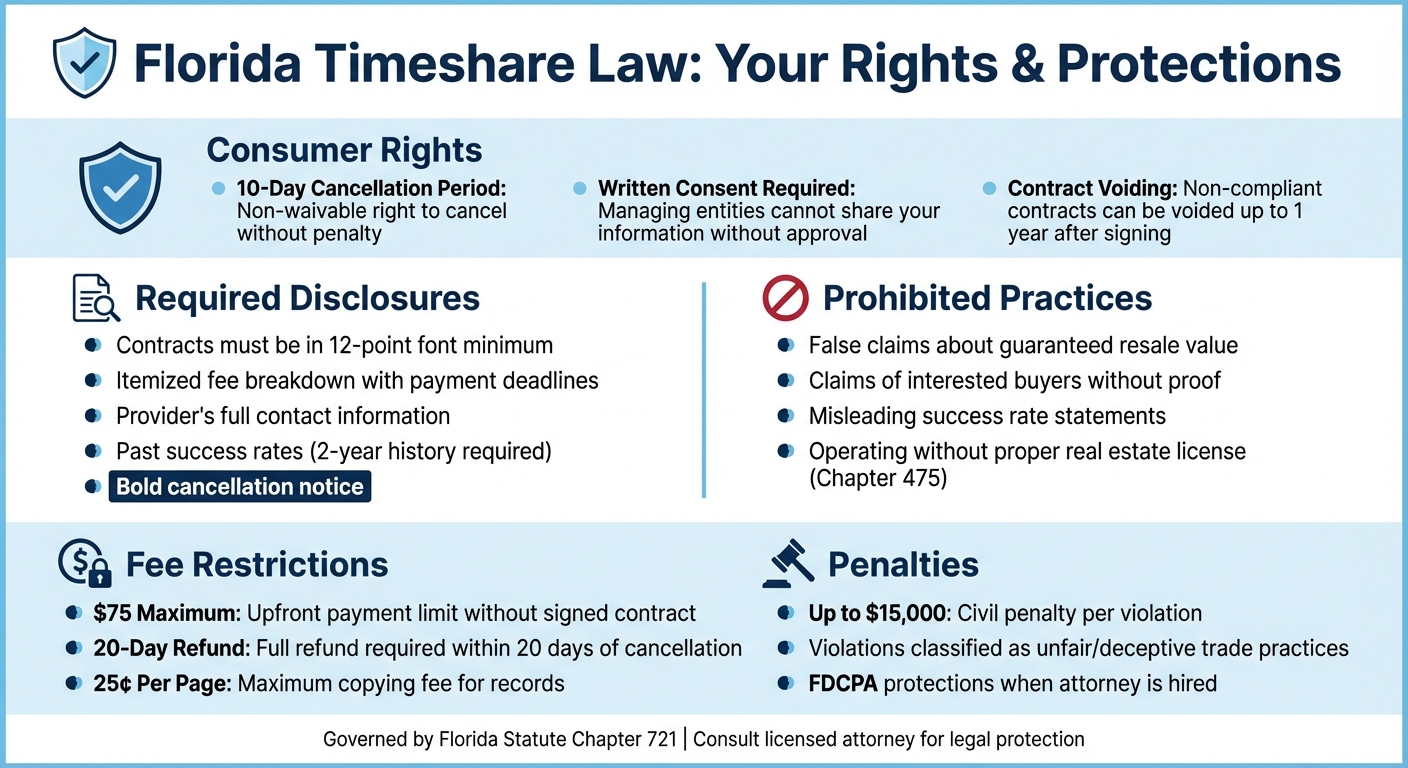
Florida Timeshare Law: Key Consumer Protections and Third-Party Obligations
Definitions and Roles of Third-Party Service Providers
What Defines a Third-Party Service Provider Under Florida Law
Under Florida law, third-party service providers are distinctly separate from developers and managing entities in the timeshare industry. Developers are responsible for creating and selling timeshare plans, while managing entities oversee the day-to-day operations. Third-party providers, on the other hand, focus solely on the secondary market, offering services to timeshare owners who want to sell, transfer, or market their timeshare interests.
As outlined in Florida Statute 721.17(f):
"Providing timeshare interest transfer services… including acting as an agent or third-party service provider for a resale service provider, constitutes operating, conducting, engaging in, or carrying on a business or business venture in this state."
Unlike managing entities, which are bound by a fiduciary duty under Florida Statute 721.13(a), third-party providers are not held to the same standard. This distinction is critical for maintaining consumer protections and ensuring fair practices in the Florida timeshare market.
Common Services Offered by Third-Party Providers
Third-party service providers offer a range of services tailored to the secondary market. These include:
- Resale advertising: Using methods like telemarketing, direct mail, or email to promote timeshares for resale.
- Licensed resale brokerage: Facilitating sales through licensed brokers, as regulated by Chapter 475.
- Transfer assistance: Helping with the legal paperwork needed to transfer ownership.
- Exchange programs: Allowing owners to trade their usage rights with other timeshare owners.
- Lead dealing: Collecting and selling contact information of five or more timeshare owners.
One notable category within third-party providers is exchange companies. These organizations run programs enabling timeshare owners to swap usage rights with others. Exchange companies can be classified as "affiliated" if they have a contractual relationship with the developer or managing entity, or "nonaffiliated" if they operate independently.
Florida law also requires lead dealers to keep detailed records of their transactions. This ensures transparency and accountability, reinforcing the legal framework outlined in Chapter 721. Understanding these roles and responsibilities is essential for navigating the timeshare market in Florida.
sbb-itb-d69ac80
Legal Requirements for Third-Party Service Providers
Required Disclosures and Fee Transparency
Florida law demands strict compliance from third-party service providers to safeguard consumers. Before any work begins, providers must present clear and detailed disclosures. Contracts must be written in at least 12-point font and include essential information such as the provider’s full contact details, an itemized breakdown of fees with payment deadlines, and a schedule outlining advertising platforms and their usage frequency. If a provider touts past success in selling or renting timeshares, they are required to disclose the percentage or ratio of actual sales or rentals compared to the total number of advertised timeshare interests from the previous two calendar years. Additionally, contracts must prominently display a bolded notice about the consumer’s unwaivable right to cancel within 10 days. If these requirements aren’t met, the contract can be voided for up to a year after signing. Violations of these rules may result in civil penalties of up to $15,000 per infraction.
Restrictions on Deceptive Marketing and False Claims
Florida law also takes a firm stance against misleading marketing practices. Under Florida Statute 721.205, service providers are prohibited from making false claims about their services. For example, they cannot assert they have an interested buyer or renter unless they can immediately provide the buyer’s contact information. Providers are also barred from suggesting that a timeshare has a set resale value. Any claims of successful sales or rentals must be backed up with documentation at the time the claim is made. Furthermore, providers offering direct sales or brokerage services must hold a valid real estate license under Chapter 475. The law emphasizes that providers are responsible for the actions of their employees and agents. As stated in the statute, "the use of any unfair or deceptive act or practice by any person in connection with resale advertising services is a violation of this section" – Florida Statute 721.205. Such violations also fall under Florida’s Chapter 501, which governs unfair and deceptive trade practices.
Fee Limits and Credit Card Charge Restrictions
To prevent financial exploitation, Florida enforces tight restrictions on upfront payments. Third-party providers are prohibited from charging a consumer’s credit card, initiating electronic transfers, or collecting more than $75 within a 12-month period unless the consumer has signed a contract that complies with the law. Even for amounts under $75, providers must first share the contract’s terms and conditions and secure the consumer’s consent via mail or electronic communication. If the consumer decides to cancel, the provider must issue a full refund within 20 days of receiving the cancellation notice or within 5 days after a check has cleared, whichever is later. The $75 cap ensures that no significant payments are made until a proper contract is in place. These rules highlight Florida’s dedication to protecting consumers in timeshare transactions.
Data Sharing Rules for Managing Entities
Limits on Sharing Timeshare Owner Information
In Florida, managing entities face strict rules when it comes to sharing owner information. According to Florida Statute 721.13, managing entities are not allowed to publish or distribute the owner list to any purchaser or third party. The only exception is the Division of Florida Condominiums, Timeshares, and Mobile Homes. This restriction remains in place even if another owner requests contact details for association-related matters.
Sharing any owner information requires explicit written consent. The statute clearly states:
"the managing entity may not furnish the name, address, or electronic mail address of any purchaser to any other purchaser or authorized agent thereof unless the purchaser whose name, address, or electronic mail address is requested first approves the disclosure in writing."
This ensures that your personal information remains private unless you specifically approve its release.
For legitimate association business, owners must work through the managing entity to communicate. Instead of providing direct access to the owner list, the managing entity is required to handle mailings on behalf of the requesting owner. The requesting owner must cover the mailing costs upfront, but this process ensures privacy while still enabling necessary communication.
These privacy measures are part of a broader framework designed to protect owners’ personal information and maintain confidentiality.
Record-Keeping Requirements for Managing Entities
Managing entities are also responsible for maintaining an up-to-date owner list, which must be refreshed quarterly. While this list cannot be shared with third parties, it must be available for review by the Division. The statute specifies:
"the managing entity shall maintain among its records and provide to the division upon request a complete list of the names and addresses of all purchasers and owners of timeshare units in the timeshare plan."
Owners or their authorized agents can request copies of records, which must be provided within 7 days of a signed request. Managing entities are allowed to charge a copying fee, capped at 25 cents per page. If records are stored off-site, the managing entity must notify the Division within 30 days of any changes, including the name, address, and location of the custodian. This custodian information is also included in the annual budget documentation, ensuring owners know where records are kept.
These requirements ensure transparency and accountability while safeguarding owners’ privacy.
Conclusion
When to Seek Legal Help
Florida law offers protections for timeshare owners, but enforcing those rights often requires timely legal assistance. For instance, if a provider charges more than $75 before a contract is signed or fails to disclose essential information about fees and success rates, they are violating state law. Similarly, if a provider claims to have a buyer but refuses to share their contact details, that’s another clear legal breach.
Aaronson Law Firm focuses on helping clients cancel timeshare contracts and navigate these tricky situations. It’s important to note that only licensed attorneys can fully protect your rights. Relying on non-attorney advice could increase your financial risks. Once you hire an attorney, the Fair Debt Collection Practices Act (FDCPA) ensures that third-party debt collectors must direct all communication through your legal representative, giving you immediate relief from aggressive collection efforts.
Whether you’re facing foreclosure, disputing maintenance fees, or dealing with a potential resale scam, consulting a specialized attorney can provide protections that non-legal services simply can’t offer. Florida law allows contracts that don’t meet statutory requirements to be voided for up to one year after signing. Knowing these legal options gives you the power to stand up for your rights.
Consumer Protection Through Legal Compliance
Legal action doesn’t just resolve disputes – it also reinforces the consumer protections outlined in Chapter 721. This legal framework is designed to shield you from deceptive practices by third-party providers. Clear disclosures, transparent fees, and data privacy requirements are all enforceable protections. When providers adhere to these rules, you can make informed decisions, understand exactly what you’re paying for, and keep control over your personal information.
Violating these legal requirements is considered an unfair and deceptive trade practice, with civil penalties reaching up to $15,000 per violation. This means you have the right to take action if providers fail to comply. For example, if a managing entity shares your contact information without your written consent or a resale advertiser makes false claims about success rates, these are actionable offenses. Knowing your rights under Florida law is crucial to avoiding the financial and legal pitfalls that can come from dealing with non-compliant third-party providers. By understanding and enforcing these rights, you can protect yourself and make more confident decisions.
FAQs
What are the penalties for third-party providers who violate Florida’s timeshare laws?
Third-party service providers, like resale companies, that fail to follow Florida’s timeshare laws can face tough penalties under Chapter 721 of the Florida Statutes. These can range from losing their state license – either temporarily or permanently – to hefty civil fines and even legal action.
Florida takes these regulations seriously to safeguard consumers and maintain strict compliance. Those who break the rules not only jeopardize their finances but also risk damaging their professional standing.
How can I protect myself from deceptive timeshare marketing practices in Florida?
To guard against deceptive marketing practices in Florida’s timeshare industry, it’s essential to understand the protections outlined in Chapter 721 of the Florida Statutes and the Florida Deceptive and Unfair Trade Practices Act (FDUTPA). For instance, resale advertisers are required to clearly disclose all fees and their payment schedules before offering their services. They are also prohibited from falsely claiming that a buyer or renter has been secured unless they can provide verifiable details, such as the buyer’s name and contact information. These measures are designed to promote transparency and shield consumers from misleading claims.
When considering a timeshare purchase, it’s critical to carefully review the contract. The document must include essential details such as the developer’s name and address, the total purchase price, additional costs like financing or assessments, and estimates for future expenses. If verbal promises made during the sales process are not documented in the contract, you may have legal grounds to challenge them under FDUTPA, which addresses unfair or deceptive business practices.
If you decide to work with a third-party resale or marketing firm, make sure the company holds a valid, active license under Chapter 475. Unlicensed firms are not legally permitted to provide resale advertising services. Should you find yourself stuck in a misleading timeshare agreement, the Aaronson Law Firm offers free consultations and legal support to help you cancel the contract and safeguard your financial interests. Staying informed and cautious can go a long way in protecting yourself from deceptive tactics.
What should I do if I believe my personal information was shared without my consent in a timeshare agreement?
If you believe a timeshare resale service or third-party provider has shared your personal information without your consent, here’s what you should do:
- Request records from the provider. Under Florida law, timeshare service providers must keep detailed records of all disclosures and fees related to your transaction. Send a written request asking for this information.
- Notify the provider in writing. Clearly explain your concerns, demand that they stop any further unauthorized disclosures, and ask for a detailed account of who received your data and why. Use certified mail or another trackable method to ensure you have proof of your communication.
- File a complaint with the authorities. Report the issue to agencies like the Florida Attorney General’s Office, the Federal Trade Commission, or the Florida Department of Agriculture & Consumer Services. These organizations can investigate and take action if privacy laws were violated.
- Speak with a legal professional. Florida has strict timeshare laws that may offer you options like rescission, compensation, or other remedies. An experienced attorney, such as those at Aaronson Law Firm, can guide you in understanding your rights and taking the necessary steps to protect your interests.
Remember, Florida law imposes strict deadlines for addressing these issues, so acting quickly is crucial.
Related Blog Posts
- Timeshare Laws: Federal vs. State Protections
- State Laws on Timeshare Resale Restrictions
- Florida Statutes on Timeshare Marketing Compliance
- Hawaii Timeshare Disclosure Checklist