
Colorado has strong laws to protect you when buying or selling a timeshare. These laws address common scams, ensure transparency, and give you the right to cancel contracts. Key protections include:
- 5-Day Cancellation Period: You can cancel a timeshare purchase within five days without penalties, giving you extra time to reconsider.
- Mandatory Disclosures: Sellers must clearly explain costs, cancellation rights, and contract terms upfront.
- No Upfront Fees for Resales: Resale companies cannot charge fees until the transfer is complete.
- Penalties for Deceptive Practices: Misleading claims about resale value, fees, or benefits are prohibited, and violators face legal consequences.
If sellers violate these rules, you can void contracts or take legal action under the Colorado Consumer Protection Act (CCPA), which may allow you to recover damages and fees. Always keep records, verify licenses, and seek legal advice if needed.
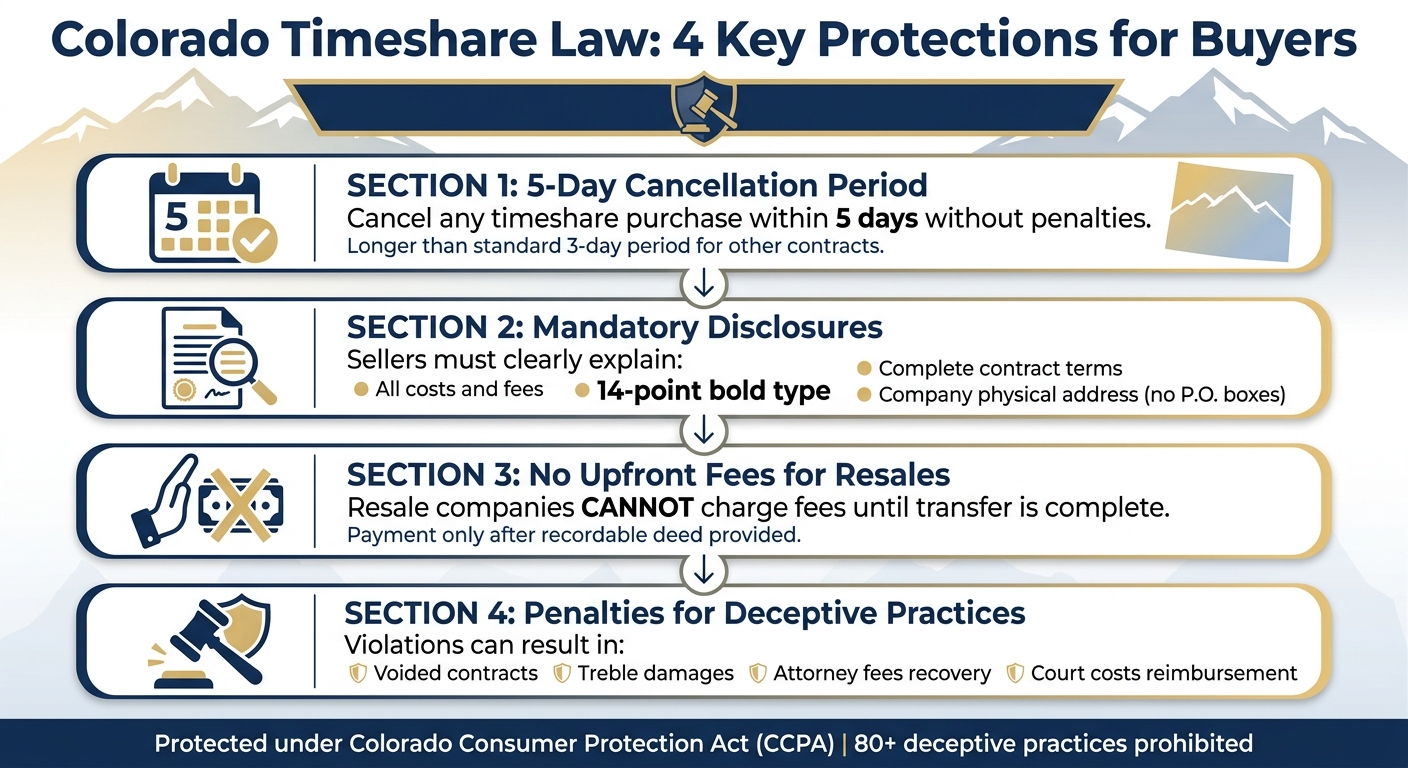
Colorado Timeshare Buyer Protections: Key Legal Rights
Problems Timeshare Buyers Face
Timeshare buyers often encounter deceptive practices that have become all too common in the industry. Recognizing these tactics helps explain why strong legal protections are so important.
Deceptive Sales Tactics
Timeshare companies frequently lure potential buyers with tempting incentives. Offers like free hotel stays, vacation certificates, or prizes are used to draw people into sales presentations. Once there, buyers are subjected to intense pressure designed to cloud their judgment. Salespeople exaggerate the benefits, such as property accessibility and value, while glossing over the near impossibility of reselling a timeshare.
"Colorado law makes it illegal for a timeshare seller to misrepresent or make false statements regarding the investment, resale, or rental value of any timeshare." – Amy Loftsgordon, Attorney
The misleading promises don’t stop with verbal assurances. Companies often guarantee returns that never materialize. Some even rely on bait-and-switch tactics, advertising one set of terms but presenting completely different contract conditions during the sale. The Colorado Consumer Protection Act outlines over 80 deceptive trade practices – many of which are common in timeshare sales.
Adding to these concerns, sellers often hide important financial details.
Lack of Transparency
Beyond aggressive sales tactics, timeshare sellers frequently withhold crucial financial information. Ongoing costs like regular assessments, special assessments, and property taxes are often downplayed or omitted entirely during sales pitches, leaving buyers trapped in long-term financial commitments.
"Companies trying to sell timeshares will often lure consumers into a sales pitch with promises of free vacations and other ‘gifts,’ which are often difficult to redeem and not as valuable as promised." – Stop Fraud Colorado
Sellers also mislead buyers by portraying timeshares as assets that can be easily sold if circumstances change. Unfortunately, many buyers later realize there’s virtually no resale market. Desperate to offload their timeshare, some fall victim to resale scams, where unlicensed entities promise quick sales but vanish after collecting upfront fees – often exceeding $5,000.
These deceptive practices underscore the importance of Colorado’s strong legal protections for consumers.
sbb-itb-d69ac80
Colorado Timeshare Law Protections
Colorado has put strict rules in place to protect consumers from deceptive timeshare practices, ensuring developers and resellers follow clear standards.
Mandatory Disclosures
Transparency is a cornerstone of Colorado’s timeshare laws. Every timeshare contract must clearly outline the buyer’s right to cancel within five days. For resale service contracts, this cancellation notice must appear in 14-point bold type directly above the signature line.
Resale and transfer companies are also required to provide buyers with a detailed written agreement. This agreement must include the company’s name, phone number, and physical address (P.O. boxes are not allowed). It must also explain the exact process or documentation the reseller will use to transfer ownership and provide an estimated completion date.
"Under Colorado law, timeshare resellers or transfer companies are required to provide you with a detailed transfer agreement with their name, telephone number and physical address (no PO boxes), a description of the method or documentation the reseller will use, and the date by which the sale is estimated to be complete." – Stop Fraud Colorado
Additionally, resellers cannot charge any fees upfront. They can only collect payment after providing the buyer with a recordable deed or written proof that the timeshare transfer is complete.
These disclosure rules set the stage for further protections, including the extended cancellation period outlined below.
5-Day Rescission Period
Colorado gives timeshare buyers five days to cancel their purchase without any penalties. This is longer than the typical three-day period for other contracts in the state, offering buyers extra time to reconsider their decision – especially in cases where high-pressure sales tactics may have been used. Buyers can cancel by email, postal mail, or hand delivery.
The cancellation becomes effective as soon as it is mailed (postmarked), emailed, or delivered in person. Once the seller receives the cancellation notice, they are required to refund any down payment or deposit within seven days. If the buyer’s check hasn’t cleared yet, the seller may wait up to an additional seven days to issue the refund.
Prohibitions on Deceptive Trade Practices
Colorado law explicitly bans misleading claims often associated with timeshare sales. Under C.R.S. 6-1-703, sellers cannot misrepresent key details like the investment value, resale potential, rental income, exchange conditions, or facility availability. If a contract fails to meet these standards, it can be voided by the buyer for up to one year.
"A person engages in a deceptive trade practice when… [they fail] to provide conspicuous notice on the contract of the right of a purchaser of a time share or time share resale service to rescind the sale in writing either by electronic means, mail, or hand delivery." – C.R.S. Section 6-1-703
False promises about offers to buy or rent a timeshare, the time required to complete a sale, or future costs like maintenance fees are also prohibited. These rules are designed to protect buyers from falling victim to misleading or fraudulent claims.
Protections Against Resale and Transfer Scams
Colorado law goes beyond mandatory disclosures and cancellation rights to tackle timeshare resale scams. Through SB13-182, the state has put in place measures specifically aimed at curbing fraudulent resale practices. These rules set clear requirements for companies that help owners sell or transfer their timeshares, offering extra security against scams.
Resale Disclosure Requirements
Before any transaction begins, resale companies are required to provide a detailed written agreement. This agreement must outline all fees the owner will need to pay, explain the transfer process step by step, and include an estimated date for completion.
One of the most critical protections is the ban on advance fees. Resale companies cannot collect any payment until they provide a recordable deed showing the transfer is complete. This prevents scammers from demanding large upfront fees, which often exceed $5,000.
Additionally, resale agreements must inform owners that they are responsible for any assessments and taxes until the transfer is finalized. These agreements also prohibit transferring timeshares to individuals who are unable to handle future obligations.
To ensure legitimacy, verify the resale company’s license with the Colorado Secretary of State and check brokers’ licenses through the Colorado Division of Real Estate. Always confirm licensing and secure formal proof of transfer before making any payments.
Legal Remedies and Enforcement Options
Colorado’s laws provide strong protections for buyers, offering both immediate contract remedies and legal avenues to recover damages when those protections are violated. These measures ensure buyers have recourse when developers fail to meet their obligations.
Voidable Contracts for Non-Compliance
In Colorado, contracts can be voided if developers fail to follow mandatory requirements. For instance, if a seller neglects to provide the necessary disclosure documents, skips the five-day rescission notice, or engages in deceptive practices, buyers have the right to challenge the contract’s validity. This protection also applies to resale agreements that violate SB13-182 by collecting upfront fees before completing a transfer or by omitting key disclosures about fees and timelines.
To void a contract, buyers need to document any failure to meet disclosure requirements. Keeping all sales-related paperwork is essential, as these records serve as evidence of violations. This documentation becomes especially important if you need to assert your right to cancel after the standard five-day period.
If voiding the contract doesn’t resolve the issue, additional legal actions can be pursued.
Litigation and Legal Support
When voiding a contract isn’t enough to address the problem, buyers can turn to legal remedies. The Colorado Consumer Protection Act (CCPA) allows individuals to file lawsuits for deceptive trade practices. To win under the CCPA, buyers must demonstrate that the developer engaged in a deceptive act during business operations, that this act had a significant public impact, and that it caused actual financial harm. The CCPA outlines over 80 specific actions that qualify as deceptive practices.
"The CCPA is meant to deter and punish deceptive trade practices by businesses against consumers. The claim is very attractive to consumers because it gives you access to treble damages." – Volpe Law LLC
If bad faith is proven, buyers may be awarded treble damages, along with reimbursement for attorney fees and court costs. This makes pursuing legal action a practical option, even for disputes involving smaller amounts of money.
Firms like Aaronson Law Firm offer free consultations to assess your case and provide specialized services such as legal demand letters, credit protection, and full litigation support for timeshare contract cancellations. Given the overlap between Colorado timeshare law, real estate law, and contract law, working with attorneys who focus exclusively on timeshare issues ensures your case is handled with the expertise needed to enforce your rights effectively.
Conclusion
Colorado’s laws are designed to protect buyers from deceptive practices through measures like a five-day rescission period, strict disclosure requirements, and a ban on upfront resale fees. These safeguards aim to reduce financial risk and empower buyers.
However, these protections are only effective when you fully understand your rights. Keep thorough records, verify that resellers hold valid real estate broker licenses through the Colorado Division of Real Estate, and never pay fees without written proof of transfer. Staying informed is your first line of defense against potential issues.
If violations occur, Colorado law provides strong enforcement tools. The Colorado Consumer Protection Act enables you to take legal action against deceptive trade practices. In cases of bad faith, you may recover treble damages, attorney fees, and court costs. Additionally, contracts that fail to meet disclosure requirements can be voided, offering you an exit even after the rescission period has passed. Prompt action is crucial when your rights have been violated.
For those facing challenges with a timeshare contract or suspecting a violation of their rights, seeking legal advice is essential. Aaronson Law Firm provides free consultations to assess your case and offers services such as legal demand letters, credit protection, and full litigation support for timeshare cancellations. Given the complexities of timeshare law, working with attorneys who specialize in this area ensures your case is handled with the expertise it requires.
FAQs
When does the 5-day cancellation clock start?
In Colorado, buyers have a 5-day cancellation period for timeshare contracts. This period starts once the buyer receives a written notice outlining their right to cancel. This rule is designed to ensure buyers are aware of their rights and have a chance to reconsider their decision, as protected by state law.
What should I do if I missed the 5-day deadline?
If you’ve missed the 5-day deadline to cancel a Colorado timeshare contract, it’s a good idea to consult an attorney who specializes in timeshare law. They can explain your legal options and help you figure out possible solutions since the law offers only a short window for cancellation. Acting quickly is crucial to safeguard your rights and deal with any financial commitments linked to the agreement.
How can I verify a resale company is licensed in Colorado?
To confirm whether a resale company is licensed in Colorado, look up its registration with the Colorado Division of Real Estate. This organization oversees adherence to state laws that require resale companies to include key details in transfer agreements and prohibit misleading practices. These regulations aim to safeguard buyers from scams and promote clarity in timeshare resale transactions.
Related Blog Posts
- Colorado Timeshare Cancellation Laws Explained
- Understanding Colorado Revised Statutes on Timeshares
- Colorado Timeshare Cancellation vs. Other States: Key Differences
- How Consumer Protection Laws Impact Timeshare Complaints