
Tennessee law gives you the right to cancel a timeshare contract without penalties during a specific cooling-off period. Here’s what you need to know:
- Cancellation Period:
- 10 days if you inspected the property.
- 15 days if you did not inspect the property.
- Refund Timeline: Developers must refund your payments within 30 days of receiving your cancellation notice.
- Non-Negotiable Right: You cannot waive this right, and any attempt to do so is void under Tennessee law.
- Required Documents: If the developer fails to provide a Public Offering Statement (POS), your right to cancel remains open indefinitely until it is delivered.
- How to Cancel: Submit a written notice via hand-delivery, prepaid U.S. mail (postmark counts), or email (timestamp counts).
This law protects buyers from high-pressure sales tactics and ensures a fair process for canceling timeshare agreements. If you’re past the cooling-off period, missed documentation or misrepresentation may still allow you to void the contract.
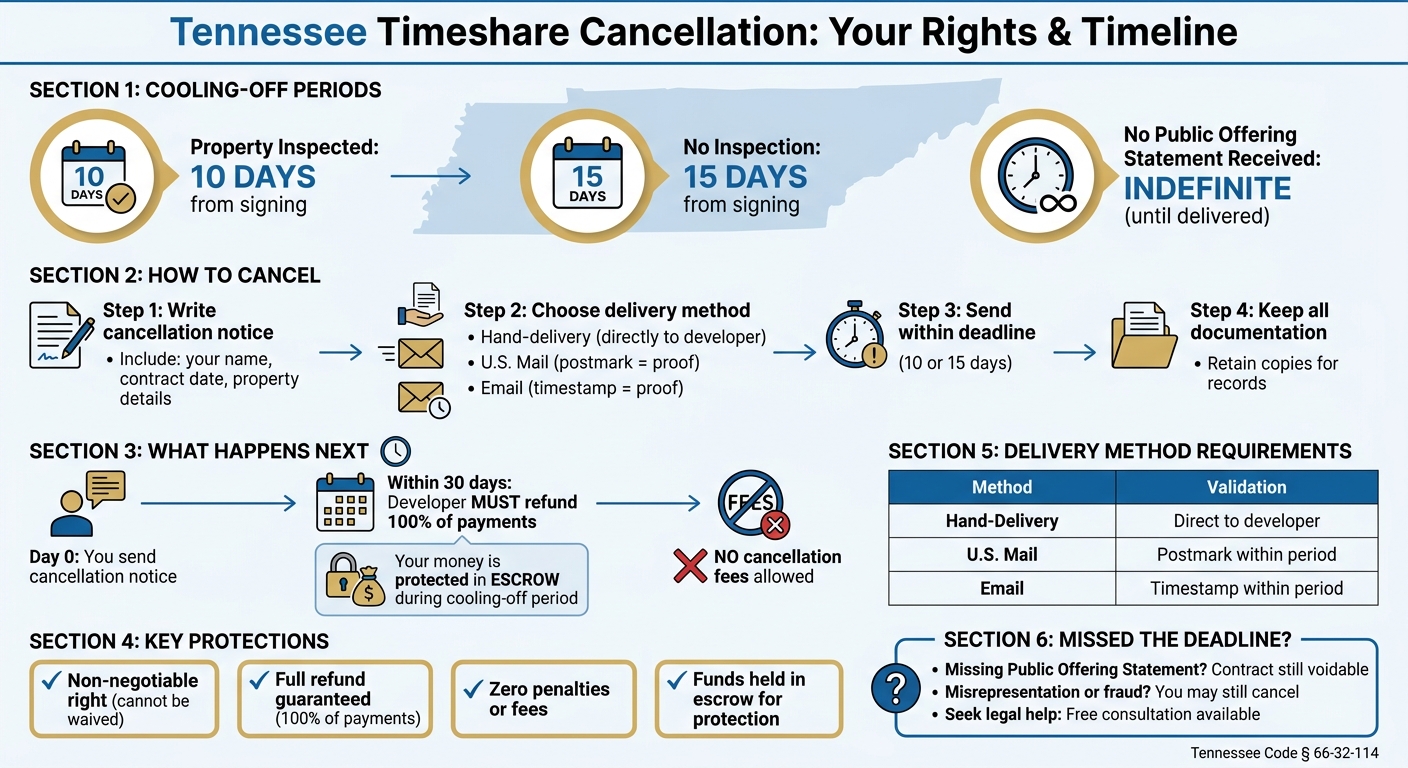
Tennessee Timeshare Cancellation Rights and Timeline Guide
How Tennessee’s Cooling-Off Period Works
Here’s a closer look at how Tennessee’s cooling-off period functions to protect timeshare buyers.
What the Cooling-Off Period Means
Tennessee law gives you the absolute right to cancel your timeshare contract without penalties during the cooling-off period. This right is non-negotiable – if a developer tries to get you to waive it, that waiver is legally invalid.
"Under Tennessee law, the right to cancel can’t be waived." – Amy Loftsgordon, Attorney
The cooling-off period is designed to safeguard you from making rushed decisions under high-pressure sales tactics. During this time, any money you’ve paid is held in an escrow account, ensuring you’ll receive a full refund if you cancel. Developers are prohibited from charging cancellation fees and must return your payments within 30 days of receiving your notice to cancel.
Understanding this right is key, but knowing the specific timeline for taking action is just as important.
How Long You Have to Cancel
The time you have to cancel your timeshare contract depends on whether you toured the property before signing.
- If you conducted an on-site inspection, you have 10 days from the signing date to cancel.
- If you signed the contract without visiting the property, you’re entitled to 15 days to cancel.
| Condition of Purchase | Cancellation Deadline | Statutory Reference |
|---|---|---|
| On-site inspection performed | 10 days from signing | Tenn. Code § 66-32-114(a) |
| No on-site inspection performed | 15 days from signing | Tenn. Code § 66-32-114(a) |
| Public Offering Statement not received | Until POS is delivered | Tenn. Code § 66-32-114(a) |
Another critical point: if the developer fails to provide the Public Offering Statement (POS), your right to cancel remains open until the document is delivered. The POS includes essential information about the timeshare project and instructions for cancellation. Without it, the contract remains voidable, even if the standard 10- or 15-day period has passed. These timelines are a vital part of the law, ensuring you have ample opportunity to exercise your rights.
sbb-itb-d69ac80
Who Can Cancel a Timeshare Contract
Under Tennessee law, any purchaser – whether an individual, co-owner, or corporate entity – has the right to cancel a timeshare contract. This protection applies to anyone listed as a buyer on the contract during the cooling-off period.
"Tennessee timeshare law 66-32-114 declares that both the purchaser and seller have a mutual right to cancel a timeshare contract." – TimeshareAttorney.com
If there are co-owners on the contract, all parties must sign the cancellation notice to ensure it is considered complete. This requirement guarantees that everyone involved in the agreement is equally protected.
The law treats all buyers the same, regardless of whether the timeshare was purchased individually, jointly, or through a corporate entity. What matters is meeting the statutory deadlines, which depend on whether you inspected the property and received the Public Offering Statement. Importantly, no developer can legally include language in a contract that removes or limits your cancellation rights. Any such attempt is void under Tennessee law, so long as buyers follow the cancellation deadlines tied to their purchase conditions.
How to Cancel Your Timeshare Contract in Tennessee
Canceling a timeshare contract in Tennessee involves following specific legal procedures. State law outlines the steps you must take to ensure your cancellation is valid and enforceable. Here’s how to proceed.
How to Write and Send Your Cancellation Notice
Your cancellation notice must be in writing and include your name, the date of the contract, and details about the property. Tennessee law does not accept verbal cancellations, so a written notice is mandatory.
There are three approved ways to deliver your cancellation notice in Tennessee:
- Hand-delivery: Directly to the developer.
- Prepaid U.S. mail: Any form of prepaid mail service.
- Electronic mail: Sent via email.
Each method has specific requirements to validate your cancellation. For instance, if you’re mailing your notice, it’s a good idea to use certified mail with return receipt. While this isn’t required by law, it provides proof of both the postmark date and delivery. For email, save a copy of the sent message with a visible time-stamp for your records.
Make sure you refer to the Public Offering Statement (POS) for the developer’s address and other contract details. If you haven’t received the POS, your contract remains voidable, no matter how much time has passed since signing.
"The cancellation notice must be in writing." – Office of the Attorney General, State of Tennessee
Meeting Deadlines and Delivery Requirements
Timing is critical when canceling your timeshare. Tennessee law focuses on when you send the notice, not when the developer receives it. For mailed cancellations, the postmark date is what matters. As long as your notice is postmarked within the cancellation period, it’s legally valid – even if the developer doesn’t open it for several days.
For email cancellations, the time-stamp on your sent message must fall within the cancellation window. This window is 10 days if you inspected the property before signing the contract, or 15 days if you didn’t. Always save a screenshot or copy of the email showing the exact date and time it was sent.
Here’s a quick summary of the validation requirements for each delivery method:
| Delivery Method | Validation Requirement |
|---|---|
| Hand-Delivery | Delivered directly to the developer |
| U.S. Mail | Postmarked within the cancellation period |
| Electronic Mail | Time-stamped within the cancellation period |
Lastly, keep copies of everything – your notice, proof of delivery, and any correspondence with the developer. While the law emphasizes the sending date, having thorough documentation can protect you if there’s ever a dispute about whether your notice was received.
What to Expect After You Cancel
Once you’ve submitted your cancellation notice, Tennessee law ensures a clear and straightforward process. Developers are legally required to handle your cancellation without imposing any penalties or fees. Here’s what happens next, including how your refund is handled and how your funds are safeguarded.
When and How You’ll Get Your Refund
Under Tennessee law, developers must issue a full refund within 30 days of receiving your written cancellation notice. This applies no matter how you send the notice – whether it’s delivered in person, sent through U.S. mail, or emailed.
You’re entitled to receive back 100% of the payments you made toward the timeshare purchase. State law explicitly prohibits developers from deducting any fees, such as cancellation penalties or administrative charges, as long as you cancel within the legally allowed cooling-off period.
"If you cancel, the seller (usually the developer) can’t charge a penalty and has to refund the money you paid within 30 days of receiving your cancellation notice." – Amy Loftsgordon, Attorney, Nolo
If the developer fails to refund your money within the 30-day window, it’s important to take action. File a complaint with the Tennessee Department of Commerce & Insurance’s Division of Consumer Affairs. Be sure to keep all records showing when the developer received your cancellation notice – this documentation is crucial for proving when the refund deadline starts.
Additionally, Tennessee law provides extra security for your money by requiring it to be placed in escrow.
How Your Escrowed Money Is Protected
All funds from your timeshare purchase must be deposited into an independent escrow account, as outlined in Tenn. Code § 66-32-113. This legal requirement ensures your money is safeguarded during the cancellation period.
The escrowed funds can only be released under specific circumstances:
- If you cancel the agreement
- If you default on the agreement
- When the cancellation period ends without a cancellation notice
"The point of the escrow requirement is to protect your right to a refund if you cancel the sales agreement during the cancellation period." – Nolo
When you submit a valid cancellation notice, the escrow account is required to release the funds back to you. Developers are legally obligated to process this release quickly, giving you the financial protection you deserve.
Tennessee Law Governing Timeshare Cancellations
Tennessee law, specifically Tenn. Code Ann. § 66-32-114, provides clear protections for consumers looking to cancel timeshare contracts. This law gives buyers a mandatory cooling-off period – 10 days if you conducted an on-site inspection or 15 days if you didn’t – to cancel the contract without penalty. These rules are designed to ensure buyers have adequate time to reconsider their decision.
A key point of this law is that your cancellation rights cannot be waived. According to Tenn. Code § 66-32-114(d), any clause in a contract that attempts to limit or eliminate these rights is automatically void. This means developers cannot legally require you to give up these protections, no matter what the contract says.
The law also emphasizes the importance of full disclosure. If the developer fails to provide the Public Offering Statement – a document outlining critical information about the developer and the timeshare project – the contract remains voidable. Even if the initial 10- or 15-day period has passed, you can still cancel the agreement if this document wasn’t provided. This ensures buyers aren’t locked into contracts without having all the necessary information upfront.
To make your cancellation legally valid, Tennessee law specifies acceptable delivery methods: hand-delivery, prepaid U.S. mail (with the postmark serving as proof), or email (with the timestamp acting as evidence). These options align with the procedural safeguards discussed earlier, giving buyers flexibility and clarity in exercising their rights.
What to Do If Your Cooling-Off Period Has Passed
If the cooling-off period has ended, don’t panic – Tennessee law still provides options to cancel your timeshare. Missing the deadline doesn’t mean you’re stuck forever. For instance, if you never received the required Public Offering Statement, your contract could still be voidable.
Missing Documents or Misrepresentation
If the developer failed to provide the Public Offering Statement, your contract remains open to cancellation. Beyond missing documents, misrepresentation or fraud during the sales process is another valid reason to cancel. Tennessee law prohibits developers from making false claims about a timeshare’s potential for profit or its future value. To strengthen your case, gather any brochures, promotional materials, or notes from your sales meeting that include misleading claims.
Alternative Exit Strategies
If the standard cancellation methods don’t work, you can explore other paths, like a deed in lieu of foreclosure. This involves voluntarily returning the timeshare to the developer. While developers aren’t obligated to accept these arrangements, they may consider them, especially if you’re experiencing financial difficulties. Additionally, you can file complaints with agencies like the Tennessee Department of Commerce & Insurance’s Division of Consumer Affairs, the Federal Trade Commission (FTC), or the Better Business Bureau (BBB) if you suspect fraudulent activity.
Legal Support
For more in-depth assistance, consider reaching out to the Aaronson Law Firm. They specialize in helping clients cancel unwanted timeshare contracts, even after the cooling-off period has passed. Their team can evaluate your case, identify possible violations of Tennessee’s timeshare laws, and negotiate with developers on your behalf. Services include drafting legal demand letters, protecting your credit, and offering litigation support if needed. They also provide free consultations to review your documentation and explore your legal options.
If you feel overwhelmed, professional help can make the process more manageable.
Conclusion
Tennessee’s cooling-off period gives you a short but critical opportunity to cancel your timeshare without facing any penalties. If you’ve taken part in an on-site tour, you have 10 days to cancel. Without a tour, the window extends to 15 days. Acting within this timeframe is vital, as these cancellation rights are non-negotiable. Once you submit a valid cancellation notice, the developer is required to refund all payments within 30 days.
If you miss this deadline, you may still have options. For instance, if the developer failed to provide the required Public Offering Statement or if they engaged in deceptive practices, your contract could be voidable under Tennessee law. Misleading claims by the developer are also grounds for challenging the agreement.
Tennessee Code Title 66, Chapter 32 is designed to protect buyers like you from long-term financial obligations and risks like foreclosure. Provisions such as escrow requirements, mandatory disclosures, and non-waivable cancellation rights ensure that you have a safety net. If you encounter any difficulties, this legal framework allows you to seek expert assistance.
When dealing with timeshare issues, professional legal guidance can make all the difference. Aaronson Law Firm offers a free consultation to assess your situation. Their team specializes in timeshare cancellations, handling everything from legal demand letters to protecting your credit and even providing litigation support if necessary.
Understanding Tennessee’s timeshare laws is key to protecting your financial well-being. Act quickly, know your rights, and take steps to secure your financial future.
FAQs
When does the 10- or 15-day cancellation clock start?
In Tennessee, the cancellation period for a timeshare contract typically begins on the day you sign the agreement. This period lasts either 10 or 15 days, depending on the specific terms detailed in your contract.
What should I do if the developer ignores my cancellation or refund?
If the developer doesn’t respond to your cancellation or refund request, it may be time to seek advice from a legal professional to ensure your rights are upheld. Under Tennessee law, there’s a cooling-off period of 10 to 15 days for canceling a timeshare. If the developer refuses to honor this, you might need to consider legal action to enforce your cancellation or secure a refund.
Does financing change my right to cancel and get a refund?
State law in Tennessee protects your right to cancel a timeshare purchase, whether or not it was financed. Sellers are prohibited from imposing penalties and are required to issue refunds within 30 days of cancellation. Financing does not alter these protections.
Related Blog Posts
- Timeshare Laws: Federal vs. State Protections
- Tennessee Timeshare Fraud Cases: Key Rulings
- How Texas Property Code Affects Timeshare Owners
- Florida Timeshare Rescission Laws Explained