
In Florida, developers selling timeshares must provide a Public Offering Statement (POS), ensuring buyers receive all necessary details about the property, financial obligations, and their rights. Key points include:
- 10-Day Cancellation Period: Buyers can cancel penalty-free within 10 days of signing or receiving required documents.
- Disclosure Rules: Only written terms in the POS and contract are binding – oral promises are not enforceable.
- Filing Fees: Developers must pay $2.00 per seven-day usage period for each timeshare unit.
- Approval Process: The Division of Florida Condominiums, Timeshares, and Mobile Homes reviews filings within:
- 45 days for single-site plans
- 120 days for multisite plans
- Formatting Standards: Disclosures must be in at least 10-point font, with certain warnings in larger, conspicuous type.
The POS must include property details, financial commitments, reservation systems, and any restrictions, ensuring transparency and buyer protection under Florida’s timeshare laws.
Filing and Approval Process
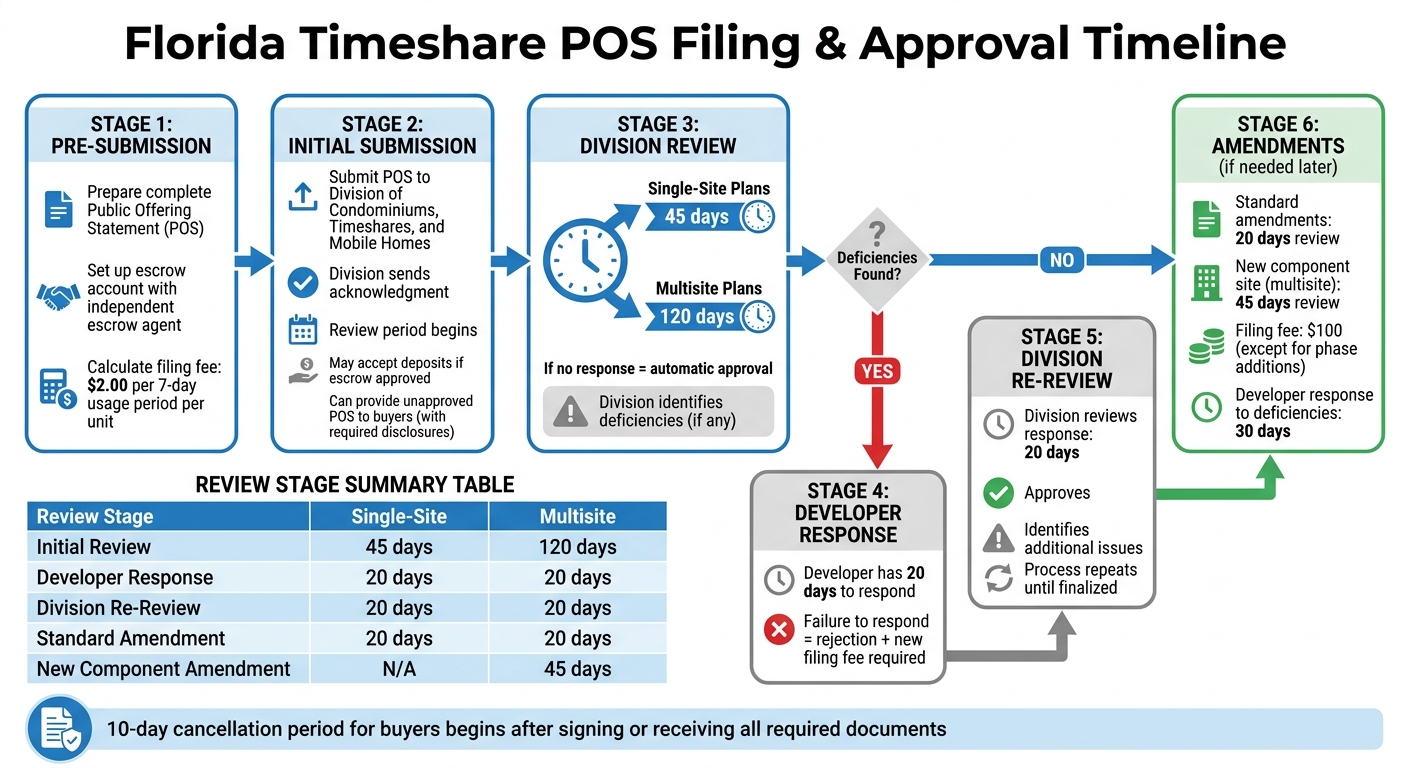
Florida Timeshare POS Filing and Approval Process Timeline
Submission Requirements
Before developers can sell any timeshare plan, they must submit a complete Public Offering Statement (POS) to the Division of Condominiums, Timeshares, and Mobile Homes. Additionally, they are required to set up an escrow account with an independent escrow agent to safeguard purchaser funds before accepting any payments or reservations.
Developers are allowed to accept deposits prior to the final POS approval, but only if the Division has approved the necessary escrow and reservation agreements. The initial filing fee is calculated at $2.00 for every seven days of annual use availability in each timeshare unit being offered. Once the filing is received, the Division sends an acknowledgment to the developer, which begins the official review period.
During this review period, developers may provide unapproved POS documents to potential buyers. However, these documents must include clear disclosures stating their unapproved status and must inform buyers of their 10-day statutory cancellation rights. If any changes are made to an approved POS, developers must file an amendment, pay a $100 fee, and gain Division approval before the changes take effect.
Once submitted, the POS enters a structured review process, as outlined in the following section.
Approval Timeline
The Division follows specific timeframes to review timeshare plans: 45 days for single-site plans and 120 days for multisite plans. If the Division fails to respond within these periods, Florida law considers the filing automatically approved.
If the Division identifies any deficiencies, developers must respond within the designated deadline. Failing to meet this deadline can lead to rejection, requiring developers to pay a new filing fee and restart the review process. After the developer submits a response, the Division reviews it again and either approves the filing or highlights additional issues. This back-and-forth continues until the POS is finalized.
The table below breaks down the review timeline for different types of filings:
| Review Stage | Single-Site Plan | Multisite Plan |
|---|---|---|
| Initial Division Review | 45 days | 120 days |
| Developer Response to Deficiencies | 20 days | 20 days |
| Division Review of Response | 20 days | 20 days |
| Standard Amendment Review | 20 days | 20 days |
| New Component Site Amendment | N/A | 45 days |
sbb-itb-d69ac80
Format and Structure Requirements
Formatting Guidelines
Developers working on public offering statements in Florida have to follow strict rules about formatting and organization. For starters, all POS content must use a minimum font size of 10-point to ensure readability, as required by Florida law.
Any required disclosures must stand out by being printed in conspicuous type. This means the font size must be at least two points larger than the surrounding text but never smaller than 10-point. For instance, if the standard text is in 10-point font, disclosures should use at least 12-point font. These disclosures must also be visually distinct from the rest of the content.
Importantly, conspicuous type is strictly for legally mandated or Division-approved disclosures. It cannot be used for promotional or marketing content. If a developer plans to lease units instead of selling them, the disclosure must be bolded. For example, it should read: "THE UNITS MAY BE TRANSFERRED SUBJECT TO A LEASE." Additionally, maintaining a clear and structured format helps ensure that these crucial details are easy to spot.
Section Organization
The way a public offering statement is structured is just as important as the formatting. Florida law lays out a specific sequence for these documents.
The front cover is reserved for the project name and any required warnings, both presented in conspicuous type. Next comes a summary page that lists all required disclosures. Following the summary, a separate index must be included to list the document’s contents and exhibits, making it easier for buyers to navigate.
Only after these introductory sections can the main narrative begin. This section provides detailed information about the property, its facilities, and management. Lastly, all required exhibits – such as contracts, budgets, and leases – must be included at the end. This structured approach ensures clarity and supports the transparency goals outlined in Florida’s timeshare disclosure laws.
Required Disclosures for Single-Site Timeshare Plans
Property Details and Usage Rights
Florida law ensures that developers provide detailed information about timeshare properties to promote transparency and fairness. The public offering statement must include key details about the property, such as the type of ownership (e.g., real property, leasehold, trust, or personal property) and whether it conveys an interest in the underlying real estate. It should also outline the number of units, buildings, bedrooms, and bathrooms for each unit type, as well as the total number of available timeshare periods.
The statement must specify the duration of the timeshare plan and the estimated completion date for any unfinished units or facilities. If amenities like pools, fitness centers, or clubhouses are part of the plan, their intended use, estimated availability, and whether they are exclusively for timeshare owners or shared with others must be disclosed.
Restrictions on the transfer or use of the timeshare interest must also be clearly stated. These could include limitations on selling, leasing, or transferring ownership, as well as any policies regarding children, pets, or other conditions. For point-based systems, developers must explain how point values may change and who has the authority to make such changes. Additionally, Florida law requires the inclusion of a prominent investment warning:
"The purchase of a timeshare interest should be based upon its value as a vacation experience or for spending leisure time, and not considered for purposes of acquiring an appreciating investment or with an expectation that the timeshare interest may be resold."
- Florida Statutes Section 721.07(p)
Beyond these property details, developers must also provide a clear picture of the financial commitments involved.
Financial Obligations and Risks
Financial disclosures are a crucial part of understanding the responsibilities of timeshare ownership. The public offering statement must include an exhibit with an estimated operating budget, detailing annual expenses to be covered by assessments. These expenses typically include administrative costs, maintenance, property taxes, insurance, security, and management fees. For real property timeshare plans, the budget must also account for reserves for deferred maintenance, such as roof repairs, painting, pavement resurfacing, and furniture replacement. These reserves are calculated using a statutory formula based on the estimated lifespan and replacement costs of each item.
The statement must also provide a schedule summarizing the estimated weekly, monthly, and annual expenses for purchasers, including assessments and any mandatory fees. If additional costs, like separate rent or membership dues for facilities, apply, this must be disclosed. Furthermore, the statement must clearly outline whether any party has the right to place a lien on the timeshare interest for unpaid assessments or rent, along with a warning that nonpayment could lead to foreclosure.
Another critical aspect is the title status of the property. The statement must address any existing liens, defects, judgments, or mortgages and explain how these issues will be resolved before closing. Developers are also required to disclose any material judgments or pending lawsuits involving the developer, managing entity, or property owner. The managing entity’s name and address must be included, along with a note if the developer retains control of the owners’ association board after most timeshare interests have been sold.
For personal property timeshare plans that do not include reserves for deferred maintenance, the statement must warn that owners may face substantial special assessments due to the lack of reserves. Lastly, developers must summarize the financial arrangements in place to ensure the completion of promised improvements.
Required Disclosures for Multisite Timeshare Plans
Multisite timeshare plans offer access to multiple locations, making their disclosures more complex than single-site arrangements. Florida law (Fla. Stat. 721.55) mandates additional transparency to ensure potential buyers fully understand the unique aspects of these plans.
Cover Page Requirements
The cover page of a multisite timeshare plan’s public offering statement must include essential elements to inform buyers about the nature of the arrangement. It should clearly state the name of the multisite plan, followed by this prominently displayed warning:
"This public offering statement contains important matters to be considered in acquiring an interest in a multisite timeshare plan (or multisite vacation ownership plan or multisite vacation plan or vacation club). The statements contained herein are only summary in nature. A prospective purchaser should refer to all references, accompanying exhibits, contract documents, and sales materials. The prospective purchaser should not rely upon oral representations as being correct and should refer to this document and accompanying exhibits for correct representations."
- Fla. Stat. 721.55(b)
In addition to this warning, the cover page must include a summary of all key disclosures. To help buyers navigate the document, an index listing all contents and exhibits is required. It should also provide a list of the component sites, including their names, addresses, and the number of units at each location. These details ensure buyers have a clear overview of what the plan entails.
Following the cover page, the public offering statement includes supporting exhibits that explain the operational structure of the multisite plan in greater depth.
Exhibits and Supporting Documentation
The exhibits are designed to give buyers a comprehensive understanding of how the plan operates. For plans without designated units, a budget exhibit meeting the requirements of s. 721.07(t) must be included.
The reservation system rules, either within the document or as a separate exhibit, should detail how accommodations are allocated. This includes explaining how owners compete for reservations, any priority booking privileges, and the process for making or canceling reservations.
If the plan includes access to an exchange program, details about the exchange company – such as its name, address, and access methods – can be included as an exhibit instead of being integrated into the main text.
Descriptions of each component site must provide specifics like the number of accommodations, bedroom and bathroom counts, kitchen facilities, and any applicable user fees. These descriptions can be presented in text, graphics, or tables. Florida law also allows developers to deliver these materials electronically via websites or internet-based platforms, provided they have approval from the division.
Additionally, developers must supply the managing entity with copies of the approved public offering statement, all exhibits, and documents related to the component sites to maintain accurate official records for the plan.
Amendments and Delivery Requirements
Florida law acknowledges that timeshare plans may change over time, which is why there’s a structured process for updating public offering statements (POS) and keeping buyers informed about any updates.
Amendment Filing Process
Any amendment to an approved POS must be filed with the Division for approval before it can be implemented. The Division reviews amendments within 20 days (or 45 days for new multisite components). A $100 fee is required, except when adding phases. If the Division identifies deficiencies, developers have 30 days to respond. Failing to respond results in the filing being rejected, requiring a new submission and fee. If the Division doesn’t respond within the review period, the amendment is automatically approved.
After approval, developers must adhere to specific rules for delivering amended documents to buyers.
Purchaser Delivery Requirements
If an amendment involves material adverse changes, it must be delivered to buyers at least 10 days before closing. However, amendments that add phases or don’t negatively affect buyers typically don’t require delivery.
"Each approved amendment… other than an amendment that does not materially alter or modify the offering in a manner that is adverse to a purchaser, shall be delivered to a purchaser no later than 10 days prior to closing." – Fla. Stat. 721.07
When delivering amendments, developers are required to include a written notice informing buyers of their 10-day cancellation period, allowing them to cancel the purchase within 10 days of receiving the updated information.
Conclusion
Florida’s 2025 statutory requirements are designed to protect buyers by emphasizing full and fair disclosure in timeshare transactions. Developers must provide detailed documentation that outlines everything from financial responsibilities to reservation systems, ensuring buyers have all the necessary information upfront. A key protection is the 10-day cancellation period, which allows buyers to carefully review all documents or consult legal counsel. This period begins either when the contract is signed or when all required documents are received – whichever occurs later. Importantly, Florida law prohibits waiving this cancellation right.
The emphasis on written disclosures is reinforced by Florida Statutes:
"The prospective purchaser should not rely upon oral representations as being correct and should refer to this document and accompanying exhibits for correct representations."
This highlights the importance of written documentation over verbal promises. Regulations, such as the 125% cap on annual assessment increases and demand balancing standards, further underscore the need for transparency. The POS must clearly outline all material risks and financial obligations in a way that cannot be overridden by oral assurances.
If you’re considering a timeshare purchase or need help with an existing contract, consulting legal professionals can clarify your rights under Florida law. Aaronson Law Firm, for instance, offers free consultations and specializes in timeshare contract cancellations. Being well-informed about these requirements can empower you to make confident and educated decisions about timeshare ownership.
FAQs
When does the 10-day cancellation period start?
The 10-day cancellation period starts at midnight on the 10th calendar day following whichever of these two events happens later: the date the contract is signed or the date the buyer receives all necessary documents, including any required notices. This timeline follows Florida law.
What if the sales agent promised something not in writing?
Under Florida law, a verbal promise made by a sales agent might not hold up legally unless it’s included in the written public offering statement or contract documents. Oral representations are typically not enforceable without written evidence to back them up.
What qualifies as a “material adverse” POS amendment?
A “material adverse” Public Offering Statement (POS) amendment refers to a change that could heavily influence a buyer’s decision-making process or alter critical details about the offering. Such amendments may impact the purchaser’s rights or even the validity of the sale. While the exact definition can differ, it typically involves changes significant enough to affect the buyer’s perception or agreement with the terms.
Related Blog Posts
- Florida Statutes on Timeshare Marketing Compliance
- Acknowledgment of Receipt in Timeshare Contracts
- Public Offering Statements: Legal Requirements by State
- Florida Timeshare Rescission Laws Explained