
Timeshare mediation is a chance to resolve disputes with the timeshare company without going to court. Success depends on preparation, so here’s a quick guide to get you ready:
- Gather Documents: Collect your timeshare contracts, financial records, and all communications with the company. Organize these to clearly outline your case.
- Set Goals: Decide what you want – like canceling the contract, reducing fees, or transferring ownership. Be clear on what you won’t compromise.
- Plan Questions: Prepare questions for the mediator about your rights, the process, and how agreements will be enforced.
- Organize Evidence: Use timelines and exhibits to support your case, especially for financial hardships or contract violations.
- Plan Next Steps: After mediation, ensure agreements are reviewed by a legal professional and keep detailed records.
Proper preparation increases your chances of reaching a fair settlement. Use this checklist to stay focused and organized throughout the process.
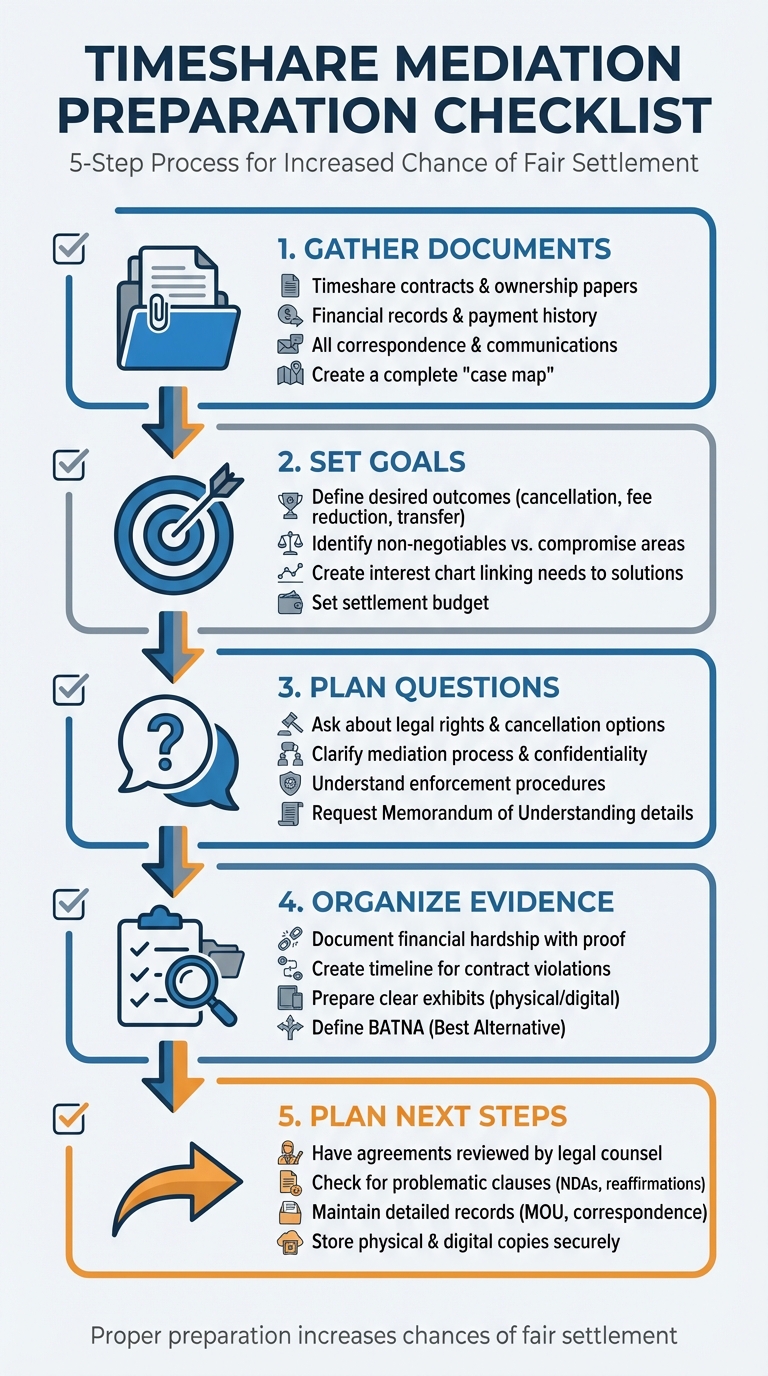
5-Step Timeshare Mediation Preparation Checklist
Collecting Required Documents
Getting all your paperwork in order before mediation is essential. A complete set of documents helps create a clear "case map", which outlines your arguments, evidence, and objectives. This ensures the mediator has a full understanding of your dispute.
"Making a case map – which is a document that outlines your statement of the case, the pertinent evidence and the goals you wish you achieve – is a smart way for parties and advocates to organize their information and ensure that each issue is addressed appropriately." – E-Mediation Services
Start gathering records early and notify the timeshare company about any documents they need to provide. This preparation not only streamlines the process but also lays the groundwork for setting your goals and strategy in the next steps.
Timeshare Contracts and Ownership Papers
Pull together your original timeshare contract, along with any amendments, addendums, or modifications. Don’t forget the deed, ownership certificates, and documents related to points or exchange programs. Review these carefully for clauses that might strengthen your case, such as rescission periods or evidence of misleading sales practices. Also, think about how the other side might interpret these documents to identify any potential vulnerabilities in your argument.
Financial Records and Payment History
Compile all financial documents, including maintenance fee statements, assessment notices, payment receipts, and mortgage agreements. Be sure to include tax forms like Form 1099-C and any records of dealings with third-party exit or resale companies. Verify the legitimacy of third-party agents with your state Real Estate Commission. Additionally, check your credit report for any foreclosure impacts, which can remain on your record for seven years and lower your credit score by over 100 points.
Correspondence and Communication Records
Keep a detailed archive of all communications with the timeshare company. This includes emails, letters, and any notes from sales presentations or complaints. Use these records to create a timeline that ties specific communications to key negotiation points, such as unfulfilled promises made during sales pitches. A well-organized communication trail not only bolsters your case but also helps the mediator grasp the history of the dispute, making it easier to reach a resolution.
Once your documents are in order, you’ll be ready to focus on setting clear goals and priorities for mediation.
sbb-itb-d69ac80
Defining Your Goals and Priorities
Once your documents are in order, it’s time to figure out exactly what you want to achieve. Start by identifying your main objective – maybe it’s gaining financial freedom from ongoing obligations – and then pinpoint the actions that align with that goal. This could mean pursuing options like a deed-back arrangement, a fee waiver, or a reduced payment plan.
Listing Your Desired Outcomes
Create an interest chart to connect your needs with possible solutions. For instance, if your primary goal is to eliminate the financial strain of your timeshare, there are several ways to achieve that: full contract cancellation, transferring ownership, cutting maintenance fees, or setting up a structured exit plan. Instead of locking onto a single result, outline a range of acceptable outcomes. You might aim for a complete cancellation with no further obligations but still be open to a transfer of ownership – especially if the timeshare company agrees to cover transfer fees or waive outstanding balances.
Think about what success means for you. As Polsky points out, “the idea of winning-at-all-costs often produces a net loss.” For example, spending $5,000 in legal fees to save $3,000 in maintenance costs doesn’t add up to a win. Determine a settlement budget by calculating your maximum exit cost or the level of financial relief you need.
Determining Negotiation Points
It’s crucial to separate your non-negotiables from the terms you’re willing to compromise on. Non-negotiables might include a full release from future liability, safeguarding your credit score, or removing all outstanding fees. Meanwhile, negotiable areas could involve payment schedules, specific amounts, or the method of contract termination.
Prioritize your goals to stay focused during negotiations. For example, your top concern might be avoiding foreclosure and protecting your credit, followed by reducing immediate costs. A longer resolution timeline might rank lower on your list. By having clear priorities, you can make strategic compromises on less critical points while standing firm on the ones that matter most. E-Mediation Services advises: “List your goals, your deal breakers, and where you’d be willing to settle for less. This will help guide your negotiations.”
Also, weigh the risks of mediation falling through – whether it’s ongoing litigation, rising fees, or foreclosure – and use that understanding to shape your negotiation strategy. With your desired outcomes and priorities in place, you’ll be ready to develop targeted questions for your mediator in the next step.
Preparing Questions for the Mediator
Once you’ve defined your goals, the next step is crafting specific questions to ask the mediator. Having a clear list of well-thought-out questions can help clarify important points and keep the mediation on track. With your documents in order and objectives outlined, these questions will help you steer the process effectively.
Questions About Legal Rights and Cancellation
Start by asking about key contract clauses, such as rescission windows and perpetuity clauses, and how they might impact your case. Clarify if discrepancies between verbal promises and written terms could strengthen your argument. Additionally, request the mediator’s assistance in presenting your settlement ideas to the timeshare developer and gauging what the company might be open to discussing.
If rising maintenance fees or special assessments are a concern, inquire how these factors could influence the negotiation. For cases involving contract violations or misrepresentations during the sales process, ask how these issues can be introduced into the discussion. Keep in mind that mediators cannot provide legal advice, so if you need a deeper understanding of your cancellation rights, consider consulting a legal professional beforehand. Firms like Aaronson Law Firm, for example, offer free consultations to help evaluate your situation and explore potential legal options.
Questions About the Mediation Process
Understanding how mediation works can help you approach the session with confidence. Ask about confidentiality rules and whether you’re giving up any rights by opting for mediation instead of going to trial. It’s also useful to know how long the mediation process typically takes, what happens if no agreement is reached in the first session, and whether informal exchanges of information could help move things forward if talks hit a roadblock.
Enforcement is another critical area to address. Before wrapping up, ask how agreements will be documented, enforced, and what the next steps are. Ensure all terms are thoroughly outlined in a signed Memorandum of Understanding. As Alexander Polsky, Owner of JAMS, emphasizes:
"The deal is done, the dance has almost come to an end. Everyone is tired. Time to go home, right? WRONG! Not until the closing stage is complete and the essential terms of the deal are reduced to a writing and signed by all parties."
If the mediation doesn’t result in an agreement, request a clear plan for what happens next, including follow-up timelines. With these steps in mind, you can move on to organizing your evidence and fine-tuning your negotiation strategy.
Organizing Evidence and Planning Your Strategy
Now that you’ve outlined your questions, it’s time to gather the evidence to back your position and map out your negotiation strategy. Solid documentation paired with a clear plan can mean the difference between reaching a favorable settlement and walking away with nothing. This step builds on your earlier preparations and helps you approach the negotiation with focus and purpose.
Documenting Financial Hardship or Contract Violations
Once you’ve collected your documents and set your objectives, the next step is to clearly outline any financial hardships or contract violations. Organize your case statement, supporting evidence, and specific goals into a well-structured summary. If your case revolves around financial hardship, compile proof such as asset and debt records, employment agreements, or medical bills that highlight your inability to keep up with timeshare payments. For contract violations, create a chronological record of events. As Alexander Polsky, Owner of JAMS, emphasizes:
"If the case is fact- and time-intensive, use a timeline, which is very effective, instead of a ten-page written overview."
Prepare clear exhibits – whether physical or digital – to strengthen your case. Put yourself in the timeshare company’s shoes to identify any weak points in your argument, such as undocumented verbal agreements or evidence that may not hold under scrutiny.
Creating a Negotiation Plan
Using your established goals and priorities as a foundation, define your Best Alternative to a Negotiated Agreement (BATNA). This is your fallback plan if mediation doesn’t work out, such as pursuing legal action or filing complaints with the Consumer Financial Protection Bureau (CFPB). Set a realistic budget and separate your "must-have" outcomes (e.g., full contract termination) from "nice-to-have" concessions (e.g., partial refunds on maintenance fees). Also, identify low-cost items you’re willing to offer that might appeal to the developer, like agreeing to a non-disclosure agreement.
Evaluate the risks of the timeshare company prevailing so you fully understand what’s at stake. As Alexander Polsky explains:
"The risk of losing, measured by the potential of compromise, and balanced with consideration of the costs/interests of both sides, is the goal of risk-based facilitative negotiation."
Maintain a professional tone throughout the process to foster productive discussions. If you’re unsure about your legal standing before mediation, Aaronson Law Firm offers free consultations to help you assess your case and explore your options. With your evidence in order and a solid plan, you’ll be well-equipped to navigate the negotiation process effectively.
Planning Your Next Steps After Mediation
Completing your mediation checklist is just the beginning. The real work often starts after the session, with follow-up actions that ensure your interests are protected. Mediation typically concludes with a Memorandum of Understanding (MOU), which might not be legally binding. If you don’t take the right steps afterward, the timeshare developer could ignore the terms, leaving you with limited options. To safeguard your settlement, here’s what you need to do next.
Having Agreements Reviewed by Legal Counsel
Before signing anything, have a legal professional review the agreement. Fran Dygulski, a well-known timeshare advocate, offers this insight:
"There are times when retaining an attorney may be necessary, but in the vast majority of circumstances, a timeshare member can work directly with their timeshare company to resolve a dispute."
However, for more complex cases, legal review is absolutely essential. An attorney can ensure the agreement aligns with state laws, particularly regarding the Public Offering Statement (POS). If you never received this document during your timeshare purchase, it could strengthen your case for an exit. Additionally, they’ll carefully examine any Non-Disclosure Agreements (NDAs) included in the settlement. These clauses are common but could limit your ability to discuss the outcome publicly.
Be cautious of clauses that require you to reaffirm your original timeshare contract. Such conditions could put you in a worse position.
"There is a huge risk that new legal contracts and affirmations can leave you in a worse position than you were in at the outset of the mediation."
If you’re unsure about your legal standing or need help reviewing the final agreement, consider reaching out to Aaronson Law Firm. They offer free consultations and specialize in timeshare law, helping identify any clauses that might create ongoing obligations.
Maintaining Proper Records
Once your agreement has been reviewed and finalized, prioritize keeping detailed records. This means saving copies of the MOU, any court-approved consent orders, and all related correspondence. Store both physical and digital versions securely to protect yourself if disputes arise later.
Maintain a detailed log of every interaction, noting dates, contacts, and discussion points. Should the timeshare company fail to honor the agreement, these records could serve as critical evidence. Compare the final agreement against your original case notes and any deal breakers to ensure nothing was missed or altered. As Citizens Advice explains:
"Legally binding means you have to stick to the terms of the agreement by law."
Checklist Summary
As you wrap up your preparation, take a moment to revisit this final checklist to ensure every task is complete.
Going into mediation without proper preparation can weaken your position. Double-check each step before your session to stay on solid ground.
Here’s a handy tracking table to keep you organized:
| Preparation Step | Purpose | Status |
|---|---|---|
| Document Collection | Gather contracts, financial records, and correspondence. | ☐ |
| Case Map | Outline the facts, evidence, and desired goals. | ☐ |
| Outcome Range | Define ideal outcomes, acceptable compromises, and deal breakers. | ☐ |
| Financial Budget | Determine maximum payment or minimum recovery amounts. | ☐ |
| Strategy Review | Evaluate case weaknesses from the opponent’s perspective. | ☐ |
| Procedural Review | Sign the Agreement to Mediate and review rules of engagement. | ☐ |
Make sure every box is checked to confirm your readiness for mediation.
Missing even one of these elements could leave you at a disadvantage. Remember, your goal is to persuade the timeshare company, not the mediator. As E-Mediation Services points out:
"A mediator cannot force parties to come to an agreement – they must voluntarily enter into one – so it is prudent for all parties to remember that as a common goal."
If you’re unsure about any part of your preparation, consider reaching out to Aaronson Law Firm. Their expertise in timeshare cases can help ensure no detail slips through the cracks.
FAQs
What’s the most important document to bring to timeshare mediation?
When attending mediation, the most crucial document to have with you is your timeshare agreement. Additionally, bring along any related evidence or correspondence. These materials are essential for clearly outlining the terms of your contract and providing support for your case.
What should I do if the timeshare company won’t provide requested records?
If the timeshare company refuses to provide the records you’ve requested, make sure to carefully document everything. Keep a record of your written requests and any responses you receive. If necessary, follow up to ensure your request is acknowledged. Should the records be essential for mediation, it might be time to consult a legal professional. They can formally request the documents on your behalf or advise you on other legal options. For specialized assistance, consider contacting a law firm experienced in handling timeshare disputes.
Is a mediation settlement legally binding right away?
A mediation settlement doesn’t automatically carry legal weight. It only becomes enforceable once all parties carefully review the terms, agree to them, and sign a formal settlement agreement. This step ensures that everyone involved explicitly approves the conditions before they are finalized.
Related Blog Posts
- Timeshare Cancellation vs. Resale: Which Option Is Better?
- Mediation vs. Arbitration for Timeshare Disputes
- Negotiation Strategies for Timeshare Owners
- Best Practices for Cross-Border Timeshare Mediation