
If you’re looking to cancel a timeshare in South Carolina, here’s what you need to know upfront: State law gives you a 5-day window to cancel your contract without penalties. This period starts either on the date you signed the contract or the date you received the required Public Offering Statement – whichever comes later. Missing this window could leave you stuck with ongoing fees and potential foreclosure risks.
Key Steps:
- Review Your Contract: Check the signing date, seller’s address, and any promised facilities.
- Gather Documentation: Collect your contract, disclosure statement, payment records, and any marketing materials.
- Send a Written Cancellation Notice: Use certified mail with a return receipt to ensure proof of delivery.
- Track Your Refund: Sellers must refund payments within 20-30 days, depending on whether you used any benefits.
- Seek Legal Help if Needed: If your cancellation is disputed or delayed, consult a timeshare attorney.
Important: Your cancellation rights cannot be waived. Acting quickly and following these steps can help you avoid long-term financial burdens.
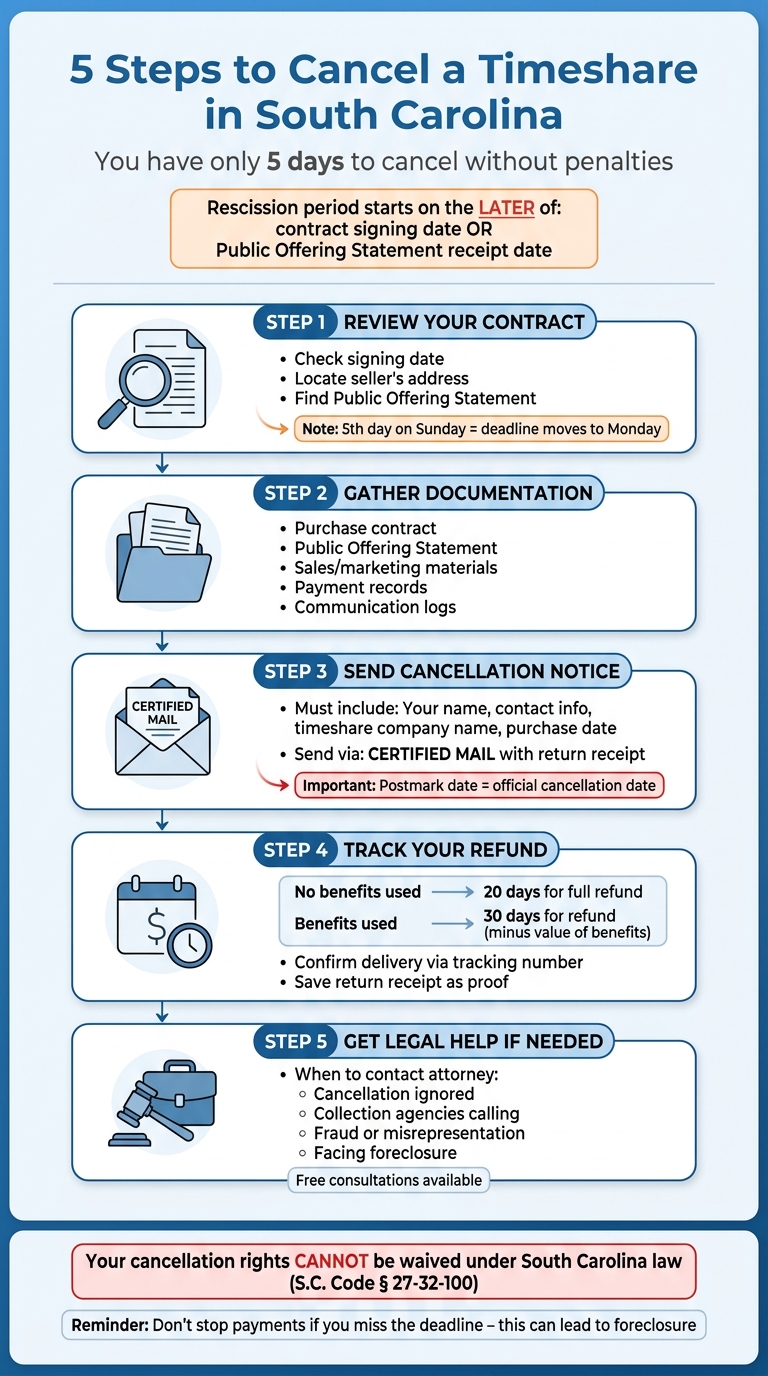
5 Steps to Cancel a Timeshare in South Carolina
Step 1: Review Your Contract and Check the Rescission Period
Start by carefully going over your timeshare contract. Pay special attention to three key details: the date you signed the agreement, the seller’s official address, and the description of the facilities that were promised to you.
Look at the signature page to confirm when you signed the contract. This date is crucial because it typically starts the 5-day rescission period. Then, locate the Public Offering Statement (also known as a disclosure agreement). Under South Carolina law (S.C. Code § 27-32-100), sellers are required to provide this document. If you received it after signing the contract, your rescission period might actually begin on the date you received the statement, not the signing date.
Make sure to record the seller’s contact address exactly as it appears in the contract. This is where you’ll need to send your cancellation notice. Using an incorrect address could cause your cancellation to be invalid. Understanding these details is critical to ensuring you meet the deadlines for canceling your timeshare.
South Carolina’s 5-Day Rescission Timeline
In South Carolina, you have five calendar days to cancel your timeshare contract. The countdown starts from the later of these two dates: the day you signed the contract or the day you received the Public Offering Statement.
One important note: if the fifth day falls on a Sunday, that day doesn’t count. For example, if your fifth day is a Sunday, your deadline will automatically move to Monday.
Calculate your deadline carefully and mark it on your calendar. To protect yourself, send your cancellation notice well before the deadline using certified mail with a return receipt. Legally, the postmark date is what matters – not the date the seller receives it.
Your Non-Waivable Cancellation Rights
South Carolina law ensures that your right to cancel within this 5-day window cannot be waived. This timeline is a safeguard for buyers, but your rights don’t end there.
If the facilities promised in your contract become unavailable and the resort cannot provide comparable alternatives, you may still have grounds to cancel – even after the rescission period has passed. Review the section of your contract that outlines the facilities and accommodations. If there’s a mismatch between what was promised and what’s actually available, you could be eligible to cancel beyond the initial 5-day period.
sbb-itb-d69ac80
Step 2: Collect Required Documentation
Once you’ve confirmed your rescission timeline, the next step is to gather all the necessary paperwork related to your timeshare purchase. Having these documents organized will not only streamline the cancellation process but also help protect your rights.
Documents You Need to Gather
Start with your purchase contract. This document is key because it includes the seller’s address for sending your cancellation notice and the date the contract was signed. Make sure to keep the original in a safe place and create copies for your records.
Next, locate the Public Offering Statement (also called a disclosure agreement). If you received this statement after signing the contract, it might extend your cancellation deadline. Attorney Amy Loftsgordon highlights its importance, as it outlines your rights and obligations as a buyer.
Gather any sales and marketing materials you were given, such as brochures, floor plans, or advertisements. These materials are especially useful if they contain promises or claims that differ from what’s in your final contract. South Carolina law, under S.C. Code § 27-32-110 and § 27-32-190, prohibits fraud and misrepresentation, so these documents could strengthen your case.
Keep proof of all payments you’ve made, including deposits, down payments, and fees. Also, document any resort benefits you’ve used, as this can impact your refund timeline. According to South Carolina law, sellers must refund your payments within 20 days if no benefits were used, or within 30 days if they were. These records will help you track and verify your refund.
Finally, log every communication you’ve had with the resort. Note dates, times, and the names of representatives you spoke with. This timeline can be critical if disputes arise during the cancellation process.
Why Complete Documentation Is Necessary
Having all your documentation in order does more than just support your cancellation request – it serves as a form of legal protection. For instance, when you send your cancellation notice via certified mail, you’ll need proof that it was sent within the legal timeframe. As attorney Amy Loftsgordon explains:
The notice of cancellation is considered given on the date postmarked so long as the notice is actually received by the seller.
Additionally, complete records shield you from relying on verbal promises made during the sales pitch. Sales representatives often make claims that aren’t included in the written contract, and without documentation, it’s nearly impossible to enforce them. Organized paperwork provides a clear, indisputable record of the facts.
If your cancellation goes beyond the standard 5-day rescission period, your documentation becomes even more critical. For example, if facilities promised in your contract are no longer available or if maintenance fees increase significantly, these could be grounds for cancellation under South Carolina law. However, you’ll need solid evidence – like your contract and related materials – to prove these claims.
Step 3: Write and Send Your Cancellation Notice
Once you’ve gathered all your documents, it’s time to draft your cancellation notice. This letter serves as the official, legally binding notification that you are canceling your timeshare contract.
What to Include in Your Cancellation Notice
Your cancellation notice needs to be straightforward and follow South Carolina law, which requires it to clearly state your intent to cancel. A simple opening like, "I am exercising my right to cancel this contract within the five-day rescission period," works perfectly.
Be sure to include these key details to identify your contract:
- Your full name (exactly as it appears on the contract)
- Your contact information
- The name of the timeshare company
- A description of the timeshare interest
- The purchase date of the timeshare
- Today’s date to establish when the cancellation is being made
Double-check the seller’s address in your purchase contract. The address for legal notices might not match the resort’s physical or mailing address. Sending your notice to the wrong address could invalidate your cancellation, so confirm this detail carefully.
Once your letter is complete, you’ll need to send it in a way that ensures proof of delivery.
Send via Certified Mail with Return Receipt
To protect yourself, send your cancellation notice using a method that provides verifiable proof it was delivered. South Carolina law considers a cancellation notice "given" on the date it is postmarked, as long as the seller receives it. This is why certified mail with return receipt requested is your safest option.
As a reminder:
If you want to cancel the purchase contract, you must notify the seller in writing by sending notice via certified mail, return receipt requested, or another verifiable means.
The return receipt acts as proof that your notice was delivered within the required timeframe. Keep copies of your signed letter, the certified mail receipt, and the return receipt as evidence. Even if a sales representative tells you that you can cancel by phone, don’t rely on verbal assurances. Written documentation is the only legally recognized method under South Carolina law to protect your rights.
Step 4: Verify Receipt and Track Your Refund
Confirm Delivery and Get Seller Acknowledgment
Once you’ve sent your cancellation notice, the next step is to ensure it reaches the seller and to keep an eye on your refund status.
Use your USPS tracking number to confirm when the seller receives your cancellation notice. This date is crucial because it starts their legal deadline to process your refund. Be sure to save the signed return receipt as proof of timely delivery.
Additionally, reach out to the seller’s surrender department and request written confirmation that your cancellation has been processed.
South Carolina’s Refund Timeline Requirements
South Carolina law outlines clear deadlines for timeshare sellers to issue refunds, which vary depending on whether you’ve used any of the benefits associated with the contract.
- If you haven’t used any benefits: The seller must refund your full payment within 20 days of receiving your cancellation notice.
- If you have used benefits (e.g., stayed at the resort): The seller has 30 days to issue a refund, deducting the value of the benefits you used.
| Refund Scenario | Legal Deadline | What You’ll Receive |
|---|---|---|
| No benefits received | 20 days after seller receives notice | Full refund of all payments |
| Benefits received | 30 days after seller receives notice | Refund minus value of benefits used |
If the refund deadline passes and you haven’t received your money, document all communication with the seller. Record details like the date, time, and the name of the representative you spoke with.
If the seller disputes your cancellation or fails to refund within the required timeframe, you may need to consult a legal professional to protect your rights under South Carolina law. Legal assistance can help ensure the process moves forward smoothly.
Step 5: Get Legal Help for Difficult Cases
Sometimes, even when you’ve followed all the proper legal steps in South Carolina, you might still face pushback. That’s when turning to a timeshare attorney is crucial. Legal professionals can step in to protect your rights and guide you through more complex situations.
When You Need a Timeshare Attorney
If your cancellation notice is being ignored or if collection agencies are still contacting you, it’s time to consult an attorney. This is especially important if there’s evidence of fraud or misrepresentation. Under South Carolina law, contracts can be challenged if material facts were illegally withheld during the sale.
Facing foreclosure because of unpaid fees? Legal counsel becomes even more important. In South Carolina, borrowers typically aren’t held responsible for deficiency judgments after a nonjudicial timeshare foreclosure, but navigating this process can be tricky. An attorney can help protect your credit and issue demand letters to stop harassing collection calls.
For those needing specific legal support, Aaronson Law Firm is one option to consider.
How Aaronson Law Firm Can Help
Aaronson Law Firm specializes in timeshare contract cancellations and offers free consultations to help you understand your options. They’ll review your contract in detail, looking for potential ways to exit your agreement. Additionally, they provide credit protection services to halt collection efforts during the cancellation process.
Their attorneys can send formal legal demand letters, which often carry more weight than standard consumer complaints. In most cases, negotiations backed by these letters lead to resolution. However, if your timeshare company refuses to honor South Carolina’s 5-day rescission period or refund requirements, Aaronson Law Firm can take legal action to enforce compliance.
"A timeshare attorney looks at how the contract was sold, not just what the fine print says." – Connor Law
Having a licensed attorney on your side ensures your rights are protected and that every aspect of your cancellation is handled professionally.
Conclusion
Canceling a timeshare in South Carolina requires quick action. The state’s five-day rescission period offers a limited timeframe to back out of your contract. As Amy Loftsgordon, Attorney at the University of Denver Sturm College of Law, points out:
The right of cancellation can’t be waived.
To increase your chances of a successful cancellation, follow these steps: review your contract immediately, gather all necessary documents, and send your cancellation notice via certified mail with a return receipt. This ensures compliance with South Carolina law. If no benefits were used, the law requires a refund within 20 days; if benefits were used, the refund must be issued within 30 days.
It’s crucial to stick to these guidelines to avoid costly mistakes. Missing the rescission deadline doesn’t mean you should stop making payments – doing so can lead to foreclosure and significant credit damage. If you face challenges, consult a timeshare attorney without delay. For instance, Aaronson Law Firm offers free consultations and specializes in timeshare cancellations, providing the legal expertise needed to navigate complex situations.
Successfully exiting your timeshare can relieve you from ongoing maintenance fees, special assessments, and financial strain. Whether you’re within the rescission period or dealing with a more complicated case, acting quickly can safeguard your finances and credit for the future.
FAQs
What if I missed South Carolina’s 5-day rescission window?
If you miss South Carolina’s 5-day rescission window, canceling your timeshare gets significantly more challenging. Once this period passes, your right to cancel usually expires, leaving you bound by the terms of the contract.
At this point, you might need legal help to assess your options. This could include proving misrepresentation or identifying other legal grounds to challenge the agreement. Reaching out to a lawyer who specializes in timeshare law, like the team at Aaronson Law Firm, can help you navigate potential solutions.
Can I cancel if the sales pitch was misleading or fraudulent?
In South Carolina, once the five-day rescission period has passed, canceling a timeshare contract based solely on a misleading or fraudulent sales pitch is generally not an option. However, if fraud was involved, you might have legal grounds to dispute the contract. Seeking advice from a timeshare cancellation attorney can help you understand your options, whether that means pursuing rescission or other legal remedies. It’s essential to follow the correct legal steps to avoid complications like foreclosure or other legal actions.
Will canceling a timeshare hurt my credit or trigger foreclosure?
Canceling a timeshare in South Carolina can have serious consequences if not handled properly. Failing to make payments or meet the terms of your contract might lead to legal actions, including foreclosure, which can hurt your credit score. To steer clear of these risks, it’s essential to follow the correct legal process. This includes sending a written cancellation notice to the seller within the legally allowed timeframe. It’s also a good idea to consult with a legal professional who has experience with South Carolina timeshare laws to ensure everything is done correctly.
Related Blog Posts
- 5 Legal Methods to Cancel Your Timeshare Contract
- North Carolina Timeshare Cancellation Laws
- South Carolina Timeshare Rescission Timeline Checklist
- Timeshare Cancellation Deadlines by State