
Buying a timeshare? Here’s what you need to know: Timeshare developers must follow financial disclosure rules to protect buyers. These rules ensure you’re fully informed about costs, fees, and payment terms before signing any agreement. Each state has its own regulations, but all developers are required to provide a Public Offering Statement (POS) detailing ownership terms, pricing, and cancellation rights. Key protections include:
- Mandatory disclosures: Total purchase price, maintenance fees, taxes, and special assessments must be clearly outlined.
- Cancellation periods: Buyers can cancel contracts within 3 to 10 days, depending on the state.
- Hidden fees: Many owners face unexpected costs like rising maintenance fees or special assessments.
Despite these protections, unclear contracts and hidden charges remain common. If you’re considering a timeshare, review all disclosures carefully and understand your rights to avoid financial surprises.
Financial Disclosure Regulations in Timeshare Agreements
Florida vs Washington Timeshare Disclosure Requirements Comparison
Timeshare agreements are governed by financial disclosure rules designed to ensure buyers fully understand their obligations before committing. While these regulations differ across regions – whether you’re buying in the United States or abroad – they share one core principle: clarity before signing.
Required Elements in Financial Disclosures
Timeshare developers are required to outline all financial obligations, covering both upfront and ongoing costs. This includes not only the total purchase price but also additional charges like closing fees and annual assessments. Buyers must also be informed about recurring expenses such as maintenance fees, property taxes, and common area costs.
A detailed operating budget is another essential component. This budget breaks down expenses like administrative costs, management fees, taxes, insurance, and maintenance. Developers are also obligated to disclose whether they maintain reserves for capital expenditures – funds set aside for major repairs – or, if not, to warn buyers about the potential for substantial special assessments in the future.
Additionally, disclosures must include information on any financing options offered, the status of the property title, and any liens or encumbrances. For timeshares using a point system, the agreement must explain how point values might change and who has the authority to make those changes. Finally, contracts must clearly specify cancellation rights and the timeline for refunds.
United States Disclosure Requirements
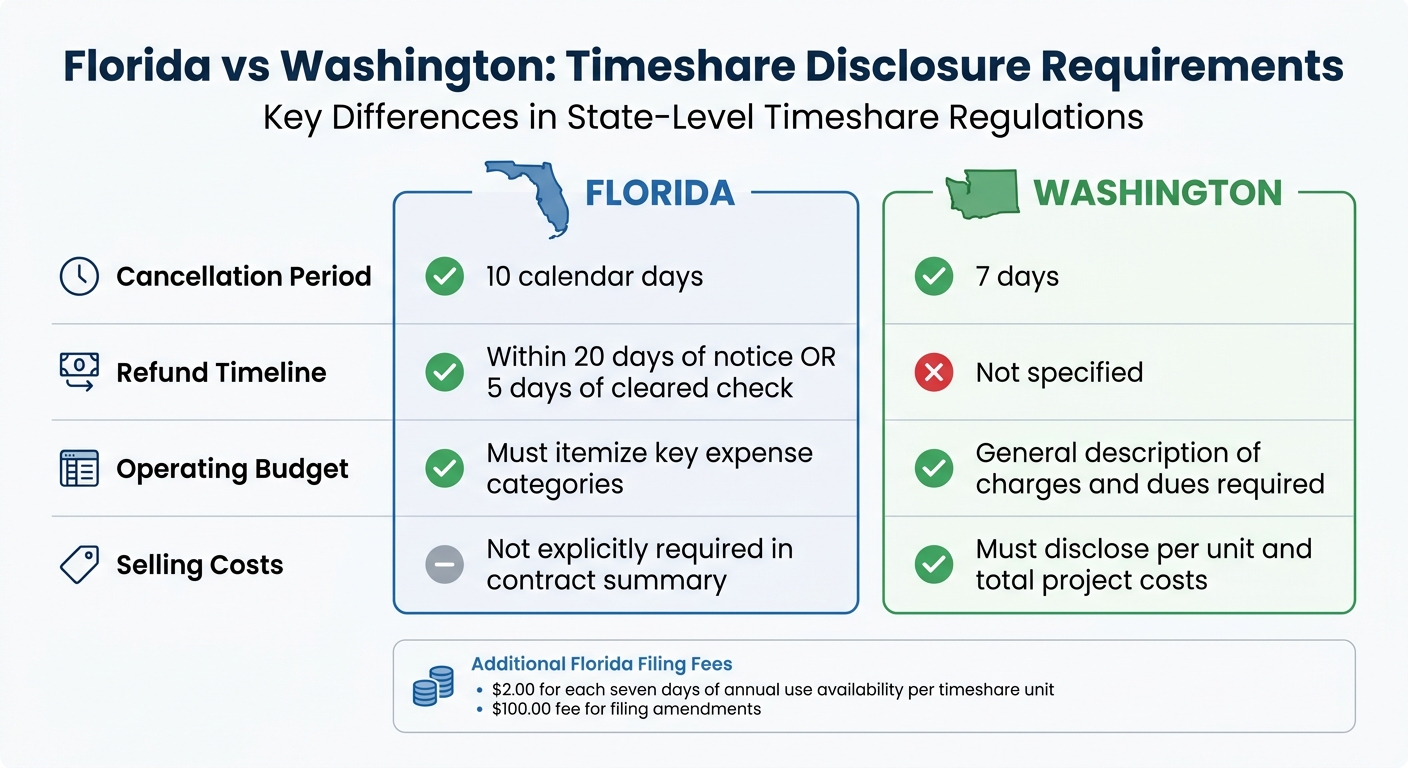
In the U.S., timeshare disclosures are regulated at the state level, leading to varying requirements across the country. For example, Florida mandates a filing fee of $2.00 for each seven days of annual use availability per timeshare unit when submitting a public offering statement, along with a $100.00 fee for filing amendments.
The table below highlights key differences between disclosure requirements in Florida and Washington state:
| Disclosure Element | Florida Requirement | Washington Requirement |
|---|---|---|
| Cancellation Period | 10 calendar days | 7 days |
| Refund Timeline | Within 20 days of notice or 5 days of cleared check | Not specified |
| Operating Budget | Must itemize key expense categories | General description of charges and dues required |
| Selling Costs | Not explicitly required in contract summary | Must disclose per unit and total project costs |
Washington state goes a step further by requiring developers to disclose selling costs and the compensation paid to the managing entity – details not explicitly required in Florida’s contract summaries.
International Disclosure Standards
Outside the U.S., countries like those in the European Union and the United Kingdom follow a more centralized approach to timeshare disclosures. The 2008 EU Timeshare Directive and the UK’s 2010 Regulations require traders to present "key information" in a standardized format before any contract is signed, ensuring that all buyers receive the same detailed financial data. This includes the total price, recurring fees, and any exchange-related costs.
Unlike U.S. practices, EU and UK laws strictly prohibit accepting payments during the 14-day withdrawal period. Additionally, all disclosure information must be provided in the buyer’s native language to ensure full understanding. For long-term holiday products, UK rules require payments to be split into equal yearly installments, preventing developers from burdening buyers with high upfront costs. If a trader fails to provide the required withdrawal form, the cancellation period can be extended by up to one year and 14 days.
sbb-itb-d69ac80
Problems with Timeshare Financial Disclosures
Even though regulations are in place to protect buyers, timeshare disclosures often fall short of providing clear and complete information. Many owners only realize the true financial commitment after signing, as confusing language and missing details lead to unexpected expenses. These gaps can create serious financial challenges for timeshare owners.
Unclear Payment Obligations
One of the most pressing issues is the lack of transparency around long-term financial commitments. Contracts frequently use terms like "common expenses", but the broad definitions make it hard for buyers to understand what they’re actually agreeing to pay. For example, Florida law defines common expenses as covering maintenance, operation, repair, overdue taxes, and "any other fees designated in the timeshare instrument." This vague wording leaves buyers guessing about their annual costs. To make matters worse, high-pressure sales tactics often discourage buyers from carefully reviewing these financial details before committing.
Hidden Fees and Special Assessments
Another common problem is the omission of certain fees from initial disclosures. Maintenance fees, for instance, tend to rise with or above inflation, yet many contracts do not include a cap on these increases. On top of that, exchange and booking fees – charges for using exchange programs or upgrading point systems – are often left out entirely. Owners are also required to pay maintenance fees and taxes regardless of whether they use their timeshare.
In some cases, these hidden costs have led to legal action. In November 2022, the FTC and Wisconsin Attorney General sued Consumer Law Group and related companies for using scare tactics to coerce older adults into paying over $90 million for exit services. These companies reportedly pressured owners by claiming their children and grandchildren would inherit permanent maintenance fees unless they acted immediately. Such practices highlight the lack of transparency that continues to plague the industry.
Financial Impact of Inherited Timeshares
Timeshares are considered real property, meaning heirs often inherit the ongoing financial responsibilities that come with them – such as maintenance fees, taxes, and special assessments. Many families are unprepared for these perpetual costs, which can create significant financial strain. For example, in 2021, Washington state filed a lawsuit against a timeshare exit company accused of charging clients anywhere from $3,000 to tens of thousands of dollars in fees. The case resulted in a $2.61 million settlement, providing restitution to affected customers. These situations often leave owners and their families seeking professional help to navigate the financial and legal challenges tied to inherited timeshares.
Legal Help for Timeshare Financial Disclosure Issues
When timeshare contracts come with hidden financial surprises, legal assistance can be essential. If disclosures are incomplete or misleading, attorneys can step in to help owners understand their rights and explore possible remedies.
Spotting Incomplete or Misleading Disclosures
Attorneys carefully examine the Public Offering Statement (POS) to ensure all required terms are clearly presented. By law, these disclosures must be in at least 10-point font, with key details highlighted in a font two points larger than the surrounding text. If crucial information – like financial obligations or cancellation rights – is buried in fine print, it could violate legal standards.
Lawyers also review the operating budget included in the disclosure statement. This document should outline management fees, taxes, insurance, and reserves for future expenses. If reserves are missing, the budget must clearly warn that the interest may be subject to "substantial special assessments." Attorneys compare these fees with the legal definition of "common expenses" to uncover any unauthorized charges. They also analyze long-term agreements, like management contracts exceeding one year, to identify financial commitments that weren’t clearly disclosed at the time of sale.
Addressing Contract Issues or Seeking Cancellation
Once disclosure problems are identified, attorneys can help owners enforce their cancellation rights. Under Florida law, buyers have the right to cancel a timeshare contract without penalty within 10 calendar days of signing the agreement or receiving all required disclosure documents – whichever comes later. If this cancellation period wasn’t properly disclosed, attorneys can determine if violations extend the deadline.
In some cases, changes to the public offering statement that negatively impact the buyer may trigger a new 10-day window to void the contract. If developers refuse to honor cancellation requests or release owners from their obligations, legal professionals can send demand letters and, if necessary, represent clients in court. Florida Statute 721.21 outlines specific remedies for buyers when developers fail to meet disclosure requirements or engage in misleading advertising.
Aaronson Law Firm‘s Expertise in Timeshare Cases

Aaronson Law Firm focuses exclusively on timeshare-related legal issues, offering specialized help for financial disclosure disputes. The firm provides free consultations to review timeshare contracts for potential violations. Their attorneys carefully audit contracts against Florida Statute 721.07, which requires clear explanations of common expenses, liens, and management terms.
The firm’s services include sending demand letters to initiate cancellations, negotiating better terms, and representing clients in court when developers resist. By focusing on contract rescission, credit protection, and other legal strategies, Aaronson Law Firm helps clients break free from long-term financial burdens tied to timeshare agreements.
Conclusion
Financial disclosure rules are in place to protect timeshare owners by requiring developers to clearly outline all charges, maintenance fees, and future cost calculations. Without this level of transparency, owners could face unexpected liens, hidden special assessments, or unexplained management fees.
"Provide full and fair disclosure to the purchasers and prospective purchasers of timeshare plans." – Florida Statutes
When developers fail to meet these legal standards, timeshare owners have options. The statutory cancellation period gives buyers the chance to review their financial commitments and cancel the agreement if necessary. This system provides a safety net for owners when disclosure obligations are not met.
Legal professionals play a key role in identifying these violations and defending owners’ rights. By carefully reviewing contracts, attorneys can pinpoint missing fee details, undisclosed liens, or improperly formatted warnings that breach state laws. Firms like Aaronson Law Firm, which specialize in timeshare law, offer free consultations to help owners determine if disclosure violations exist and whether they can cancel their contracts.
If you believe your timeshare agreement lacks the required transparency, it’s important to seek legal guidance. Proper financial disclosures are critical for protecting consumers from unexpected and long-term financial responsibilities.
FAQs
What should I look for in a Public Offering Statement (POS)?
A Public Offering Statement (POS) is your go-to document for getting a clear picture of a timeshare plan. It lays out essential details about the plan’s legal structure, ownership specifics, and terms.
When reviewing a POS, pay attention to the required elements it should include, such as:
- A summary that provides an overview of the timeshare plan.
- An index to help you navigate the document easily.
- Detailed descriptions of the plan and its components, breaking down how it works and what’s involved.
These details are crucial for understanding both your financial responsibilities and the overall framework of the agreement. Taking the time to review this information can help you make an informed decision.
Do timeshare maintenance fees have limits or caps?
Timeshare maintenance fees don’t come with any specific legal limits or caps. Instead, they’re typically calculated using methods that are reasonable and proportionate, as detailed in the timeshare agreement. These calculations can vary depending on the property and the state regulations that apply.
Can I cancel if the disclosures were missing or misleading?
Yes, it might be possible to cancel a timeshare if the required disclosures were either incomplete or misleading. Laws mandate that accurate and full disclosure must be provided, and failing to meet this obligation could give you grounds to rescind the agreement. It’s important to consult with legal professionals to understand your rights and determine the appropriate steps to take.
Related Blog Posts
- How Disclosure Timing Affects Timeshare Buyers
- Timeshare Maintenance Fees: What Developers Must Disclose
- Public Offering Statements: Legal Requirements by State
- Public Offering Statement Requirements in Florida