Timeshare disputes often leave owners feeling trapped due to aggressive sales tactics, hidden fees, and confusing contracts. Mediation offers a faster, less expensive way to resolve these issues compared to court cases. However, the process is often skewed in favor of developers, who have far more experience and resources. Here’s what you need to know:
- Common Issues: High-pressure sales, rising maintenance fees, and complex contracts often lead to disputes. Developers may exploit these situations during mediation.
- Role of Mediators: Mediators act as neutral third parties to guide negotiations, but their neutrality can sometimes be questioned due to repeat interactions with developers.
- Risks for Owners: Without proper preparation or legal support, owners may reaffirm unfavorable contracts or face additional penalties.
- Advantages of Mediation: Lower costs and quicker resolutions compared to litigation. Mediators help clarify issues and create legally binding agreements.
To protect your rights during mediation, consider legal support to level the playing field. Professionals like Aaronson Law Firm provide services such as contract reviews, demand letters, and credit protection to help owners navigate the process effectively.
Common Problems in Timeshare Disputes
Timeshare disputes don’t just arise out of nowhere. They often stem from a few recurring issues that leave owners feeling confused, financially burdened, and frustrated. These problems also explain why so many owners seek mediation and why developers often hold the upper hand during contract negotiations.
Aggressive Sales Tactics
High-pressure sales tactics frequently push buyers into making decisions they later regret. Sales agents may make verbal promises about rental income, investment opportunities, or easy booking availability – claims that often conflict with the written contract. For instance, a 2022 public records request regarding Westgate Resorts uncovered hundreds of complaints about misleading statements tied to profits and rental potential. Unfortunately, these verbal promises rarely hold up because contracts typically include clauses that void any oral representations. As Fran Dygulski from TARDA points out:
"The oral representation clause is buried in volumes of electronic fine print. Purchasers unwittingly initial that they agree they did not rely on claims made by a sales agent."
This gap between what buyers are told and what’s in the contract often leads to unmet expectations. Such tactics make mediation critical, as it brings in a neutral party to help navigate the fallout.
Undisclosed Fees and Rising Maintenance Costs
Many timeshare owners feel trapped by perpetual maintenance fees that only seem to climb over time – even if they’re not using the property. Adding to the frustration, selling the timeshare can be nearly impossible due to outstanding loans or a lack of interested buyers. While sales agents may suggest renting out the property to cover costs, developers can penalize owners for what they call "commercial activity." On top of that, invoices often include small "voluntary" fees that owners unknowingly pay. If owners stop paying altogether, developers may report them to credit agencies, damaging their credit scores over a property they no longer want.
Confusing Contract Terms
Timeshare contracts are infamous for their complexity. Many contain mandatory Alternative Dispute Resolution (ADR) clauses, which require mediation before any legal action can proceed. Buyers also often sign a Public Offering Statement they’ve never read, potentially putting them at risk of violating certain statutes. To make matters worse, consumers typically don’t get access to the booking system until after the rescission period has ended, leaving them unable to spot availability issues in time to cancel. The Centerstone Group warns:
"There is a huge risk that new legal contracts and affirmations can leave you in a worse position than you were in at the outset of the mediation."
The intricate nature of these contracts is often used by developers during mediation to pressure owners into reaffirming their agreements, which can further weaken their legal position. These challenges underscore the importance of having neutral mediators to protect consumer rights during disputes.
sbb-itb-d69ac80
How Mediators Protect Consumer Rights
The imbalance of power between timeshare owners and developers often makes dispute resolution tricky. That’s where mediators step in. Acting as neutral third parties, they help ensure negotiations are conducted fairly. For owners, understanding the mediator’s role is key to recognizing when the process is balanced – or when it might lean in the developer’s favor.
Maintaining Neutrality
Neutrality is what makes mediation effective. Many qualified mediators come from respected organizations like JAMS ADR or the American Arbitration Association (AAA), which maintain strict professional standards. These mediators guide discussions, ensuring both sides get a fair chance to present their case.
However, timeshare owners should be mindful of the "repeat customer" phenomenon. Developers often hire the same mediators repeatedly, which could give them insight into the mediator’s preferences or tendencies. While this doesn’t necessarily mean bias, it highlights why having legal counsel during mediation is important. Developers almost always come prepared with experienced legal teams, so owners should consider doing the same.
Promoting Clear Communication
Mediation offers a more relaxed environment compared to formal court proceedings, which can be intimidating. Sessions often take place in private offices or conference rooms, allowing for open and honest discussions. This informal setting can speed up resolutions by sidestepping the rigid procedures of a courtroom.
Mediators often structure discussions around the "5 Ws" – what was purchased, where, from whom, when, and why. This approach helps owners articulate their complaints clearly. Keeping detailed records of all interactions – like dates, names, and the nature of conversations – can also bolster an owner’s case, especially when challenging clauses that dismiss verbal promises made during sales pitches. This open dialogue lays the groundwork for agreements that genuinely uphold consumer rights.
Creating Legally Binding Agreements
Mediation isn’t just about talking – it’s about action. When a settlement is reached, it can be formalized into a legally binding agreement. This is a powerful tool for consumers, as it ensures developers are held accountable to the terms agreed upon during mediation.
That said, owners must tread carefully. There’s a risk of accidentally reaffirming their original contract, which could weaken their legal standing. This makes it even more critical for owners to fully understand the terms before signing anything, ensuring their rights remain protected.
Mediation Advantages: Lower Costs and Faster Results
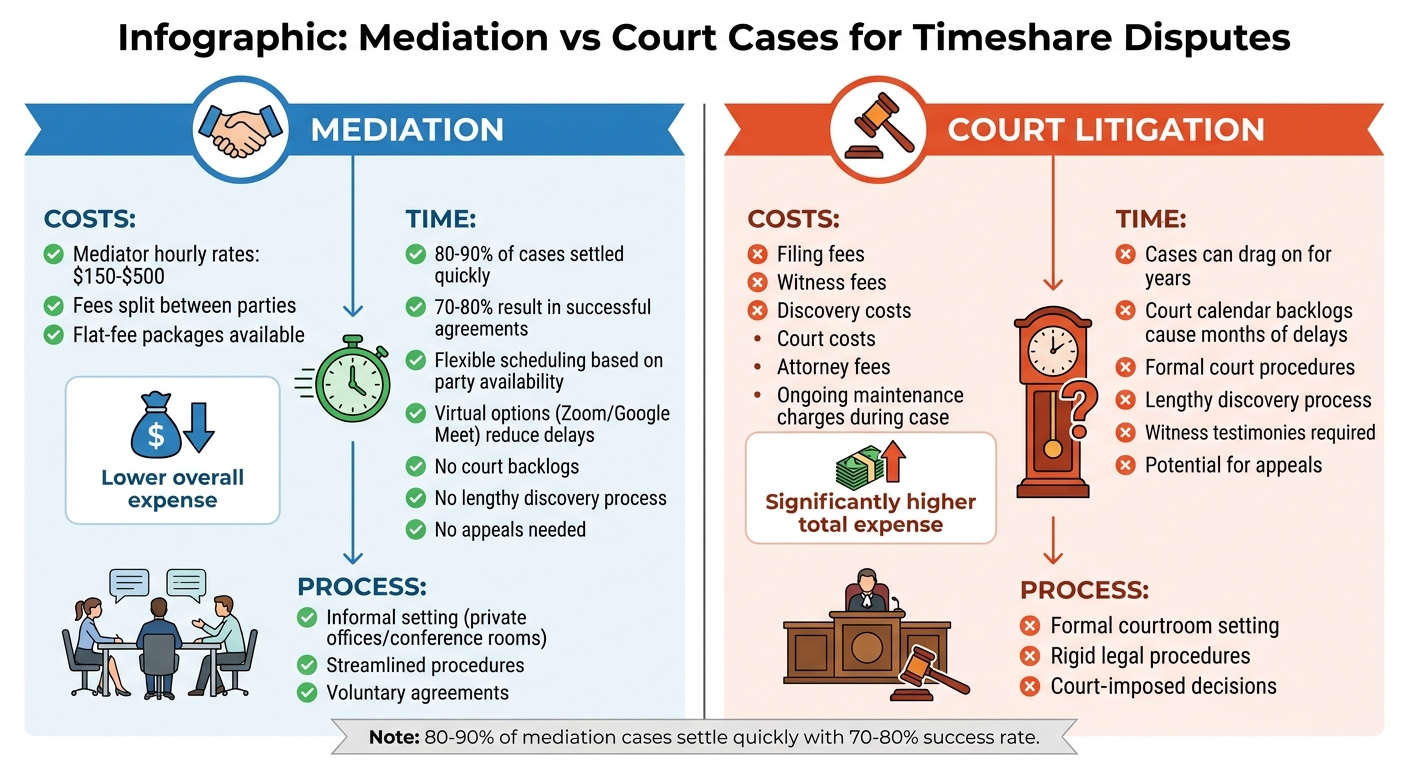
Mediation vs Court Cases for Timeshare Disputes: Cost and Time Comparison
Mediation offers a practical way for timeshare owners to resolve disputes while avoiding the hefty expenses and time-consuming nature of court cases. By cutting down on both financial and time investments, it provides a more efficient path to safeguarding rights.
Lower Costs Than Court Cases
One of the biggest draws of mediation is its cost-effectiveness. Mediators typically charge hourly rates between $150 and $500, depending on their experience and location. These fees are often split evenly between the disputing parties, making it a shared expense. Some mediators even offer flat-fee packages that cover a specific number of sessions, giving participants a clear idea of costs upfront.
Court cases, on the other hand, can quickly rack up expenses. Filing fees, witness fees, discovery costs, and attorney fees can add up fast. Add to this the ongoing maintenance and assessment charges that may accumulate during a prolonged legal battle, and the financial toll becomes even heavier.
"Mediation doesn’t cost as much as a lawsuit, which will certainly require you to incur filing fees, witness fees, court costs, and other amounts before you even get to timeshare attorney fees."
This affordability makes mediation an attractive option, especially when paired with its time-saving benefits.
Quicker Resolution Times
Beyond saving money, mediation is significantly faster. While court cases can drag on for years, mediation resolves disputes much more efficiently. In fact, 80–90% of cases are settled quickly, with 70–80% resulting in successful agreements that bypass the need for appeals.
The speed advantage comes from its flexibility and streamlined process. Unlike courts, which often have backlogged calendars causing months of delays, mediation sessions are scheduled based on the availability of the parties and the mediator. Virtual options like Zoom or Google Meet further reduce delays by eliminating travel time. Additionally, mediation avoids the formalities of court, such as lengthy discovery processes and witness testimonies.
Since agreements are voluntary and mutually crafted, there’s no need for appeals, further simplifying and speeding up the process.
Aaronson Law Firm‘s Mediation and Cancellation Services
Aaronson Law Firm takes a focused approach to protecting consumer rights, offering mediation and cancellation services designed to address the unique challenges of timeshare contracts.
Free Consultations and Demand Letters
The firm provides a free consultation to evaluate your timeshare contract and pinpoint any potential violations. Following this review, they prepare formal demand letters that clearly outline your claims. These letters are designed to push developers toward negotiation, avoiding the need for costly litigation.
Full Legal Support and Credit Protection
Aaronson Law Firm also emphasizes credit protection, operating under 15 USC 1681 to shield clients from credit damage. Their legal demand letters are crafted to reduce the risk of delinquency reports that might arise during disputes or contract cancellations.
"Emphatically, without the ability to sue or countersue the timeshare developer through a timeshare lawyer you have NO legal protection or leverage."
– Aaronson Law Firm
If mediation doesn’t yield results, the firm is ready to provide full litigation support, using the legal system to pursue contract rescission when necessary.
Client-Focused Resolution Strategies
Every case is handled with a tailored strategy that prioritizes consumer rights. Whether the goal is canceling the contract outright, reducing fees, or addressing burdensome maintenance costs, the firm adapts its approach to fit the specifics of your situation. Factors like how long you’ve owned the timeshare, your financial exposure, and the strength of your claims are all considered when crafting a resolution plan.
Once you engage their services, you’ll receive a welcome letter with direct contact information for your attorney, ensuring open and consistent communication. With a deep focus on timeshare law, Aaronson Law Firm applies its expertise to maximize the chances of a favorable outcome. Their strategies ensure your rights are protected at every stage of the mediation process.
Conclusion
Third-party mediators play an important role in timeshare disputes by staying neutral, encouraging open communication, and helping create agreements that hold up legally. Mediation often resolves issues faster and at a lower cost compared to going through the courts.
That said, timeshare developers have a clear edge in these proceedings. They handle thousands of cases each year, while many owners step into mediation unprepared and without representation. This uneven playing field makes having professional legal support absolutely crucial. Preparation is key to standing your ground.
"Timeshare companies go for the throat of the client 100% of the time and typically end up winning." – Centerstone Group
To protect yourself, take these steps before mediation: carefully review your contract for clauses requiring ADR or binding arbitration, document all details of your dispute, and – most importantly – never face mediation without experienced legal counsel. By recognizing the mediator’s neutral role and having the right legal support, you can push back against the developer’s advantage.
Aaronson Law Firm offers the expertise needed to handle these challenging disputes. From free consultations to formal demand letters, credit protection, and full litigation support, they provide tools to protect your rights. Their personalized approach ensures you’re equipped to challenge developers who rely on their repeat-experience advantage in ADR cases.
FAQs
How do I know if a mediator is truly neutral?
To make sure a mediator remains neutral, check that they have no conflicts of interest, have received professional training in mediation, and adhere to ethical guidelines aimed at ensuring impartiality and fairness during the dispute resolution process.
What should I bring to timeshare mediation to protect myself?
When heading to a timeshare mediation, make sure to gather and bring all relevant documents that back up your case and safeguard your rights. These might include contracts, payment receipts, emails or letters exchanged with the timeshare company, and evidence of any misleading or deceptive actions you’ve experienced. Having these materials on hand ensures you can present your concerns effectively, making it easier to work toward a fair outcome.
Can mediation accidentally lock me into worse contract terms?
Yes, mediation can sometimes result in less favorable contract terms if not handled properly. This risk arises if you accept terms that don’t serve your best interests or if the mediation clause is enforceable in a way that limits your options. To safeguard yourself, it’s important to approach mediation thoughtfully, participate in good faith, and ensure every step of the process protects your rights.
Related Blog Posts
- Mediation vs. Arbitration for Timeshare Disputes
- How Consumer Protection Laws Impact Timeshare Complaints
- Case Study: Winning a Federal Timeshare Dispute
- Best Practices for Cross-Border Timeshare Mediation