
Canceling a timeshare contract due to fraud is challenging but possible if you can prove specific legal elements. Fraud claims require evidence of false promises, the seller’s knowledge of deceit, intent to mislead, your reliance on those statements, and financial harm caused. Timeshare contracts often include waivers and disclaimers, making verbal assurances hard to contest. However, courts may still consider verbal promises if backed by strong documentation.
Key steps to build your case:
- Gather all sales materials, contracts, and financial records.
- Document discrepancies between promises and reality (e.g., buy-back programs or resale value).
- Consult a specialized attorney to navigate the legal process and strengthen your claim.
Proving fraud requires solid evidence and expert guidance. Without these, verbal complaints alone won’t hold up legally.
Legal Requirements for Proving Fraud in Timeshare Contracts
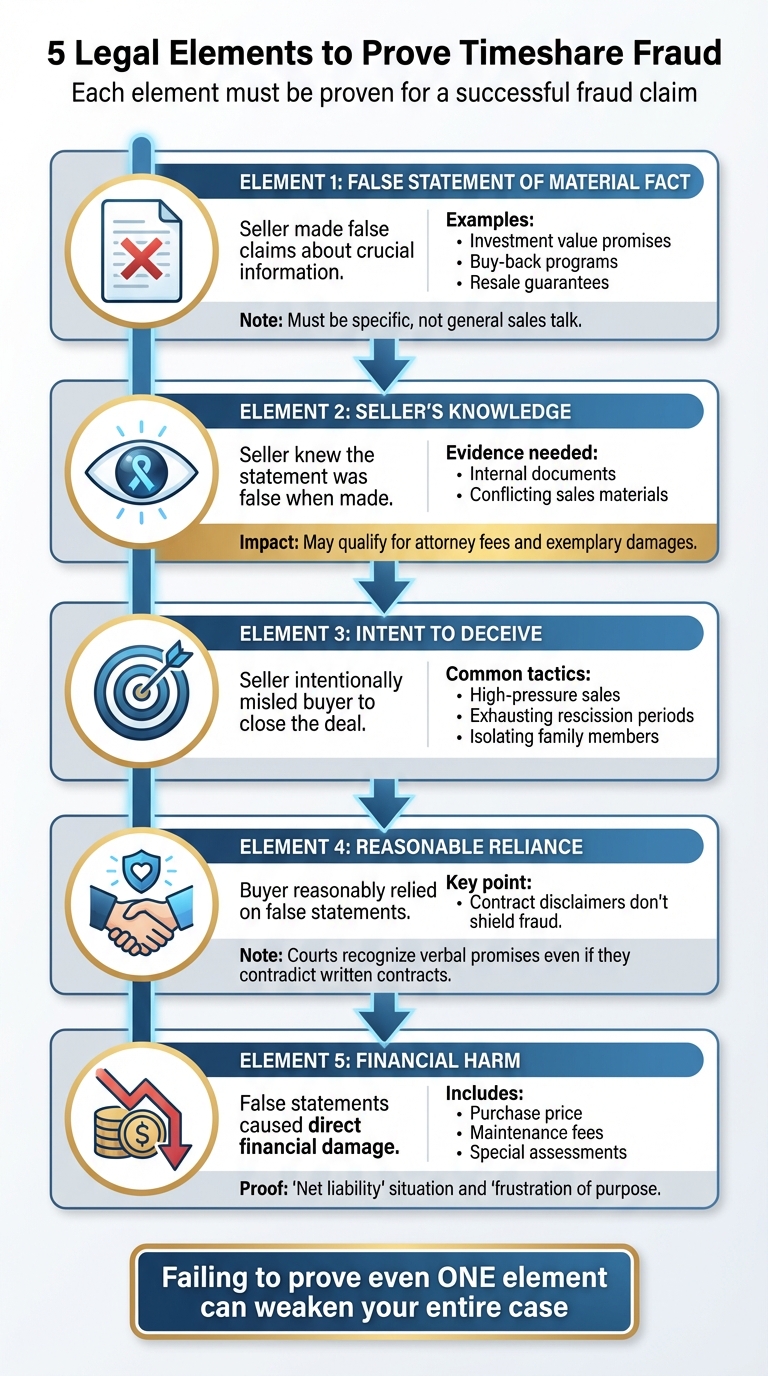
5 Legal Elements Required to Prove Timeshare Fraud
To challenge a timeshare contract on the grounds of fraud, you must prove five specific legal elements. This legal standard, often referred to as common law fraud or fraud-in-the-inducement, is defined as:
"the intentional use of deceit, a trick or some dishonest means reasonably relied upon to deprive another of money, property or a legal right."
– Aaronson Law Firm
Each element is critical – failing to establish even one can weaken your case. These five elements form the foundation of any fraud claim and provide the framework for addressing specific misrepresentations.
1. False Statement of Material Fact
A material fact refers to information crucial to your decision to purchase. In timeshare disputes, this often involves false claims about the nature of the timeshare or its benefits. Examples include assurances that the timeshare is a solid real estate investment, will increase in value, or can be easily resold, along with promises of developer buy-back programs or subleasing opportunities.
For a claim to hold, the falsehood must be clear and central to the agreement. General sales fluff like "you’ll love it here" doesn’t count. However, specific promises about financial returns or property features do.
2. Seller’s Knowledge of the False Statement
You must show that the seller knew the statement was false at the time it was made. Evidence such as internal documents or conflicting sales materials can support this. For instance, if sales representatives promoted a "buy-back program" that company records confirm never existed, it demonstrates the seller’s awareness of the deception.
Evidence of deliberate misconduct strengthens your case. In many states, consumer protection laws allow for the recovery of attorney fees or even exemplary damages if you can prove the seller knowingly engaged in deceptive practices.
3. Intent to Deceive the Buyer
It’s not enough that the seller made a false statement – they must have done so intentionally to persuade you to sign the contract. This intent often becomes evident through high-pressure sales tactics. A common example is encouraging buyers to "test" the unit during a trip, strategically exhausting the 10-day legal rescission period available in many states.
Other aggressive tactics, like isolating family members during presentations, taking buyers to remote locations without transportation, or conducting overly lengthy and coercive sales sessions, further highlight deceptive intent.
4. Buyer’s Reasonable Reliance on False Statements
You must prove that you reasonably relied on the seller’s false claims when agreeing to purchase the timeshare. This can be challenging in cases where contracts include disclaimers or waivers meant to limit the seller’s liability. However, these provisions do not shield fraudulent behavior:
"One cannot absolve himself of fraudulent conduct by inserting disclaimers or waivers in a contract… as this would constitute an illegal provision, which is by definition unenforceable."
– Aaronson Law Firm
Courts often acknowledge that buyers can rely on verbal promises made during sales presentations, even if those promises contradict the written contract.
5. Financial Harm Caused by the Fraud
Finally, you must link the false statements to direct financial harm. This includes not only the initial purchase price but also ongoing costs like maintenance fees and special assessments. Many timeshare owners find themselves in a "net liability" situation – where the financial burden outweighs the benefits.
For example, if you can show that the timeshare membership portal consistently fails to offer bookings at preferred times while non-members easily secure those dates through third-party sites, it demonstrates both financial harm and what courts refer to as "frustration of purpose." This evidence underscores how the contract failed to deliver its promised value.
How to Identify and Document Misrepresentation
1. Different Types of Misrepresentation
Misrepresentation can take different forms, and courts typically categorize it into three types: fraudulent, negligent, and innocent. Fraudulent misrepresentation involves intentional deceit – this happens when a sales representative knowingly makes false claims to persuade you into signing. Negligent misrepresentation, on the other hand, occurs when a seller makes false statements without verifying their accuracy, showing a lack of reasonable care. Innocent misrepresentation happens when a seller provides incorrect information while genuinely believing it to be true.
The critical difference lies in the intent behind the misrepresentation. Fraudulent cases require proof that the seller deliberately misled you, while negligent cases only require showing that they failed to exercise reasonable care. Once you’ve identified the type of misrepresentation, the next step is gathering solid evidence to back your claim.
2. Evidence You Need to Prove Your Case
Proper documentation is essential when building your case for any type of misrepresentation. The stronger your evidence, the better your chances of demonstrating the issue effectively.
Start by collecting your sales contract and any related offering documents. If these documents are missing, that absence can sometimes work in your favor by supporting your claim.
Preserve all marketing materials – this includes brochures, emails, and any written communication. Compare the destinations or benefits showcased in these materials with what’s actually available through your member portal. Take screenshots of booking discrepancies to highlight situations where preferred accommodations are unavailable to members but open to non-members on platforms like Expedia or Priceline. This can point to what courts often refer to as a "failure of consideration."
Document details from the sales presentation itself, such as how long it lasted, where it took place, whether your family was separated, and any verbal promises made. These could include assurances about buy-back programs, exclusive access, rental income potential, or investment growth. Even if these promises contradict the written contract, courts may still recognize them as reasonable grounds for reliance. Finally, gather financial records showing ongoing costs like maintenance fees, special assessments, and your total spending compared to any actual benefits received. This comprehensive evidence package will help substantiate your claim effectively.
sbb-itb-d69ac80
How to Build Your Fraud Case
1. Gather and Organize Your Documents
Start by creating a clear and detailed timeline of events. Include everything from the initial sales presentation to payments made, communications exchanged, and any attempts to cancel. This timeline will help pinpoint when and how the fraud occurred.
Consider building a "Promises vs. Reality" table to document discrepancies. For instance, if you were promised ocean-view units but ended up with parking lot views, list that. Add a third column to include evidence, such as screenshots, emails, or specific contract clauses, to back up your claims.
Next, organize your financial records to show the total expenses versus the benefits you’ve received. Include receipts for down payments, loan documents, maintenance fee statements, and any special assessment charges.
If you’ve tried to cancel before, gather all related documents. This might include your cancellation letter, proof of certified mail delivery, and any rejection notices from the developer. Even unsuccessful attempts to cancel can strengthen your case by showcasing the developer’s refusal to honor legitimate requests.
Once everything is in order, consult a specialized attorney to analyze your case and formulate a strategy.
2. Work with a Timeshare Cancellation Attorney
Fraud cases involving timeshares require legal expertise. Developers often rely on specific tactics to counter cancellation claims, so having an attorney who understands these strategies is crucial. Aaronson Law Firm, for example, offers free consultations to assess whether your case meets the criteria for a fraud-based cancellation.
Unlike timeshare exit companies, licensed attorneys are bound by a fiduciary obligation to prioritize your interests. They can issue formal demand letters to stop collection efforts, protect your credit score, and push for contract termination.
"The same tactics that they use to sell you on a timeshare, and stall you once you have purchased one are no different than the tactics they use when you try to cancel your timeshare. We know those tactics and how to maneuver around and through them." – Aaronson Law Firm
Experienced attorneys can identify the most critical pieces of evidence in your case. They also have the ability to subpoena internal developer records, which can be pivotal. For example, Aaronson Law Firm helped clients achieve a full contract cancellation within just four months of initial contact.
"They were able to get us completely out of our contract in 4 months from us contacting them. You will be in great hands with this team." – Katelynn C.
Once you have legal guidance, you can begin exploring your options.
3. Determine Your Legal Options
After gathering evidence and consulting an attorney, it’s time to decide on your next steps. If you’re still within your state’s rescission period (typically 3 to 15 days), you can send a formal rescission letter to cancel without needing to prove fraud. Unfortunately, most people discover the fraud after this window has passed.
For cases beyond the rescission period, your attorney can draft a legal demand letter. This letter will outline the fraudulent statements made by the developer and formally request contract cancellation. Often, this step encourages developers to negotiate rather than risk litigation. The letter should include specific misrepresentations, reference relevant laws, and demand termination of the contract and any related debt.
If negotiation fails, litigation may be necessary. Your attorney can file a formal legal claim detailing your fraud allegations and exposing any weaknesses in the developer’s practices, such as mismanagement of trust funds or conflicts of interest. Filing official complaints may also help document the developer’s deceptive behavior, adding weight to your case.
Conclusion
Proving fraud in a timeshare cancellation case requires more than just verbal claims – it demands solid documentation and legal expertise to establish these five key elements: false statements, seller knowledge, intent to deceive, your reasonable reliance, and financial harm. Contracts filled with waivers make it nearly impossible to rely on verbal promises alone.
The strength of your case lies in the evidence you collect. Sales materials, contracts, financial records, and correspondence are essential pieces of the puzzle. Developers often employ high-pressure tactics even during the cancellation process, making it critical to have someone on your side who understands how resorts operate and knows how to counter their strategies effectively.
This is where licensed attorneys come in. They bring a unique advantage by having a fiduciary duty to protect your interests. They can subpoena records, issue demand letters to safeguard your credit, and uncover weaknesses like mishandled trust funds or conflicts of interest.
"Quite often, one’s signature on a timeshare contract is obtained by fraud. And the debt that it creates generally outweighs any benefit to the owner. But to address it properly, it is imperative that you retain a licensed attorney." – Aaronson Law Firm
If you suspect fraud, don’t navigate this alone. Consulting a timeshare cancellation attorney is a crucial first step. Aaronson Law Firm offers free case evaluations to help determine whether your situation qualifies for fraud-based cancellation and to develop a tailored legal strategy. Taking this step can turn verbal misrepresentations into a strong, evidence-backed case.
FAQs
What kind of evidence is needed to prove fraud in a timeshare cancellation case?
To prove fraud in a timeshare cancellation case, you’ll need solid evidence showing misrepresentation or deceptive practices during the sales process. This might involve false promises, misleading information, undisclosed fees, or differences between what was promised and what was actually delivered.
Some of the most important pieces of evidence include:
- Copies of contracts and written agreements: These can highlight discrepancies or clauses that were not properly disclosed.
- Email or written communication records: Messages exchanged with the timeshare company may reveal misleading statements or broken promises.
- Marketing materials or sales presentations: Brochures, slides, or videos that contain exaggerated or false claims can serve as proof.
- Witness statements or personal notes: Accounts from others present during the sales process or your own detailed notes can strengthen your case.
Organizing this evidence is a key step in building your argument. If you suspect you’ve been misled, reaching out to a legal professional who specializes in timeshare cancellations is a smart move. They can guide you through the process and help protect your rights.
Can verbal promises override disclaimers in a timeshare fraud case?
Yes, verbal promises can play a role in supporting a fraud claim, even when a contract contains disclaimers. To establish fraud, you need to prove that the verbal statements were knowingly false or made with reckless disregard for the truth, with the intent to mislead. Additionally, you must show that you relied on these promises when making your decision, and that this reliance led to harm. While disclaimers might make the situation more complex, they don’t provide automatic protection against fraudulent conduct under the law.
What can I do if the timeshare rescission period has already passed?
If the deadline to cancel your timeshare has already passed, don’t lose hope – there may still be legal avenues to explore. Timeshare contracts can sometimes be challenged and canceled if there’s evidence of fraud, misrepresentation, or unfair terms. These situations often involve deceptive sales practices, misleading information, or contract clauses that are excessively one-sided.
To navigate this, it’s essential to consult a legal professional who specializes in timeshare law. Experts, such as those at Aaronson Law Firm, have experience in helping clients address these issues. They can assess your situation, explain your options, and guide you through the process to safeguard your rights and finances.
Related Blog Posts
- 5 Legal Methods to Cancel Your Timeshare Contract
- How Courts Handle Deceptive Timeshare Sales
- How to Document Timeshare Misrepresentation
- Misrepresentation vs. Fraud in Timeshare Law