When courts deal with timeshare fraud cases, they focus on two main types of damages: compensatory and punitive. Compensatory damages aim to reimburse victims for their financial losses, while punitive damages penalize fraudulent behavior to discourage future misconduct. Here’s a quick breakdown:
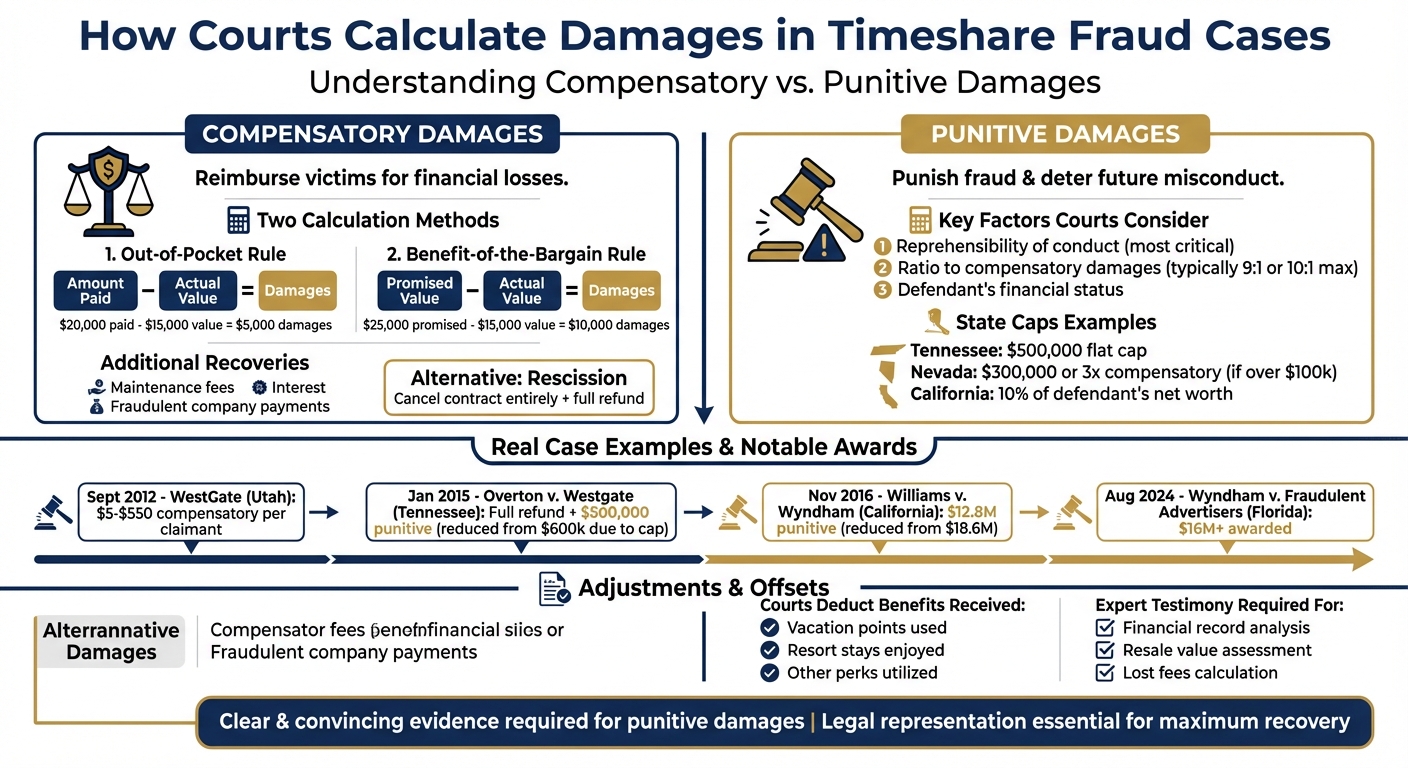
- Compensatory Damages: Calculated using two methods:
- Out-of-pocket rule: The difference between what victims paid and the actual value of the timeshare.
- Benefit-of-the-bargain rule: The gap between the promised value and the actual value.
- Additional recoveries may include maintenance fees, interest, and payments to fraudulent companies.
- Rescission: Courts may cancel the contract entirely, refunding victims and eliminating future obligations.
- Punitive Damages: Awarded for intentional fraud to punish wrongdoers. These are calculated based on the severity of misconduct, the harm caused, and the defendant’s financial status. States often cap these damages.
Courts also adjust damages for any benefits victims received, such as vacations taken under the timeshare agreement. Expert testimony often plays a key role in determining accurate damage amounts. Legal representation is essential for navigating these cases and maximizing recovery.
How Courts Calculate Damages in Timeshare Fraud Cases
Compensatory Damages in Timeshare Fraud Cases
Compensatory damages aim to restore victims financially to the position they were in before signing the contract.
"Compensatory [damages] are pursued when the goal of the civil lawsuit is to compensate the plaintiff or victim of fraud for any financial losses that actually occurred as a result of the fraud." – Karrass Law
Economic Damages
Economic damages address specific financial losses that victims can prove through documentation. Courts typically calculate these damages using one of two methods: the out-of-pocket rule or the benefit-of-the-bargain rule.
The out-of-pocket method determines damages based on the difference between what the victim paid and the timeshare’s actual market value. For example, if someone paid $20,000 for a timeshare worth only $15,000, their financial loss would be $5,000. On the other hand, the benefit-of-the-bargain method looks at the gap between the value promised by the seller and the timeshare’s true value. In the same scenario, if the seller claimed the timeshare was worth $25,000 but its actual value is $15,000, the victim would be entitled to $10,000 – a larger compensation.
Victims may also recover additional expenses like maintenance fees, interest, and payments made to fraudulent exit or resale companies. A notable example comes from a September 2012 Utah case involving WestGate Resorts, where a jury awarded claimants actual economic damages ranging from $5 to $550 for fraudulent vacation certificate claims.
In some cases, courts go beyond monetary compensation by offering to nullify the contract entirely.
Rescission-Based Recovery
Rescission provides an alternative remedy by effectively canceling the contract. This approach nullifies the agreement, erasing all future obligations and requiring the developer to refund the full purchase price. When combined with economic damages, rescission ensures victims are fully compensated for the financial harm caused by fraud.
One example is the January 2015 ruling by the Tennessee Court of Appeals in Nathan B. Overton et al. v. Westgate Resorts, LTD., L.P. et al. The court allowed plaintiffs to rescind their timeshare contract after proving fraud and violations of the Tennessee Time-share Act. Westgate was ordered to repay the full purchase amount, returning the victims to their financial position before the contract.
To qualify for rescission, victims must demonstrate material misrepresentation or fraudulent inducement during the sales process. Courts also apply the "clean hands" doctrine, which means plaintiffs must act in good faith. Victims should document specific false claims made during sales presentations – such as exaggerated promises about resale value or rental income – and avoid actions that could unnecessarily worsen their losses.
Punitive Damages: Deterring Fraudulent Behavior
While compensatory damages are designed to make up for losses, punitive damages focus squarely on the misconduct itself. Their purpose is to punish intentional wrongdoing and discourage similar fraudulent practices in the future. Together, compensatory and punitive damages safeguard consumers while sending a strong message against fraud. Courts only award punitive damages when there’s clear and convincing evidence of fraud, malice, or oppression – not for simple negligence or honest mistakes.
The idea is to impose a financial penalty significant enough to force companies to rethink their behavior. As stated in Rufo v. Simpson:
The purpose of punitive damages is not served by financially destroying a defendant. The purpose is to deter, not to destroy.
For large corporations, small fines often get brushed off as just another cost of doing business. That’s why courts aim to set punitive awards at levels that truly impact a company’s bottom line.
Factors Courts Consider for Punitive Damages
When determining punitive damages, courts weigh several factors. Among these, the reprehensibility of the misconduct is considered the most critical. Judges evaluate whether the fraud was intentional, whether it targeted vulnerable individuals like the elderly, and whether it was part of a broader pattern of behavior rather than a one-off incident.
For example, in the November 2016 case Williams v. Wyndham Vacation Ownership, a San Francisco jury labeled the company’s deceptive practices as "highly reprehensible." The jury initially awarded $18.6 million in punitive damages, though this was later reduced to $12.8 million in March 2017.
Another key consideration is the ratio between punitive and compensatory damages. The U.S. Supreme Court has suggested that punitive awards exceeding a single-digit ratio (such as 9:1 or 10:1) rarely meet due process standards. However, courts may allow higher ratios in extreme cases. In Overton v. Westgate Resorts, the punitive damages – 16 times the compensatory damages – highlighted the court’s intent to penalize severe misrepresentations and underscore the gravity of the misconduct.
Courts also take the defendant’s financial status into account. Often, this involves a bifurcated trial to ensure the punitive award is both an effective deterrent and proportionate to the defendant’s ability to pay. In California, for instance, punitive damages are typically capped at 10% of a defendant’s net worth.
Examples of Punitive Damage Calculations
Different states impose varying limits on punitive damages. In Nevada, punitive damages are capped at $300,000 if compensatory damages are under $100,000, or at three times the compensatory amount if they exceed $100,000. Tennessee, by contrast, enforces a flat cap of $500,000. For instance, in the Overton v. Westgate case, the Tennessee Court of Appeals reduced a $600,000 punitive award to the $500,000 cap, as the injury occurred after the state’s tort reform took effect on October 1, 2011.
The September 2012 Utah case WestGate Resorts, Ltd. v. Adel offers further insight. In this case, a jury awarded 15 claimants $66,666.67 each in punitive damages, totaling $1 million, despite actual economic damages ranging from just $5 to $550 per claimant. However, the Utah Supreme Court vacated the entire punitive award because the plaintiff’s attorney improperly encouraged the jury to base damages on harm to 3,000 non-party victims – a clear violation of constitutional rules against punishing defendants for harm caused to individuals not involved in the lawsuit.
In August 2024, a Florida federal court awarded Wyndham Vacation Ownership over $16 million in a case involving advertising fraud by third-party individuals. This hefty penalty highlights the court’s determination to crack down on deceptive practices in the timeshare industry. Collectively, these examples demonstrate how punitive damages play a crucial role in combating fraud and holding wrongdoers accountable.
sbb-itb-d69ac80
Adjustments and Offsets in Damage Calculations
Offsets for Benefits Received
When calculating damages, courts take into account the actual value of benefits that consumers received under a timeshare agreement. For instance, if a consumer used vacation points, stayed at resorts, or enjoyed other perks, these benefits are factored into the final damage calculation.
The goal is to determine the difference between what was paid and the value that was actually received. A notable example is the November 2022 case of Zwicky v. Diamond Resorts Mgmt., where the U.S. District Court for the District of Arizona approved a $13 million settlement for about 25,000 timeshare owners. These owners had been charged hidden corporate overhead fees from 2011 to 2022. The settlement fund was distributed on a pro rata basis, meaning refunds were proportional to the amount each class member had paid in fraudulent fees – those who paid more received larger refunds.
However, offset calculations often result in smaller awards, as courts recognize the residual value of benefits received. These adjustments highlight the need for precise analysis, which is where expert testimony becomes crucial.
The Role of Expert Testimony
Expert testimony plays a key role in fine-tuning damage calculations, particularly when offset adjustments are involved. Experts analyze financial records, estimate lost residuals and servicing fees, and assess the often negligible resale value of timeshares.
For example, in May 2023, the case of Bluegreen Vacations Unlimited, Inc. v. Timeshare Lawyers, P.A. relied heavily on expert analysis. U.S. District Judge Robert N. Scola, Jr. reviewed evidence presented by the developer, which included losses from residuals and servicing fees. Experts examined 209 contracts, linking fraudulent advice from exit firms to consumer defaults. The findings were striking – 48% of owners stopped making payments within one month of hiring a fraudulent exit firm, and 82% stopped within three months. This analysis helped the court award $100,000 in disgorgement damages, carefully balancing the value of returned inventory against the profits earned by the defendants.
Additionally, experts provide clarity on costs that developers resume when timeshare contracts are rescinded, such as maintenance fees, real estate taxes, and utilities. This ensures that damage calculations reflect the true financial impact on all parties, rather than focusing solely on the consumer’s initial purchase price.
Conclusion
Key Takeaways
When courts award damages, they focus on two main types: compensatory damages and punitive damages. Compensatory damages aim to cover financial losses, often calculated using the "out-of-pocket" rule. This method measures the gap between what victims paid and the actual value of what they received. On the other hand, punitive damages are designed to penalize particularly egregious behavior, such as fraud or malice. To secure punitive damages, plaintiffs must provide clear and convincing evidence – a higher bar compared to compensatory claims.
Courts also evaluate whether fraudulent actions directly caused financial harm, ensuring there were no pre-existing reasons for a breach of contract. Recent cases emphasize the importance of establishing a clear connection between fraudulent conduct and financial losses.
In many states, statutory caps limit the amount of damages awarded. For example, in Tennessee, the case of Nathan B. Overton et al. v. Westgate Resorts, LTD., L.P. et al. (January 2015) saw punitive damages reduced from $600,000 to $500,000 to align with Tennessee Code Annotated § 29-39-104(a). These caps, alongside high-profile cases with substantial awards, demonstrate the range of potential financial recoveries.
This complexity underscores the need for expert legal guidance.
How Legal Professionals Can Help
Attorneys play a critical role in navigating these cases. They can establish fraudulent intent, calculate economic losses, and challenge developer defenses. By meticulously documenting false claims and proving the direct link between misrepresentations and financial harm, legal professionals strengthen their clients’ cases.
In this intricate legal environment, Aaronson Law Firm specializes in timeshare contract cancellations and fraud litigation. Their services include free consultations, legal demand letters, credit protection, and litigation support, helping clients recover the maximum amount allowed under state laws.
FAQs
What’s the difference between compensatory and punitive damages in timeshare fraud cases?
In cases of timeshare fraud, compensatory damages are intended to cover the victim’s actual financial losses caused by deceptive actions, like false promises or misrepresentation. The goal is to return the victim to the financial state they were in before the fraudulent activity took place.
Meanwhile, punitive damages serve a different purpose. These are not about reimbursing the victim but rather about holding the defendant accountable for deliberate or outrageous misconduct. They aim to punish such behavior and discourage others from engaging in similar fraudulent practices. While compensatory damages address the victim’s loss, punitive damages focus on setting an example and promoting accountability.
What do courts consider when deciding to cancel a timeshare contract?
When courts decide to cancel a timeshare contract, it’s often because there’s clear evidence of misrepresentation, fraud, or deceptive sales tactics. For example, this might involve buyers being misled with exaggerated promises, undisclosed fees, or intense high-pressure sales methods.
If consumer protection laws were violated – like failing to share critical details or engaging in unfair practices – courts are more inclined to side with the buyer. Common factors influencing these rulings include statutory breaches, false assurances about the timeshare’s worth, or coercive sales approaches.
In the end, the goal is to safeguard consumers who can demonstrate they were misled or defrauded, ensuring they aren’t bound by contracts formed under unfair or deceptive circumstances.
How do courts use expert testimony to determine damages in timeshare fraud cases?
Expert testimony plays a crucial role in timeshare fraud cases, helping courts evaluate the financial damage caused by dishonest practices. These experts analyze the timeshare’s value, review financial documents, and calculate losses tied to fraud or misrepresentation. Their detailed assessments ensure that any damages awarded match the actual financial harm suffered by the plaintiff.
In certain instances, expert witnesses also aid in claims for punitive damages. They provide insight into the defendant’s intent, misconduct, and how their actions compare to industry standards. This information can guide the court in deciding if additional penalties are necessary to prevent similar misconduct in the future. By offering unbiased and specialized evaluations, expert testimony ensures damage assessments are both fair and precise in these cases.
Related Blog Posts
- How Courts Handle Deceptive Timeshare Sales
- How Consumer Protection Laws Impact Timeshare Complaints
- Misrepresentation vs. Fraud in Timeshare Law
- Proving Fraud in Timeshare Cancellation Cases