
If you’re considering a timeshare in Hawaii, understanding your rights and the seller’s obligations is critical. Hawaii law requires developers to provide a written disclosure statement before you finalize a purchase. This document outlines key details like fees, ownership type, and your legal rights, including a seven-day cancellation period. Here’s what you need to know:
- Disclosure Statement: Must include details on fees, ownership type (deeded or right-to-use), and any restrictions or pending lawsuits.
- Seven-Day Cancellation: Starts when you receive the disclosure or sign the contract – whichever comes later.
- Financial Obligations: Sellers must disclose all costs, including maintenance fees, taxes, and how they’re calculated.
- Prohibited Practices: Misleading claims, unlicensed sales, and improper handling of escrow funds are illegal.
- Legal Remedies: Missing or incorrect disclosures may allow you to cancel even after the seven-day period.
Always review the disclosure carefully and compare it with verbal promises. If something feels off, you may have legal options to cancel or seek damages. Keep all documents organized and consider consulting a lawyer if needed.
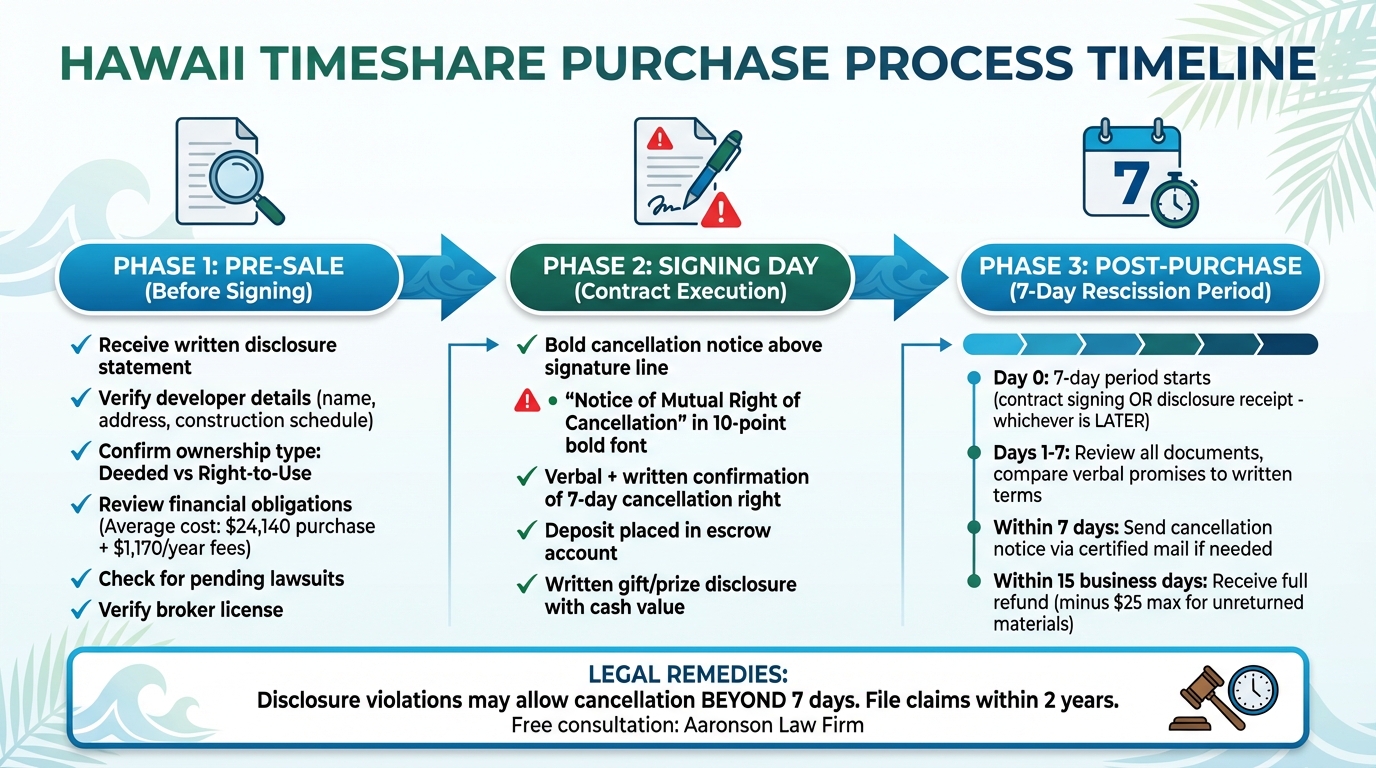
Hawaii Timeshare Purchase Timeline: Pre-Sale to Post-Purchase Checklist
Pre-Sale Disclosures: What to Verify Before Signing
Before you sign anything, make sure you’ve received a complete written disclosure. This document is crucial because the seven-day cancellation period only starts once you have it. Take time to carefully review the written disclosure, along with the details of the timeshare plan and financial obligations, before moving forward.
Written Disclosure Statement
You should receive a standalone written disclosure summarizing the timeshare plan and outlining your legal rights. A licensed broker must also confirm your seven-day cancellation period verbally. If you’re offered a gift or prize for attending a presentation, ask for a written description that includes its cash value and any associated terms or conditions.
Timeshare Plan Details
The disclosure must provide a detailed description of the timeshare plan, including the developer’s name, address, construction schedule, unit details, and availability dates.
"The timeshare disclosure statement must contain… the developer’s schedule for completion of all buildings, units, and amenities and dates of availability." – Amy Loftsgordon, Attorney, Nolo
Check if the plan is a "timeshare ownership plan" (deeded real property) or a "timeshare use plan" (right-to-use agreement). The statement should clearly define your rights and responsibilities, along with any limitations on transferring or selling your timeshare interest. Additionally, it must disclose any pending or expected lawsuits that could significantly impact the timeshare units or the overall plan.
Financial Obligations and Fees
The disclosure must outline your total financial commitment, including the purchase price, additional charges, and recurring expenses such as maintenance fees and taxes. It should also explain how these costs are calculated. For example, in 2024, the average interval cost is $24,140, while annual fees typically range between $500 and $1,000, with an average of $1,170.
"Sellers also have to disclose… an estimate of the dues, maintenance fees, real property taxes, and similar periodic expenses, and the method or formula by which they are derived and apportioned." – Amy Loftsgordon, Attorney, Nolo
Look into the history of fee increases and special assessments. Ensure that all funds are held in escrow until the sale is finalized. If you decide to cancel, refunds should be processed within 15 days.
Signing Day Checklist: Required Notices and Contract Terms
Before putting pen to paper, make sure the contract includes all necessary legal disclosures and protections. Missing information could signal non-compliance and may put your rights at risk. By following these steps, you can ensure the contract meets Hawaii’s disclosure requirements.
Cancellation Rights
Before signing, look above the signature line for this bold statement: "ANY PURCHASER HAS, UNDER THE LAW, A SEVEN-DAY RIGHT OF RESCISSION OF ANY TIME SHARING SALES CONTRACT." This statement should be easy to spot. Additionally, there must be a separate "Notice of Mutual Right of Cancellation of Time Share Purchase" written in at least 10-point bold font, clearly showing the seller’s information and relevant dates. At the time of signing, the salesperson is legally required to inform you – both verbally and in writing – about your seven-day cancellation right.
"YOU OR THE DEVELOPER MAY CANCEL THIS TRANSACTION WITHIN SEVEN CALENDAR DAYS AFTER EXECUTION OF THE CONTRACT OR AFTER YOUR RECEIPT OF THE TIME SHARE DISCLOSURE STATEMENT, WHICHEVER OCCURS LATER, AND YOU SHALL BE ENTITLED TO A REFUND WITHIN FIFTEEN BUSINESS DAYS AFTER THE DATE THE NOTICE OF CANCELLATION IS RECEIVED." – Haw. Code R. § 16-106-20
Make sure the contract doesn’t include any language that restricts or waives your cancellation rights. Double-check that the cancellation notice includes the correct mailing address and that all dates are accurate – these determine when your seven-day cancellation window begins and ends.
Escrow and Deposit Handling
Your deposit must be held in an independent escrow account until the sale is finalized, canceled, or defaults. The contract should clearly outline the conditions for releasing these funds. If you decide to cancel, you’re entitled to a refund of all payments (minus up to $25 for unreturned sales materials) within 15 business days.
Prohibited Sales Practices
Hawaii law strictly forbids misrepresenting timeshares as financial "investments" or exaggerating potential resale or rental income. If a salesperson makes verbal promises that aren’t included in the written disclosure, this is a red flag for non-compliance.
"In Hawaii, timeshare salespeople can’t offer a promotional device without first telling you that the device is being used or offered for the purpose of selling you a timeshare." – Amy Loftsgordon, Attorney, Nolo
If you’re offered a gift, prize, or discounted tourist activity as an incentive to attend the sales presentation, the developer must give you a written description of the item’s cash value and all terms and conditions before the presentation begins. Lastly, confirm that the person handling your transaction is a licensed real estate broker, as only licensed professionals can legally complete timeshare sales in Hawaii.
Post-Purchase Checklist: Verifying and Protecting Your Rights
After signing the contract, your seven-day rescission period officially begins. This is your opportunity to carefully review everything and back out if something feels off. Start going through your documents right away.
Reviewing Documents During the Rescission Period
First, confirm when you received your disclosure statement. This date is crucial because it determines when your seven-day cancellation period starts. The countdown begins either on the day you signed the contract or when you received the disclosure statement – whichever came later. Mark this date and calculate when your rescission period ends.
Next, compare the written disclosure with any verbal promises made about the developer’s timeline or fee structure. If there’s a mismatch, that could indicate a legal issue.
Make sure the contract includes the required cancellation notice. Double-check that the disclosure statement clearly outlines the developer’s name, address, unit details, any transfer restrictions, and a full breakdown of financial obligations.
Once you’ve verified all the details, keep these documents safe for future reference.
Keeping Your Records Organized
Protecting your rights means staying organized. Securely store key documents like the signed purchase agreement, the disclosure statement, and ownership certificates. These will be essential if you need to cancel or deal with any disputes later. Also, hold onto copies of escrow receipts to confirm your payments are being held in a neutral account until the transaction closes.
Keep any written descriptions of promotional offers and all billing statements. These records are vital for checking that charges align with the disclosure.
Seeking Legal Help for Contract Issues
If you uncover missing or incorrect disclosures during your review, take action quickly. You can cancel within the seven-day window by sending a written notice to the address listed in your contract. The cancellation becomes valid on the date it’s postmarked or hand-delivered, so use certified mail to ensure proof of delivery. Be sure to return any sales materials in good condition within 15 business days to avoid a $25 fee.
If the seven-day rescission period has already expired but you’ve discovered disclosure violations or deceptive practices, Aaronson Law Firm can help. They specialize in timeshare contract cancellations and offer free consultations to evaluate your case. In some instances, disclosure violations can still provide legal grounds for canceling a timeshare agreement even after the initial cancellation period has ended.
sbb-itb-d69ac80
Using Disclosure Violations to Explore Legal Exit Options
If you’re stuck in a timeshare contract you no longer want, Hawaii’s strict disclosure requirements might provide a way out. Developers who fail to meet these legal obligations open the door for potential contract cancellations – even after the standard seven-day rescission period has passed. These violations not only undermine your ability to make informed decisions but also create legal opportunities to challenge the agreement.
Common Disclosure Violations
When developers fail to provide full and accurate disclosures, they violate Hawaii law. Missing or incomplete disclosures – such as omitting the developer’s name, unit details, completion timelines, or transfer restrictions – are serious breaches. For instance, written disclosures must clearly explain the formula used to calculate maintenance fees and detail how costs are shared among owners.
Financial misrepresentation is another common issue. Developers are required to disclose your total financial obligations upfront, including estimates for maintenance fees. Additionally, only licensed real estate brokers can legally sell timeshares in Hawaii. If an unlicensed salesperson was involved, that’s another violation – check the Hawaii professional licensing database to confirm credentials.
Other deceptive practices include undisclosed gifts used to lure buyers. Developers must provide written details about the gift’s cash value and terms. Misleading claims about timeshares being "investments" or exaggerating resale values are also illegal. Improper handling of escrow funds, such as failing to deposit them in an independent account, is another red flag.
Legal Remedies for Non-Compliance
If you discover these violations, you may have legal options to cancel your contract even after the initial rescission period. Hawaii law allows consumers to bring claims for fraud, developer breaches, or consumer protection violations within two years of receiving the disclosure statement.
"Experienced counsel will exploit additional vulnerabilities. For example, the developer may well be perpetrating an ongoing conflict of interest. Improper handling of trust funds are also a major issue. This is where the developer is most vulnerable. This is where your leverage is." – Aaronson Law Firm
Attorneys can subpoena a developer’s records to uncover issues such as trust fund mismanagement or conflicts of interest. You can also file complaints with Hawaii’s Regulated Industries Complaints Office (RICO) or the Hawaii Attorney General’s office. Acting quickly is key if you suspect any of these violations.
How Aaronson Law Firm Can Help

Aaronson Law Firm specializes in reviewing timeshare contracts for disclosure violations. They provide free consultations, issue demand letters to stop collections, and safeguard your credit under 15 USC 1681. If necessary, they can litigate to cancel contracts, terminate loans, and seek damages on your behalf.
Conclusion
Before signing any agreement, it’s crucial to double-check all required disclosures to safeguard yourself from unexpected financial commitments. Knowing the deadline for canceling your contract is equally important, as it preserves your right to back out if needed.
Make it a point to compare what was promised during the sales presentation with the terms outlined in the contract. Pay close attention to the disclosure statement – it often reveals the actual costs of ownership, including fees that may have been downplayed or omitted during the pitch. A thorough review of these disclosures ensures your transaction aligns with Hawaii law and protects your consumer rights.
"A buyer’s right to rescind is generally non-waivable. In most cases, it must be clearly stated, emphasized, and effectively communicated within the contract to adhere to various state regulations." – Aaronson Law Group
If you’ve already signed but suspect fraud or incomplete disclosures, don’t lose hope – you might still have recourse. Check if your contract includes the required cancellation notice. If it’s missing, that could indicate a violation of Hawaii law. Be sure to keep all related documents, as they may be critical in supporting your case.
Should you find any inconsistencies after your review, act quickly to explore your legal options. If disclosure violations are uncovered, Aaronson Law Firm offers free consultations to review your contract and discuss potential remedies. Whether you’re still within your cancellation window or dealing with a contract obtained through misleading practices, knowing your rights is the first step to protecting yourself from unnecessary financial strain.
FAQs
What should I do if I notice errors in my timeshare disclosure after signing the contract?
If you spot errors or missing details in your timeshare disclosure statement, it’s important to act fast. Under Hawaii law, you have a 7-day rescission period to cancel the agreement. To cancel, you’ll need to send a written notice to the seller – either by mail or in person – within this window.
For extra peace of mind, you might want to reach out to a qualified timeshare attorney, such as Aaronson Law Firm. They can help you draft your cancellation notice correctly and make sure your rights are protected. Time is of the essence to avoid unnecessary financial commitments.
How do I check if my timeshare salesperson in Hawaii is properly licensed?
To confirm whether your timeshare salesperson is licensed in Hawaii, you can search their credentials on the state’s Professional & Vocational Licensing Division website. By entering their name or license number, you’ll be able to verify their status, license type (such as Acquisition Agent), and see if there are any disciplinary actions on record. The database is updated every weekday, but recent changes might take some time to reflect. For accuracy, it’s smart to double-check this information closer to your purchase date.
Hawaii law mandates that all timeshare sales and marketing agents must hold a valid license under Chapter 514E-2.5 of the Hawaii Revised Statutes. If you can’t find a record for the individual, they are not legally authorized to sell timeshares. In such cases, you should either request a licensed representative or reconsider moving forward with the transaction.
If you run into licensing concerns or need help understanding your rights, Aaronson Law Firm can guide you through the process, including exploring options for rescission or other consumer protections.
What can I do if I find out about disclosure violations after the seven-day cancellation window has passed?
If you find out that required disclosures weren’t provided even after the seven-day cancellation period, don’t worry – you might still have legal options. Hawaii law allows you to take steps to void the contract and seek remedies like rescission, damages, injunctive relief, or civil penalties. Typically, the process kicks off with a demand letter crafted by a skilled timeshare attorney.
Getting advice from a legal professional who focuses on timeshare law – such as Aaronson Law Firm – can make all the difference. They can help you understand your rights, walk you through the process of addressing disclosure violations, and potentially assist in canceling your timeshare agreement.
Related Blog Posts
- How Disclosure Timing Affects Timeshare Buyers
- Hawaii Timeshare Cancellation Laws Explained
- Timeshare Disclosure Laws: What Sellers Must Reveal
- Timeshare Maintenance Fees: What Developers Must Disclose