When developers ignore rescission laws, timeshare buyers face serious consequences. These laws provide a short window for buyers to cancel their contracts and receive a full refund, protecting them from high-pressure sales tactics. Violations by developers – like rejecting valid cancellations, delaying refunds, or providing misleading information – trap buyers in unwanted contracts, often leading to financial strain, damaged credit, and legal battles.
Key points to know:
- What rescission laws do: Allow buyers to cancel timeshare contracts penalty-free within a specific timeframe.
- Common violations: Ignoring valid cancellation requests, withholding refunds, or hiding cancellation rights in contracts.
- Legal consequences for developers: Fines, lawsuits, court-ordered refunds, and damage to their reputation.
- What buyers can do: File complaints with agencies like the FTC or Attorney General, and seek legal help if needed.
If you’re dealing with a developer ignoring rescission rights, act quickly to enforce your legal protections.
Rescission Laws and What Developers Must Do
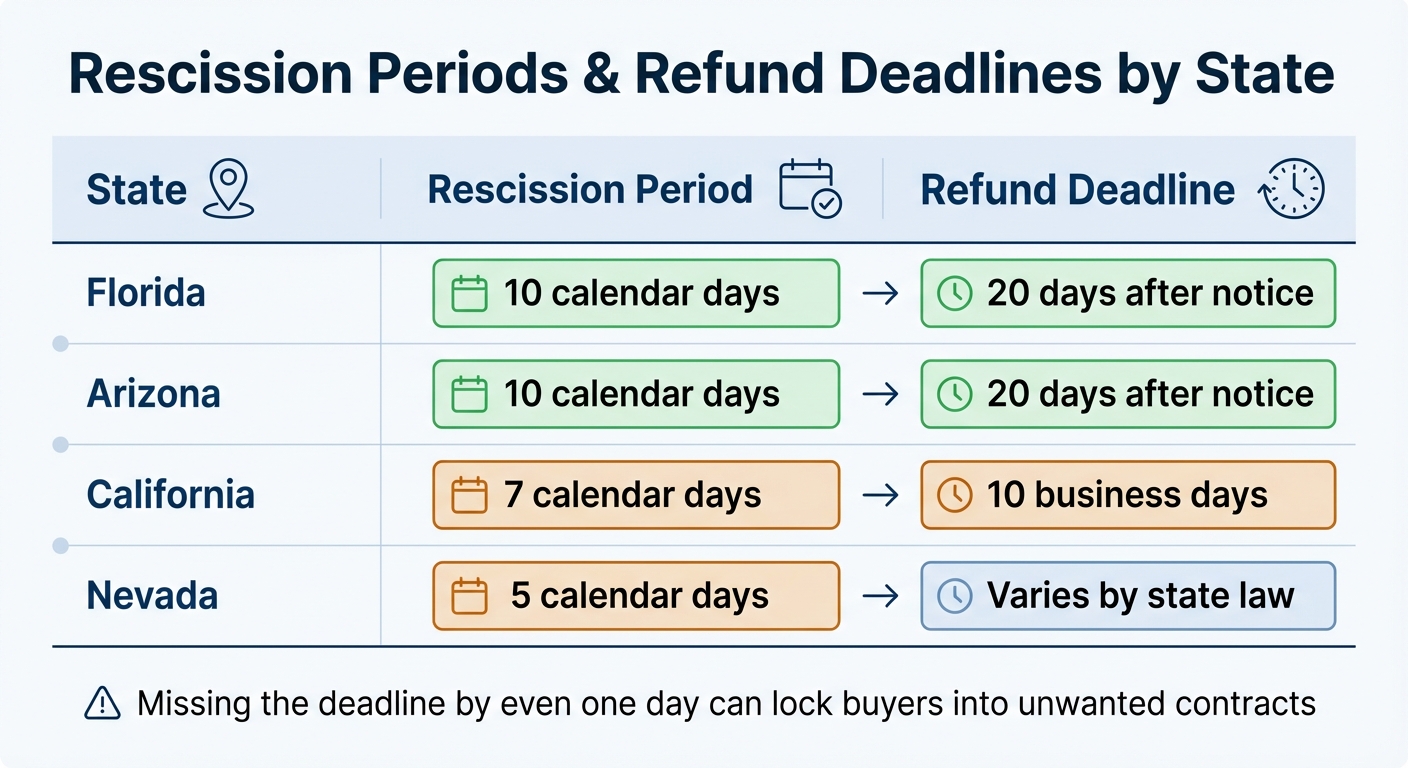
Timeshare Rescission Periods and Refund Deadlines by State
What Rescission Laws Are
Rescission laws give buyers a penalty-free window to back out of their purchase without needing to explain or face consequences. This "cooling-off" period is designed to let buyers step away from the often high-pressure atmosphere of sales presentations and carefully review their contracts. To ensure transparency, the contract must clearly disclose these cancellation rights, usually in bold or prominent text right before the signature line. Importantly, developers are prohibited from finalizing the sale – such as delivering the deed or ownership documents – until this period has ended.
What Developers Are Required to Do
If a buyer decides to cancel within the rescission period, developers are legally bound to fulfill specific obligations. First, they must provide the purchase agreement along with the seller’s contact information. Once a valid cancellation notice is received, developers must issue a full refund of all payments. In Florida, for example, this refund must be processed within 20 days of receiving the notice or 5 days after the funds have cleared, whichever comes later. Arizona takes it a step further, considering any refusal to honor rescission rights without a legitimate legal reason as an "unlawful practice" that can trigger an investigation by the attorney general.
"Any attempt to obtain a waiver of your cancellation right is void and of no effect." – Florida Statutes § 721.06
Rescission Periods by State
The duration of the rescission period can vary widely depending on the state where the timeshare is located. Florida and Arizona both provide buyers with 10 calendar days to cancel, while Nevada offers just 5 days. In California, buyers get 7 calendar days for short-term timeshare products. These timeframes are critical because missing the deadline, even by a single day, can lock buyers into contracts they may regret. The rescission period typically begins on the date the buyer signs the contract or receives all required documents, whichever is later. For instance, in Florida, if the developer delivers an unapproved public offering statement, the 10-day countdown doesn’t start until the buyer receives the approved version along with any revisions.
| State | Rescission Period | Refund Deadline |
|---|---|---|
| Florida | 10 calendar days | 20 days after notice |
| Arizona | 10 calendar days | 20 days after notice |
| California | 7 calendar days | 10 business days |
| Nevada | 5 calendar days | Varies by state law |
Up next, we’ll explore common ways developers fail to meet these obligations.
How Developers Violate Rescission Laws
Even though rescission laws are designed to protect consumers, developers often find ways to sidestep these rules, trapping buyers in canceled contracts. These violations are not accidental; they are calculated moves to prevent consumers from exercising their legal rights. Let’s break down some of the most common tactics.
Rejecting Valid Cancellation Requests
One of the most common tricks is rejecting legitimate cancellation requests. Developers may claim the notice wasn’t submitted correctly or bury crucial rescission details in overwhelming amounts of paperwork, making it nearly impossible for buyers to meet deadlines.
"Unscrupulous salespersons are adamant that certain pricing is contingent on purchasing the timeshare during the presentation, and do not provide consumers with sufficient time to review the contract before, during, or after the presentation." – National Association of Attorneys General
In Arizona, this issue is explicitly addressed by law. Denying a consumer’s right to rescind without a valid legal reason is considered unlawful and can lead to investigations by the attorney general. However, developers often gamble that most buyers won’t take legal action, routinely rejecting valid requests.
Delaying Refunds
Even when cancellation requests are accepted, developers often delay issuing refunds, creating unnecessary stress for consumers. Federal law requires refunds to be processed within 20 days, but many developers ignore this mandate, holding onto the money for as long as possible.
These delays can have serious consequences. Consumers may face financial strain while waiting for their refund, and the added emotional toll only worsens the situation. For instance, in 2016, the Arizona Attorney General’s Office reached a settlement with Diamond Resorts Corporation, resulting in $650,000 in restitution and enabling hundreds of consumers to exit their contracts. This settlement saved buyers an estimated $25 million in future maintenance fees.
Giving False or Incomplete Information
From the very beginning, developers often mislead buyers about their cancellation rights. Salespeople make verbal promises that directly contradict the terms laid out in the written contract. By the time buyers realize the truth, it’s often too late.
"A timeshare seller might bury these details in the paperwork, or the instructions might be confusing." – Amy Loftsgordon, Attorney
Other deceptive tactics include hiding rescission disclosures in obscure sections of the contract. Arizona law requires these notices to appear prominently before the signature line, but developers often tuck them away in less noticeable areas. Some contracts even include illegal waiver clauses that falsely claim buyers are giving up their right to cancel – a right that cannot legally be waived. Developers may also withhold copies of signed agreements or omit critical contact information, leaving buyers unsure of where to send their cancellation notices.
Legal Penalties Developers Face for Non-Compliance
When developers fail to comply with rescission laws, they open themselves up to serious legal consequences. These penalties are designed to protect consumers and ensure developers respect the rules, emphasizing the high stakes of non-compliance.
Financial Penalties
The financial penalties for violating rescission laws vary depending on the state. For example, in Arizona, denying a buyer’s rescission rights without a valid legal reason is considered an "unlawful practice", which can trigger investigations by the Attorney General. Over in Washington, knowingly breaking these laws is classified as a Class C felony, while unintentional violations may be treated as gross misdemeanors.
On the federal level, the Federal Trade Commission (FTC) can impose civil penalties of up to $50,120 per violation for unfair or deceptive practices. For developers, this means that violating rescission laws for multiple buyers could lead to penalties that far outweigh any profit made from those sales.
| State | Legal Classification | Key Consequences |
|---|---|---|
| Arizona | Unlawful Practice | Investigations and actions by the Attorney General |
| California | Statutory Violation | Full refunds required; funds secured via escrow or bond |
| Florida | Statutory Violation | Full refund of all payments |
| Washington | Unfair Practice / Misdemeanor | Class C felony for knowing violations; liability for attorney’s fees |
In California, the rules are particularly strict. Developers must refund 100% of payments and ensure buyer funds are protected through escrow accounts or bonds.
Lawsuits and Court-Ordered Refunds
Financial penalties are just the beginning. Developers may also face lawsuits that lead to court-ordered rescission. This process can force developers to unwind transactions, returning the buyer’s full payment along with accrued interest.
Under the Truth in Lending Act (TILA), failing to provide required disclosures or notices of rescission rights can extend the consumer’s cancellation window from three days to three years. Once rescission is triggered, developers must return all fees and give up any claim to the property within 20 days.
If developers refuse to comply with court-ordered refunds, things can escalate quickly. Authorities may classify unpaid judgments as "recoverable land revenue", which allows them to freeze bank accounts or even seize and auction off property to settle the debt. Persistent refusal to follow court orders could lead to criminal charges, with penalties that include up to three years in prison.
Damage to Business Reputation
Beyond financial and legal consequences, a developer’s reputation can take a major hit. State licensing boards often view rescission violations as "unprofessional conduct", which can lead to disciplinary actions and create a public record that potential buyers can access.
"The director may take disciplinary action against a timeshare salesperson’s registration… if the director finds that the applicant or registrant has committed unprofessional conduct." – Washington Revised Code § 64.36.090
Regulators may also issue cease-and-desist orders, halting sales until the developer resolves compliance issues. In severe cases, repeated violations can result in permanent license revocation. Courts may even appoint a receiver or conservator to take over the developer’s projects and assets.
On top of all this, violations are often reported to organizations like the Better Business Bureau, the FTC, and State Attorney General offices. These reports create a lasting public record, making it harder for developers to regain trust and attract future buyers.
sbb-itb-d69ac80
What Consumers Can Do When Developers Don’t Comply
When developers refuse to honor rescission laws – whether through delays, misinformation, or outright denials – consumers need to act quickly and decisively. If your valid rescission request is ignored, it’s crucial to document every communication and take steps to enforce your rights.
Filing Complaints with Government Agencies
If a developer disregards your cancellation notice or fails to issue a refund within the required 20-day period, you can turn to key government agencies for help. Start by filing a complaint with the Federal Trade Commission (FTC) at ReportFraud.ftc.gov. The FTC can address violations related to the developer’s refusal to comply. Another important resource is the Consumer Financial Protection Bureau (CFPB), especially if your issue involves timeshare financing.
You should also contact the State Attorney General’s Office in both your home state and the state where the property is located. For example, in Arizona, denying rescission rights without a valid legal reason is considered an unlawful practice, which may lead to an investigation by the Attorney General. Be sure to include all relevant documentation, such as your cancellation notice, proof of delivery, and any misleading promises made by the developer.
Additionally, filing a complaint with the Better Business Bureau (BBB) can be beneficial. While the BBB doesn’t have enforcement authority, your complaint creates a public record that can warn other consumers and might pressure the developer to resolve the issue to protect their reputation.
If these steps don’t resolve the matter, legal action may be your next option.
Taking Legal Action
When complaints to government agencies fail to produce results, legal action becomes a necessary step. Under federal law (15 U.S. Code § 1635), courts can provide additional relief beyond canceling the contract when a creditor violates rescission requirements. For example, if the developer failed to provide required Truth in Lending disclosures, your right to cancel could extend from three days to as long as three years.
To navigate this process effectively, consult an attorney. They can ensure your rescission notice meets all legal requirements and help you take further steps, such as drafting demand letters, filing lawsuits, or challenging a developer’s rejection of your cancellation. Courts can order developers to return all payments (with interest), void security interests, and implement changes to prevent future violations.
When self-advocacy and complaints aren’t enough, working with an experienced attorney becomes essential.
Getting Help from Aaronson Law Firm

For those facing uncooperative developers, Aaronson Law Firm specializes in timeshare cancellations and offers a free consultation to review your case and recommend the best course of action.
If your cancellation request has been ignored, Aaronson Law Firm can prepare formal legal demand letters – known as Rescission Predicate Correspondence – that clearly outline your rights and the developer’s obligations under the law. These letters often prompt developers to act when informal efforts fail. The firm also provides credit protection services, shielding you from aggressive collection attempts while your case is being resolved. Since a valid rescission voids the contract, you shouldn’t be responsible for ongoing payments.
If developers remain noncompliant, Aaronson Law Firm offers full litigation support. They represent clients in court to enforce their rescission rights and recover refunds. With their deep knowledge of timeshare law, they understand the specific state and federal regulations that apply to your case, whether it involves missing disclosures, extended rescission periods, or fraudulent practices.
Conclusion
Rescission laws are designed to give consumers a short, penalty-free window to cancel timeshare contracts, protecting them from high-pressure sales tactics. When developers disregard these laws – whether by denying valid cancellations, stalling refunds, or providing false information – they risk facing serious legal consequences.
"The denial of a purchaser’s rights under this section without a good faith legal basis constitutes an unlawful practice." – Arizona Revised Statutes, Section 32-2197.03
Violating rescission laws can lead to hefty fines, court-ordered refunds, and investigations by agencies like the Attorney General’s office. These consequences highlight the importance of taking swift action if your cancellation rights are ignored.
Failure to comply with rescission laws not only causes financial strain but also undermines your legal protections. If a developer refuses to honor your rights, it’s critical to act quickly: file complaints with the FTC and your state’s Attorney General, and consult an attorney to help secure your refund.
Aaronson Law Firm, with over 25 years of experience and a top ethical rating from Martindale-Hubbell, offers expert assistance in timeshare cancellations. From drafting demand letters to representing clients in court, they provide the legal support needed to protect your rights. They even offer a free consultation to evaluate your case.
Your rescission rights are protected by law. If a developer fails to respect them, having skilled legal counsel can be the key to achieving the resolution you deserve.
FAQs
What can I do if the developer rejects my valid rescission request?
If a developer doesn’t honor your valid rescission request, it’s crucial to act promptly to safeguard your rights. By law, developers must process cancellations and refunds within the rescission period, but some may not follow through.
Getting legal help can make a big difference. An experienced attorney can walk you through the process, manage communication with the developer, and, if needed, take additional steps to ensure your cancellation and refund are properly handled.
How do rescission laws differ across states in the U.S.?
Rescission laws across the U.S. differ significantly from state to state, particularly in terms of how long buyers have to cancel a contract, the steps involved in the cancellation process, and the delivery method for the rescission notice. In most states, buyers are given a 3 to 15-day window to cancel a timeshare agreement without any penalties. However, the exact timeframe depends on the state’s specific regulations.
Some states go a step further by requiring that the purchase agreement clearly detail the cancellation process and deadlines. The way you deliver the rescission notice – whether through mail, electronically, or in person – can also vary based on state laws. To ensure you don’t miss any important deadlines, it’s crucial to understand the rescission rules and procedures in your state.
Being aware of these differences can help you effectively cancel a timeshare agreement and avoid unwanted financial commitments.
What can I do if a developer doesn’t issue my refund on time?
If a developer doesn’t process your refund within the required timeframe after you’ve canceled during the rescission period, you have options to protect your rights. U.S. laws require developers to return all payments promptly once a valid cancellation is submitted. Failing to do so may violate these regulations.
To resolve this, consider consulting an attorney experienced in timeshare contract disputes. They can guide you through the legal process, which might involve sending a formal demand letter or, if necessary, pursuing legal action. Acting promptly can help ensure your rights are protected and your refund is returned without further delays.
Related Blog Posts
- What Are Rescission Rights in Timeshare Contracts?
- Timeshare Rescission Laws: Developer Compliance
- Consumer Notification Failures in Timeshare Sales
- State Laws on Developer Rescission Obligations