
If I were building a timeshare misrepresentation claim, I’d start with one rule: the best evidence is the evidence made at or near the sale. That usually means the contract, financing papers, disclosures, emails, texts, payment records, booking records, recordings, witness accounts, buyer notes, and outside complaints or enforcement records.
Here’s the short version:
- Written sale records come first. Signed agreements, loan papers, and disclosure documents show what I agreed to on paper.
- Direct sales statements matter next. Emails, texts, brochures, and recordings help show what I was told before I signed.
- Usage and money records show harm. Booking denials, fee increases, loan statements, and collection notices help tie the sales pitch to loss.
- Timing matters. Notes, screenshots, and witness statements work best when they were made during the sale or soon after.
- Weak proof usually looks the same. Vague memories, edited screenshots, missing contracts, and long delays make claims harder.
A misrepresentation claim usually comes down to five points: what was said, who said it, when it was said, whether I relied on it, and how much money I lost. In many contracts, merger and non-reliance clauses make oral promises harder to use later. That’s why I’d want a file that shows a straight line from the sales pitch to the signed deal to the later problem.
Quick Comparison
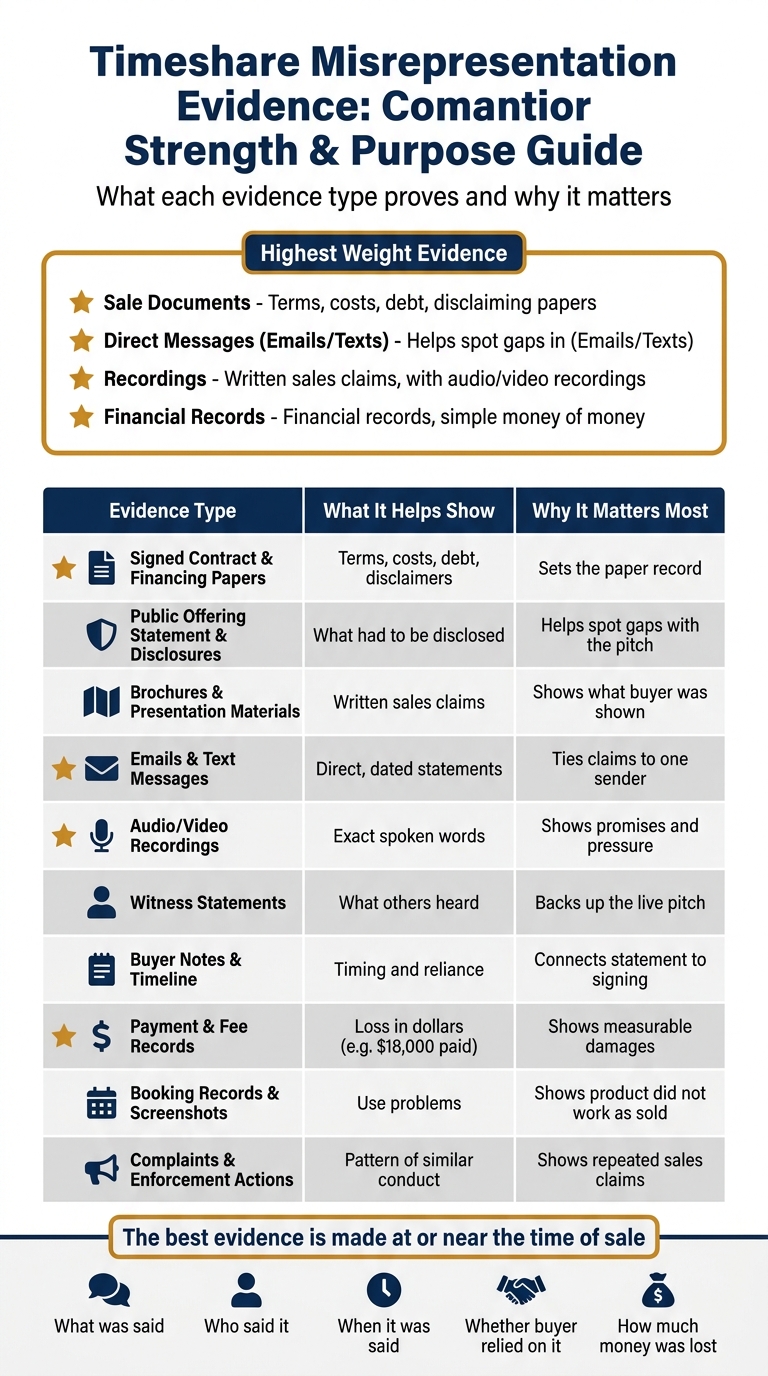
Timeshare Misrepresentation Evidence: Strength & Purpose Guide
| Evidence type | What it helps show | Why it matters most |
|---|---|---|
| Signed contract and financing papers | Terms, costs, debt, disclaimers | Sets the paper record |
| Public offering statement and disclosures | What had to be disclosed | Helps spot gaps with the pitch |
| Brochures and presentation materials | Written sales claims | Shows what I was shown |
| Emails and texts | Direct, dated statements | Ties claims to one sender |
| Audio/video recordings | Exact spoken words | Shows promises and pressure |
| Witness statements | What others heard | Backs up the live pitch |
| Buyer notes and timeline | Timing and reliance | Helps connect statement to signing |
| Payment and fee records | Loss in dollars | Shows damages such as $18,000 paid |
| Booking records and screenshots | Use problems | Shows the product did not work as sold |
| Complaints and enforcement actions | Pattern of similar conduct | Helps show repeated sales claims |
If I had to rank what usually carries the most weight, I’d put sale documents, direct messages, recordings, and financial records at the top. Everything else works best when it supports those core records.
sbb-itb-d69ac80
Why Evidence Quality Matters in Timeshare Misrepresentation Cases
Not all evidence has the same pull. Courts and arbitrators tend to lean hardest on records made during the sale or right after it – contracts, emails, notes, and financial documents.
Why? Because those records lock in the timeline. They show what was said, when it was said, and what the buyer received before any fight started. That matters when you need to show a statement was made, that it was false, and that you relied on it. In plain English: the strongest claims usually begin with paperwork from the sale itself.
Merger and non-reliance clauses make this even tougher. Most timeshare contracts say the written agreement is the "entire agreement" and that the buyer is not relying on oral promises made outside the contract. If the contract specifically says the buyer did not rely on statements about the same issue later claimed as a misrepresentation, outside evidence of those oral statements may become inadmissible.
That’s the problem with a strong sales pitch that was never written down. It may sound convincing, but without supporting records, it often won’t carry enough weight. With that bar in place, the most useful evidence usually comes from the sale record and the months right after it.
What Courts and Attorneys Look for in Misrepresentation Cases
Courts and attorneys usually boil a misrepresentation claim down to four simple questions: what was promised, who said it, when they said it, and what harm came after. That framework helps sort the evidence in a way that makes sense.
The first question is what, exactly, was promised. This part matters a lot. General sales talk is often treated as puffery. A clear promise is different. If someone says maintenance fees will never go above $1,200 per year, that’s specific. It can be checked. And the more concrete the statement is, the more use it tends to have in a legal claim. Once that promise is pinned down, the next step is figuring out who made it.
Who made the statement and in what capacity affects how much weight it gets. A statement from an authorized sales representative carries far more weight than something said by an unrelated third party. If the statement came from the developer’s sales staff during a presentation, it can often be tied back to the company. That’s why statements from authorized sales staff matter most. Training scripts or internal policies may also help show the company knew the claim was false. To connect the speaker to the company, documents like these can help:
- Business cards
- Email signatures
- Branded presentation slides
- Presentation sign-in sheets
Then there’s timing. When the statement was made can show whether it shaped the buyer’s decision.
Timing, reasonable reliance, and measurable harm round out the picture. Statements made during the sales pitch or at the signing table usually carry the most legal weight because they may have directly influenced the choice to sign. Proof of high-pressure tactics can help explain why a buyer relied on spoken promises instead of dense contract wording. That can include long presentations, today-only pricing, or a rushed signing setting.
Reasonable reliance means an ordinary buyer could have trusted the statement in that situation. Courts use that same basic test. And there also has to be real harm that can be measured. That might mean:
- Loan interest paid
- Maintenance fees that went above what was promised
- Costs caused by a timeshare that couldn’t be used as represented
These questions shape how the evidence below is organized.
| Core Element | What Courts Ask | Evidence That Answers It |
|---|---|---|
| The statement itself | Was it specific and factual, or just vague opinion? | Brochures, scripts, emails, recordings |
| Who made it | Was the speaker an authorized company representative? | Business cards, email signatures, branded slides |
| When it was made | Did it happen before or during signing? | Dated emails, presentation records, timelines |
| Reasonable reliance | Would an ordinary buyer have justifiably trusted this? | Buyer notes, contemporaneous emails, age/experience |
| Measurable harm | Is there measurable financial or practical damage? | Fee histories, loan statements, booking records |
1. Signed Purchase Agreements and Financing Documents
Start with the papers the developer had you sign. They’re the backbone of the claim.
Signed closing documents create the written record you can stack against the sales pitch. That matters because these papers show whether the deal on paper matched the story told in the room, and whether any gap between the two was material.
Shows the Exact Promise Made and Contradicts Oral Representations
The purchase agreement lays out the specific promises and product details you relied on when you signed. One of its main uses is simple: compare the contract to what the sales rep said.
If a sales rep promised fixed maintenance fees, but the contract allows those fees to go up, that conflict is right there in black and white. A clear written conflict can help show the salesperson knew the promise was false or misleading. Handwritten initials, addenda, and marked-up pages can be especially helpful because they show what was pointed out at signing.
Links Reliance to the Purchase Decision
Financing records, such as promissory notes, Truth in Lending disclosures, and payment schedules, show that the sale led to a long-term debt. If the timeshare was pitched as producing rental income or keeping its value, those records can help show you were led to sign under materially false terms.
Helps Prove Financial Harm or Intent
The numbers in your financing papers, including the purchase price, interest rate, monthly payment, maintenance fees, and recurring costs, put a dollar figure on the harm. If the paperwork shows costs that were hidden or played down during the presentation, that can support an inference that the seller knew the deal was more burdensome than represented.
Save every page, including:
- the fully executed agreement
- addenda
- acknowledgments
- disclosures
- financing records with signatures, dates, and page numbers
These records are most useful when you match them with sales materials, messages, and notes from the presentation.
2. Public Offering Statements and Required Disclosures
The public offering statement (POS) is the main disclosure document for a timeshare plan. It’s one of the best tools you have for checking the written deal against the sales pitch and spotting gaps, conflicts, or missing details.
Put simply: the contract shows what you signed. The POS shows what the developer had to disclose.
Shows the Exact Promise Made
Several states require a warning that buyers should rely on the POS and contract, not oral sales statements. That matters. It gives buyers and attorneys a clear point of comparison.
So if a salesperson promised guaranteed weeks, fixed fees, or booking flexibility that doesn’t appear in the POS, that mismatch can serve as evidence. It helps show the sales pitch went past the written disclosure record.
Contradicts Contract Terms or Actual Performance
Compare the POS with your signed contract and your actual booking history. That side-by-side review can tell you a lot.
If the POS describes broad booking access, but you repeatedly could not reserve the dates and unit types that were said to be available, that gap can support a claim that the original representation was misleading. The same goes for benefits or exchange options described in the POS that the final contract later narrows or disclaims.
In that sense, the POS can help show that the promise was false in practice, not just on paper.
Helps Prove Financial Harm or Intent
Required disclosures often spell out fees, assessments, financing terms, and resale limits that a salesperson may have minimized or skipped over during the presentation. If those disclosures reveal costs or limits that were downplayed at the time of sale, that gap can help support intent and reliance.
Keep every version you received, and note when each one was delivered.
3. Sales Brochures, Flyers, and Presentation Materials
Alongside the POS and contract, these materials can help show what the salesperson sold you. Brochures, flyers, and slide decks handed out during a timeshare sales presentation create a paper trail of what you were shown before you signed. You can then compare those materials with the contract and with what happened when you tried to use or book the timeshare.
Shows the Exact Promise Made
Use these materials to spot the exact claims the seller made in writing. When a promise appears in a handout or presentation packet, it can show precisely what the seller placed in front of you before signing.
Links Reliance to the Purchase Decision
Marketing materials can also help tie the salesperson’s statements to your decision to buy. If a flyer or presentation packet highlighted a key benefit that mattered to you, that material may help show what pushed the purchase forward.
Contradicts Contract Terms or Actual Performance
These materials matter when they clash with the contract or with what happened after the sale. Compare the brochure’s claims with the contract, POS, and your actual use records. That gap becomes stronger when you pair it with later emails, recordings, or booking records.
Helps Prove Financial Harm or Intent
If the brochures or handouts left out major limits or costs, that may help support your claim that the materials were misleading and that you suffered financial harm. Save every handout, insert, and packet page from the presentation.
4. Emails and Text Messages from Sales Representatives
Unlike brochures, emails and texts preserve the sales rep’s own words as they were sent. That matters. These messages create a timestamped record of what was promised before you signed, during the pitch, and in follow-up pressure. So when printed materials stay vague but a direct message gets specific, the email or text can carry a lot more weight.
Shows the Exact Promise Made
A text saying "this property always appreciates in value" or an email confirming "we have an active buy-back program" is much harder to walk back than a spoken promise. These messages often spell out claims about appreciation, resale, buy-back rights, rental income, or exclusive access.
That makes them direct, dated, and tied to one person in a way verbal statements usually aren’t.
Links Reliance to the Purchase Decision
Save any message where you asked a clear question and got a reassuring answer. For example, if you emailed asking whether you could book peak-season dates and the rep replied "absolutely, members always get priority access", that exchange helps tie your purchase decision to that exact claim.
In plain English, it shows you didn’t buy on a hunch. You bought after getting a direct answer.
Contradicts Contract Terms or Actual Performance
Emails and texts become even more useful when they clash with what happened after you signed. If the rep promised easy booking, but the member portal failed while third-party sites showed better availability, that mismatch helps support your claim.
If the portal did not deliver the access promised, that gap can point to misrepresentation.
Helps Prove Scienter and Financial Harm
Written messages can also help show scienter, or knowledge that the statement was false. If an email or text leaves out a key fact, that half-truth may be treated as concealment or omission.
Keep the focus on what the messages show:
- the salesperson’s own words
- the date the statement was made
- who made it
- what you were told before you paid
Preserve original emails and texts without editing or deleting anything.
5. Audio or Video Recordings of Sales Presentations
When written materials leave gaps, recordings can fill them. A recording preserves the exact words, tone, and pressure used during the presentation. That matters because a contract or brochure often leaves out what happened in the room.
Shows the Exact Promise Made
Recordings lock in verbal claims that never appear in the contract. That’s the whole point. They preserve spoken promises, not just what made it onto paper.
Links Reliance to the Purchase Decision
A recording can connect your decision to a specific statement made during the sale. If a salesperson’s assurance pushed you to sign, the recording may show exactly what was said and when it was said.
Contradicts Contract Terms or Actual Performance
This is where recordings often matter most. If the contract later denies what was promised, the recording can show the conflict in plain terms.
Contract disclaimers do not wipe away a false statement preserved on a recording. If the recording promised easy booking but the system later failed, that file helps show the gap between the sales pitch and what you got.
Use recordings alongside witness statements and contemporaneous notes to build a stronger timeline.
Helps Prove Financial Harm or Intent
If a recording shows repeated false statements used to close a sale, it may point to willful misconduct. Save the original file, and check your state’s recording-consent rules before recording any conversation.
6. Witness Statements from Co-Attendees and Third Parties
When there’s no recording, a firsthand witness can help fill that gap. A spouse, friend, family member, or another prospective buyer who sat through the sales presentation with you may have heard the same pitch and can help confirm what was said.
Stick to firsthand recollections only. That means no guessing, no assumptions, and no hearsay. These statements work best to back up the live sales pitch when no recording exists.
Shows the Exact Promise Made
Use witness statements for direct facts only: who said what, where, and when. The statement should include the salesperson’s name, the date, the location, the exact words used, and how long the presentation lasted.
It also helps to have the witness write, date, and sign the statement right away, using their full name and contact information. Small details matter here. They can make the statement more believable and easier to check later.
Links Reliance to the Purchase Decision
If the witness heard you ask about the claim, that detail helps tie the statement to your decision to buy. That’s a big piece of the puzzle.
For example, if your spouse or co-attendee heard the salesperson make a specific claim, and you both relied on that claim when signing, the statement helps connect the misrepresentation to the purchase itself.
Contradicts Contract Terms or Actual Performance
The main value here is corroboration. The witness helps confirm both the oral promise and the later booking failure.
A witness can also confirm that the unit or dates promised were not actually available. That matters when the spoken pitch and the actual booking result don’t match.
Helps Prove Financial Harm or Intent
Once the witness confirms the claim, connect it to what happened after closing. That’s where the statement starts doing more work.
Third-party witness statements can also show repeated use of the same false claim. If a witness heard the same misleading claims made to multiple buyers, that can help show the statements were intentional, not accidental.
7. Buyer Timelines and Notes Written at the Time
When written records are thin, your own notes can help fill in the blanks. Notes you wrote during the sales presentation, or right after it, can carry a lot of weight. They help pin down what was said, when it was said, and how it shaped your decision. And because they were made before any dispute began, they often look more reliable.
Shows the Exact Promise Made
A handwritten note or typed entry from the day of the presentation can preserve the promise the salesperson made. Notes written during the pitch can also record repeated claims or very specific false statements before any conflict existed. If your notes include the source, date, and context, they help lock the claim in place.
Links Reliance to the Purchase Decision
A timeline that runs from your first contact with the resort through the closing date helps show why you signed. Say your notes from the presentation mention a promise, and your purchase agreement was signed that same day. That sequence helps tie the statement straight to your decision to buy.
Contradicts Contract Terms or Actual Performance
This is where a timeline becomes especially useful. It lets you compare the sales pitch with the deal you actually signed. If your notes describe a promise that never showed up in the written agreement, that gap can serve as direct evidence. The same goes for later usage records showing the promised availability never happened. Your dated notes give that pattern a clear starting point.
Helps Prove Financial Harm or Intent
Track fees, payments, and other costs to show financial harm. A timeline can also show the order of events, which may help when intent is being looked at. Leave the original entry as-is, and date any later additions on their own. That kind of record can help separate a bad sales experience from a misrepresentation claim you can actually prove.
8. Payment Records, Loan Statements, and Fee Histories
After the sale documents, the next thing to gather is proof of what you actually paid. These records show the money trail: what you paid, when you paid it, and how the cost changed over time.
Contradicts Contract Terms or Actual Performance
Fee histories matter most when they show that the real cost of ownership didn’t match what you were told. Say you were told maintenance fees would stay fairly stable, but your HOA statements show the annual fee climbing from $700 to $1,200. That paper trail clashes with the promise.
Special assessment notices can help too. They often show up on HOA statements even when they never came up during the sales pitch. That kind of gap can matter a lot.
Helps Prove Financial Harm or Intent
Payment records give attorneys a way to put a dollar amount on the loss. A clear record of your down payment, total loan payments, annual maintenance fees, and extra charges like exchange or reservation fees shows what you paid versus what you were led to expect.
For example, if you were told the timeshare would bring in enough rental income to cover the cost, but your records show $18,000 paid over five years with no rental revenue, that gap helps show the financial harm.
Use these records to show the real cost of ownership, not the advertised cost.
| Document Type | What It Shows |
|---|---|
| Loan statements | Interest rate, payment schedule, total financing cost |
| Fee and assessment invoices | Annual fee amounts, increases, and undisclosed charges |
| Bank and card statements | Down payments, recurring charges, and how the purchase was financed |
| Collection notices | Financial harm, delinquency timeline, and downstream credit impact |
These records turn a vague complaint into a measurable loss. Past-due notices and collection letters can show how things moved from regular payments to delinquency, often after the buyer saw that the costs were higher than promised. Credit report entries tied to timeshare debt can also show broader harm, including damaged credit scores and higher borrowing costs. Together, these records help support damages claims and settlement demands.
9. Booking Records, Availability Screenshots, and Usage Data
After you show what you paid, show what the timeshare actually gave you. Payment records show the money that went out. Booking records show what you were able to book. If a salesperson said you could book any resort at any time, your reservation history can help show whether that claim matched the facts.
Contradicts Contract Terms or Actual Performance
This is where booking evidence does a lot of the heavy lifting. Many timeshare contracts use broad wording like access to participating resorts, but they often don’t spell out blackout dates, inventory limits, or point expiration rules in plain terms. So the key issue is simple: what happened when you tried to book?
If your account history shows repeated denials, waitlists, or forced substitutions, that can help show the promised access did not exist in practice. This matters even more when the same destinations and travel windows came up during the sales pitch. A single bad result may look like bad luck. A long pattern is much harder to brush off.
Helps Prove Financial Harm or Intent
Booking problems can also help show damages. Tie each failed booking to money you lost: wasted fees, expired points, upgrade charges, and extra travel costs. If points expired unused, if you had to pay more to get inventory that was said to be included, or if unavailable dates forced you to book different travel at a higher cost, those losses help connect your out-of-pocket costs to the misrepresentation.
Use dated screenshots that show:
- the search
- the resort
- the dates
- the results
- whether the dates were unavailable
- whether the unit type was unavailable
- whether the points could not be used
One screenshot doesn’t say much. Repeated dated screenshots can show a pattern. If a public booking site shows availability that your owner portal does not, take screenshots of both on the same day. That side-by-side comparison can be very persuasive.
Use these records with the contract and sales pitch to show the promise, the failure, and the loss.
10. Regulatory Complaints, Prior Lawsuits, and Enforcement Actions
Most of the proof up to this point comes from your own records. After that, third-party filings can help back it up.
Regulatory complaints, prior lawsuits, and enforcement actions can show the same false claims showing up across many buyers. That matters because it helps connect your case to a larger pattern, not just one bad sales meeting.
Contradicts Contract Terms or Actual Performance
When a state attorney general or a federal agency investigates a timeshare company, the agency’s findings may show that sales claims about exits, refunds, or benefits didn’t match the written contract or what happened in practice.
Use those findings to show the same conduct appeared in multiple consumer cases. If the company told many people one thing and the contract said another, that’s hard to brush off as a mix-up.
Helps Prove Financial Harm or Intent
Large enforcement actions can help show the deception was widespread and deliberate. In plain English, they may point to a sales system that kept repeating the same false pitch.
That pattern across cases supports an argument that the conduct was systematic rather than a simple misunderstanding.
You should collect:
- Press releases from attorneys general announcing lawsuits or settlements
- Consent decrees and court orders detailing findings of deceptive practices
- Consumer advisories from the FTC or CFPB
- Prior consumer complaints describing the same scripts or guarantees you encountered
Find these on agency websites and save them as PDFs so the dates and formatting stay intact.
Save these records with the rest of your file before building your timeline.
How to Organize Evidence Before Filing a Complaint
Once you’ve gathered the evidence, the next move is to turn it into a file that makes your claim easy to see. You want a clean, easy-to-scan record that ties each document to falsity, reliance, intent, or damages.
Build a Timeline From First Contact to Current Dispute
Start with one chronological log that runs from your first sales call to today. Put every major event in it: the resort presentation, contract signing, financing date, follow-up emails or texts, first booking attempt, denied reservations, fee notices, annual maintenance bill increases, rescission or cancellation attempts, and complaint filings. Use MM/DD/YYYY for each entry so U.S.-based attorneys and readers can follow the sequence without slowing down.
For every entry, include who made the statement and where it came from. That could be a salesperson, a manager, a brochure, or a company email. This helps show whether the claim came from the sales pitch or surfaced later during the dispute. The pattern should be easy to spot: sales pitch → signing → failed use → fees → complaint.
After that, sort the events and records by claim.
Group Documents by Claim Type
Once the timeline is done, place your documents into separate folders by issue. Useful categories include investment or resale promises, cancellation or rescission statements, booking access problems, maintenance fee increases, rental-income claims, and financing representations. That setup makes it much easier to match each record to a specific claim.
When the file is grouped this way, the main points become much easier to scan.
Create a Simple Evidence Index
A one-page index pulls the whole file together. Use a table or spreadsheet with columns for date, speaker or sender, document name, source, claim category, and a short note explaining why the item matters. Here’s a simple format:
| Date | Speaker/Sender | Document | Source | Claim Category | Why It Matters |
|---|---|---|---|---|---|
| 07/14/2026 | Sales rep, John Smith | Rental brochure PDF | Email attachment | Rental-income claim | Supports alleged promise of income potential |
Keep it short and functional. The point is to show, at a glance, what each item helps prove about falsity, reliance, intent, or damages.
Save Original Files and Screenshot Details
Keep every file in its original format. Don’t crop, annotate, or edit the evidence file itself. If you want to highlight something, make a separate copy and mark that one instead. For emails, export the full message with headers that show the date, time, sender, and recipient. For screenshots, capture the full screen so the device timestamp and surrounding context are visible. Use descriptive file names like 03-14-2025_BookingDenial_OrlandoResort.png.
It also helps to keep duplicate copies in a backup location while leaving the originals untouched. Originals matter. Edited files are much easier for the other side to challenge.
To keep everything neat, use a folder structure like this:
01_Chronology02_Contracts03_Marketing04_Emails_Texts05_Billing06_Screenshots
Common Weak Spots That Can Undermine a Claim
The same records that help a claim can also show where it may fall apart. Even strong proof can miss the mark if it’s incomplete, too late, or tough to verify. Those are usually the first pressure points the defense goes after. The next sections explain how to find those gaps and deal with them before filing.
Missing or Incomplete Records
Without the signed agreement, it’s much harder to show what was sold, under what terms, and who made the deal. Without the contract, there’s no clear way to check an oral claim against the written terms. Missing related records cause the same kind of problem. They leave gaps and make it much harder to tie the alleged misrepresentation to the purchase.
Vague Oral Statements Without Supporting Proof
General sales talk doesn’t carry much weight unless it’s tied to a date, a named speaker, and records that back it up. A statement starts to matter only when another record confirms it. That extra proof is what turns a fuzzy memory into evidence that can support a finding of misrepresentation.
Long Delays Before Raising a Complaint
Long delays can weaken arguments about memory, reliance, and loss, even when the claim is still filed on time. The longer the delay, the easier it is for the other side to say the buyer didn’t rely on the statement. If the delay happened because of something the sales team said or did, document that as a separate point.
Altered Screenshots or Weak Digital Preservation
Cropped or edited screenshots are easy to attack. Keep the original files, full-screen captures, and metadata.
Contract Disclaimers and Non-Reliance Clauses
Merger clauses and non-reliance language can make fraud claims harder, but they do not automatically block specific proof of intentional false statements.
Disappointment vs. Actionable Fraud
A bad result is not fraud on its own. The claim still needs a specific false statement, reasonable reliance, and measurable harm. Fraud requires proof that a false statement was made to induce the sale, not just proof that the outcome was bad.
If your file has one or more of these issues, the next step is legal review.
When to Consider Hiring a Timeshare Attorney
Get legal help when the dispute turns into a debt, contract, or fraud matter. Once the paper trail points to fraud, debt pressure, or a denied rescission, it usually makes sense to get a lawyer to review it.
Signs Your Case May Need an Attorney
The clearest sign is collection or foreclosure pressure. If you’re dealing with a large balance, getting repeated collection calls or letters, receiving a delinquency notice with late fees and attorney’s fees, or facing threats of foreclosure or repossession, this is no longer a simple customer-service issue. The same goes for rising monthly maintenance fees or a cancellation or rescission request that the developer rejected, ignored, or called untimely.
Arbitration demands are another warning sign. Many timeshare contracts now have mandatory arbitration clauses. That can move a dispute out of court and limit class relief. If the developer is pointing to that clause, a lawyer can help you sort out what it means for your choices.
Repeated false statements can also point to a legal claim. If you heard the same promises over and over – guaranteed rental income, an easy exit, no maintenance-fee increases, or “investment” value – that may show a deceptive sales pattern, not a one-off error.
What a Timeshare Attorney Can Do With Your Evidence
A timeshare attorney can take scattered records and turn them into legal claims tied to falsity, reliance, intent, and damages. That may mean checking whether your facts support fraud, misrepresentation, breach of contract, or consumer-protection claims under state law. It can also mean drafting a demand letter, preparing an arbitration filing, or filing a lawsuit when needed.
They can also organize your proof in a way that is easier to present to the developer, a mediator, an arbitrator, or a court. That matters more than most people think. A messy stack of emails and bills tells part of the story. A clear file with dates, names, and payment amounts tells it much better.
Before any consultation, gather:
- Your contract
- Your financing agreement
- Billing statements
- Any cancellation notices you sent
- A simple timeline with dates, amounts paid in U.S. dollars, and the names of the salespeople involved
- Copies of collection notices or cancellation denials
That prep helps a lawyer size up your situation fast and give you a plainspoken view of your options.
Conclusion
Strong claims stand on one thing: a paper trail that ties the sales pitch to the contract, the use problem, and the money lost. Courts want to see a straight line from what was said to what happened.
A strong claim puts promise, reliance, purchase, and loss into one clear timeline.
Cases get weaker when they lean on memory, missing records, or vague statements that the contract cuts against. When the contract, emails, texts, and payment records all line up, the case gets easier to prove.
If that same pattern shows up across several records, the next move is legal review. Aaronson Law Firm focuses only on timeshare-related legal issues and offers free consultations.
Preserve originals early. A dated file with names, dollar amounts, and source documents is easier to prove.
FAQs
What if I only have oral promises?
If all you have are oral promises, your case can be tougher to prove, but it’s not impossible. In most disputes, written contracts carry more weight. They may also include clauses meant to limit claims based on what was said out loud during a sales pitch.
That’s why details matter. Write down everything you can about the sales presentation, including the representative’s name, how long the presentation lasted, where it took place, and the exact promises that were made. When you pair that with your financial records and proof of harm, it can help show that you reasonably relied on those statements, even if the contract includes disclaimer language.
Can I still file without the full contract?
Yes. You may still be able to pursue a claim even if you don’t have the full contract. In some cases, missing documents can even help show that the developer failed to provide required disclosures.
A legal professional may help recover missing paperwork or build your case using other evidence, such as marketing materials, sales communications, fee statements, and witness accounts. Aaronson Law Firm offers free consultations to discuss your situation and legal options.
How soon should I gather evidence?
If you suspect timeshare fraud or misrepresentation, act immediately. Start gathering and organizing your documents as soon as you spot a gap between what you were promised and what you’re dealing with now.
Timing matters. You need to follow your state’s cancellation deadlines, and those windows can close fast. An early talk with Aaronson Law Firm can help you assess your case and understand the legal steps tied to possible contract rescission.
Related Blog Posts
- How Courts Handle Deceptive Timeshare Sales
- How to Document Timeshare Misrepresentation
- 5 Evidence Types for Misrepresentation Claims
- Proving Fraud in Timeshare Cancellation Cases