
Timeshare ownership often promises affordable vacations but can quickly turn into a financial burden due to hidden fees. From rising maintenance costs to unexpected assessments, these expenses can double your initial investment within a decade. Here’s a breakdown of the most common complaints:
- Maintenance Fees: Annual fees increase 5-10% on average, with some exceeding $2,000 per year.
- Special Assessments: One-time charges for repairs or shortfalls, often ranging from $1,000 to $6,500.
- Revenue Gap Fees: Cover budget gaps caused by other owners’ defaults, leaving you to pay more.
- Exchange Program Costs: Membership and transaction fees can add $300–$800+ annually.
- Transfer Fees: Selling or exiting a timeshare can cost $500 to $10,000.
- Taxes & Utilities: Often bundled into maintenance fees, these costs rise unpredictably.
- Reservation & Upgrade Fees: Additional charges for booking, cancellations, or upgrades.
These fees, often buried in contracts, can significantly inflate the cost of ownership. Always review terms carefully and seek legal advice if needed.
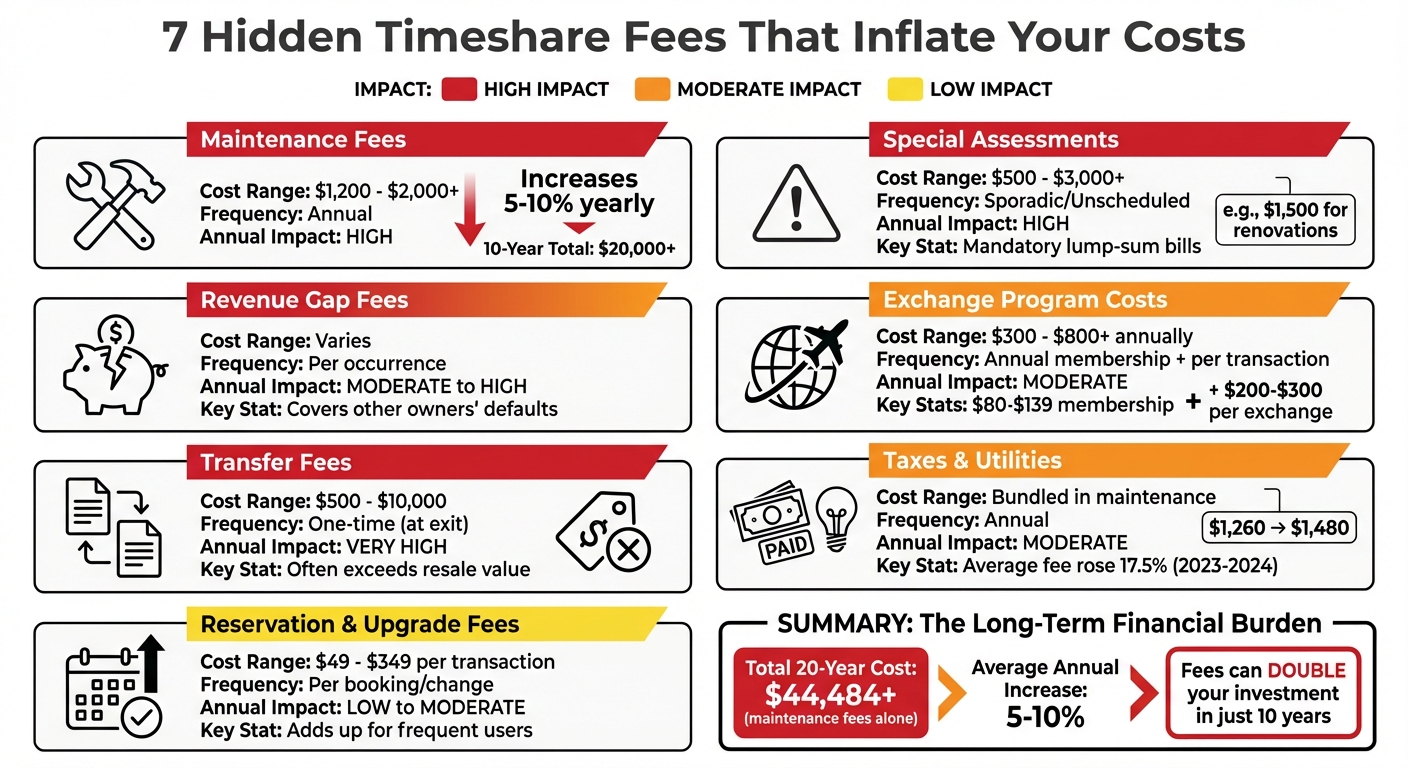
Timeshare Hidden Fees Comparison Chart: Annual Costs and Financial Impact
1. Escalating Maintenance Fees
Maintenance fees are unavoidable yearly expenses meant to cover upkeep, staffing, insurance, utilities, and management. The real shock comes from how quickly these fees can rise.
Cost Range
In 2024, the average U.S. timeshare maintenance fee climbed to $1,480, up from $1,260 in 2023 – a hefty 17.5% increase in just one year. Fees generally fall between $1,200 and $2,000 annually, but properties in high-demand spots like Hawaii and Florida often exceed $2,000. At premium resorts, these charges can skyrocket to $5,000 or more per year.
Frequency of Charges
Maintenance fees typically increase by 5%–10% annually, with some resorts pushing even higher. For instance, a Florida resort raised its fees by 13.74% in 2025, far outpacing the 2.3% inflation rate. In Lake Tahoe, Nevada, owners faced a 2025 bill of $3,410.66, while a Honolulu owner with two intervals had to pay a staggering $5,344.
Financial Impact
Over two decades, the average owner will shell out around $44,484 just for maintenance fees. To put that into perspective, a $1,400 annual fee growing at 6% per year adds up to over $20,000 in just 10 years. Alarmingly, about 50% of resorts plan to increase fees by 10% or more in the coming years. When some owners default, the remaining ones often absorb the unpaid costs. For example, at a Sedona, Arizona resort, 179 foreclosed intervals led to each owner being billed $2,620 to cover the shortfall.
Transparency in Contracts
One major issue with timeshare contracts is their lack of clarity regarding fee increases. Most agreements don’t include caps or clear formulas for calculating these fees. During sales presentations, maintenance fees are often pitched as "affordable annual dues", but the compounding increases are rarely mentioned. Timeshare Contract Resolution (TCR) highlights the problem:
"Your fees can go up as much as the developer decides, even when your income and travel plans do not increase at the same pace."
Additionally, many resorts don’t use competitive bidding for management contracts, which often results in fees rising faster than the actual operating costs. This lack of transparency around fee caps sets the stage for other hidden expenses, which will be explored further in upcoming sections.
sbb-itb-d69ac80
2. Unexpected Special Assessments
Special assessments are a hidden cost of timeshare ownership that can significantly increase expenses over time. Unlike the predictable annual maintenance fees, these are sudden, one-time charges meant to cover unforeseen expenses like hurricane damage, large-scale renovations, or revenue shortfalls. Let’s take a closer look at how these charges can impact your finances.
Cost Range
Special assessments usually range between $400 and $1,000, but they can sometimes climb much higher. For instance, in August 2025, a Sedona resort charged $1,500 per interval for cabinet replacements, jacuzzi repairs, and retiling. This came just two years after owners had already paid a $975 assessment for similar upgrades. Similarly, in Honolulu, Hawaii, a "Hotel Income Supplemental Assessment" issued in June 2025 cost owners $1,200 per interval. One owner, with two intervals, paid an additional $2,400 on top of their $2,944 annual maintenance fee, bringing the total for that year to a staggering $5,344.
Frequency of Charges
These assessments typically occur about once every six years, but they are becoming more frequent as resorts age. Properties built in the 1990s and early 2000s now require major repairs like replacing roofs, siding, and plumbing systems. For example, a Lake Tahoe vacation club issued a $969.66 assessment in 2025 to fund a $3.5 million renovation for new roofing, siding, and windows. The Sedona resort’s association explained the situation bluntly:
"We do not have the funds to keep operating as the yearly timeshare maintenance fees are just not enough to cover the expenses."
- Sedona Resort Association
Financial Impact
Over two decades, even modest special assessments can add approximately $3,333 to your total costs. These fees are mandatory once approved by the homeowners’ association and are shared among all owners. In Sedona’s case, the $1,500 assessment was partly due to 179 foreclosed intervals and 80 pending foreclosures, leaving the remaining owners to shoulder the unpaid costs. This highlights how financial strain within the ownership group can lead to higher expenses for everyone.
Transparency in Contracts
Sales presentations often highlight "affordable annual dues" and "locking in vacation costs", but they rarely emphasize the fine print that allows for special assessments. Important details – like how a $1,200 charge in Hawaii was allocated – are often buried in complex contract language. To avoid surprises, request a complete history of past assessments and planned projects before signing anything.
If the terms seem unclear, consider consulting a timeshare legal professional. For example, Aaronson Law Firm offers free consultations to help you understand your obligations.
3. Revenue Gap Fees
One unexpected cost that can catch timeshare owners off guard is the revenue gap fee. This fee is charged to cover budget shortfalls caused by other owners failing to pay their maintenance fees. Essentially, you’re footing the bill for someone else’s unpaid dues.
Cost Range
The exact amount of a revenue gap fee depends on the resort’s financial situation and how many owners are delinquent on their payments.
Frequency of Charges
Unlike annual maintenance fees, revenue gap fees don’t follow a predictable schedule. Resorts can impose these charges whenever they face a budget shortfall. This unpredictability can make it harder to plan for the total cost of ownership.
Financial Impact
These fees can feel especially frustrating because they’re mandatory and non-refundable. Even if the resort eventually collects the delinquent payments, you won’t see a refund. In essence, responsible owners end up subsidizing the financial gaps left by defaulters.
Transparency in Contracts
Unfortunately, many timeshare contracts include clauses that allow resorts to charge these additional fees, but they’re often buried in the fine print. Sales representatives rarely highlight these provisions during their pitches. That’s why it’s so important to carefully review the sections of your contract that deal with additional assessments and revenue gap fees. Understanding these terms upfront can save you from unpleasant surprises down the road.
If you’ve been hit with unexpected revenue gap fees or have questions about your timeshare agreement, it might be time to seek legal advice. Aaronson Law Firm offers free consultations and specializes in helping owners cancel their timeshare contracts, giving you a chance to better understand your rights.
4. Exchange Program Costs
Many timeshare owners are drawn to the idea of flexible vacationing through exchange programs. However, sales presentations often skim over the hefty fees tied to these networks. Major players like Resort Condominiums International (RCI) and Interval International (II) come with layers of costs that can pile up quickly. Here’s a closer look at what you might face.
Cost Range
Exchange programs come with two main types of fees: annual membership fees and exchange reservation fees. For instance, RCI’s membership costs hover around $80–$90 per year, while Interval International charges anywhere from $51 to $139, depending on your membership level. Beyond that, every exchange reservation typically adds another $200–$300. Additional charges – like guest certificates, unit size upgrades, or banking points – can push the total cost of a single vacation through these networks to $800 or more.
Frequency of Charges
The annual membership fee is a recurring cost, billed whether or not you use the service. On top of that, transaction fees apply every time you make a reservation. As noted by one industry source:
"The exchange fee you pay is for a ‘resort search’ that is meant to match your ideal parameters as closely as possible." – Centerstone Group
Financial Impact
These fees can significantly increase the overall cost of timeshare ownership. On average, exchange-related charges add about $300–$500 annually if you make just one exchange per year. Many owners eventually realize that these expenses can surpass the price of comparable hotel stays or vacation rentals.
Transparency in Contracts
Sales pitches often emphasize the allure of "vacationing anywhere" but bury the true costs in the fine print. In some cases, developers automatically enroll new owners in exchange programs during the purchase process, leading to surprise bills later on. If you’re unsure about these fees or feel misled, Aaronson Law Firm can help clarify your rights and obligations.
5. Real Estate and Transfer Fees
The price you see advertised for a timeshare often doesn’t tell the whole story. Closing costs and administrative fees can add anywhere from $500 to $2,000 on top of the purchase price. These extra charges, much like maintenance fees and special assessments, can catch owners off guard and significantly increase the long-term financial commitment. In 2024, the average timeshare transaction cost $23,160 – before financing. And financing? That often comes with interest rates as steep as 17% or higher.
Cost Range
Transfer fees come into play when ownership changes hands – whether you’re selling, gifting the timeshare to a family member, or surrendering it back to the resort. These fees can vary widely, from $500 to as much as $10,000. Some resorts offer deed-back programs with lower fees, typically around $400 to $500. However, many owners report paying thousands just to exit their agreements.
Frequency of Charges
These fees are not recurring; they’re one-time expenses tied to the initial purchase or the transfer of ownership. However, if you’re unable to pay the transfer fee, you remain responsible for ongoing maintenance costs, which can add up over time.
Financial Impact
High transfer fees can create a financial trap for owners. Many find that their timeshare has lost most of its resale value, often selling for as little as $3,000 on the secondary market compared to the original $23,000+ purchase price. When transfer fees are close to or even exceed the current market value of the timeshare, owners can feel stuck. This lack of transparency around fees is similar to other hidden costs associated with timeshares.
Transparency in Contracts
Like many other hidden fees, closing and transfer charges are often glossed over during sales presentations. As one industry expert put it:
"High-pressure sales highlight perks and skip the math. Key terms live deep in the paperwork. Owners feel blindsided when bills spike or access shrinks." – Timeshare Contract Resolution
Before signing any agreement, it’s essential to comb through your contract for details on deed-back provisions and perpetuity clauses. Understanding these fees is just as important as knowing about maintenance fee increases. Remember, most states allow a 3- to 10-day rescission period where you can cancel the purchase and receive a full refund. If you’re already locked in and facing unexpected transfer costs, Aaronson Law Firm can help review your contract and explore your legal options.
6. Taxes and Utility Charges
Owning a timeshare comes with more than just maintenance fees – taxes and utility charges can quietly add to the financial burden.
Annual maintenance fees often bundle property taxes, insurance, and utilities like electricity, water, and trash collection. However, most timeshare contracts lack clear guidelines or limits on how much these costs can rise. This gives developers the freedom to increase fees, even if your usage or travel plans stay the same.
Cost Range
The numbers can be surprising. In 2023, the average annual maintenance fee, which often includes utilities and property taxes, was $1,260. By 2024, that figure had climbed to $1,480 – a 17.5% jump in just one year. Location plays a huge role in costs. For example, timeshare owners in Sedona, Arizona, paid $1,120 annually in 2025, while those in Honolulu, Hawaii, faced a hefty $2,944. On top of that, property taxes alone can add $1,000 or more, and these are often billed separately.
Frequency of Charges
These costs typically show up once a year as part of your maintenance fees. Occasionally, resorts might also issue additional assessments to cover unexpected tax or utility shortfalls.
Financial Impact
Here’s the kicker: you’re on the hook for these charges whether you use your timeshare or not. Over time, long-term owners often find themselves absorbing rising operational costs. With an average annual increase of 7%, your total bill could double in just ten years. In many cases, owners discover they’re paying more in fees than it would cost to simply book the same resort as a regular guest.
Transparency in Contracts
Sales pitches rarely highlight the details of utility and tax costs. According to the National Association of Attorneys General:
"Most states lack disclosure rules that would put a consumer on notice that they are signing up for a lifelong commitment to pay an undetermined amount of money that will increase each year."
Before signing a contract, ask whether property taxes are included in the maintenance fee and request a detailed history of past charges. Many states allow a 3- to 14-day rescission period, during which you can cancel the agreement and get a full refund. If you’re already locked into a contract with rising fees, Aaronson Law Firm can help review your agreement and explain your legal options. Fully understanding these costs is essential to avoid surprises down the line.
7. Reservation, Cancellation, and Upgrade Fees
Owning a timeshare might seem like a hassle-free way to plan vacations, but many owners quickly realize it comes with unexpected costs. Among these are reservation fees, cancellation charges, and upgrade costs, which can add hundreds of dollars to each trip. These expenses are often not clearly explained during the sales pitch, leaving owners to discover them later. Such hidden fees can significantly increase the ongoing financial burden of owning a timeshare.
"Some properties also implement booking fees or reservation charges that weren’t clearly explained during the sales process. You thought you owned the right to use the property, but then you discover there are additional costs just to make a reservation." – Timeshare Legal
Cost Range
In addition to the membership fees for exchange programs mentioned earlier, timeshare owners face specific charges for reservations and upgrades. For example:
- Transaction fees for points members: $59 to $349 per transaction
- Modifications or point transfers: $49 to $249
- Cancellation protection: Around $129 per reservation, allowing cancellations within 30 days of arrival without losing points
These fees aren’t one-and-done – they can add up over time and become a recurring expense.
Frequency of Charges
These charges apply to each transaction, and if you’re part of an exchange program, you’ll also need to renew your membership annually. For frequent travelers who book multiple trips or often switch destinations, these costs can quickly spiral out of control.
Financial Impact
The financial strain doesn’t stop there. Many timeshare owners report being unable to book their desired weeks through the system, only to find the same units available on public hotel booking platforms. This forces them to pay out-of-pocket for accommodations they technically already own – essentially paying twice for the same vacation. And if you don’t have cancellation protection, changing or upgrading a reservation close to your travel date (within 30 to 60 days) could mean losing all your points for that booking. When combined with maintenance and assessment fees, these additional charges can make your annual timeshare costs skyrocket.
Transparency in Contracts
Sales representatives often focus on showcasing glossy brochures and appealing base costs, while skimming over the fine print. Most states offer a rescission period – a limited window to cancel a new timeshare contract. For example:
- Florida: 10 days
- California, Hawaii: 7 days
- Nevada: 5 days
If you’re already locked into a contract and struggling with mounting fees, check your resort’s website for options like "exit services" or "deed-back" programs. These programs may allow you to cancel your timeshare for a processing fee of $400 to $500. Before turning to third-party exit companies that charge $3,000 to $7,000 upfront, consider consulting legal experts like Aaronson Law Firm. They can review your contract and help you explore more cost-effective ways to exit your timeshare.
Fee Comparison Table
The table below provides a side-by-side look at the major fees associated with timeshare ownership, breaking down their typical costs, frequency, and overall financial impact.
| Fee Category | Typical Cost Range | Frequency | Estimated Annual Impact |
|---|---|---|---|
| Maintenance Fees | $1,200 – $2,000+ | Annual | High; increases 5–10% yearly |
| Special Assessments | $500 – $3,000+ | Sporadic/Unscheduled | High; mandatory lump-sum bills |
| Revenue Gap Fees | Varies (hotel rate) | Per occurrence | Moderate to High; paying twice for the same vacation |
| Exchange Program Costs | $109 – $768 membership + $59 – $349 per swap | Annual + Per transaction | Moderate; compounds with each use |
| Real Estate & Transfer Fees | $3,000 – $7,000+ | One-time (at exit) | Very High; often exceeds resale value |
| Taxes & Utility Charges | Varies by location | Annual (often bundled) | Moderate; difficult to track separately |
| Reservation, Cancellation & Upgrade Fees | $49 – $349 per transaction | Per booking/change | Low to Moderate; adds up for frequent users |
Maintenance fees stand out as the most impactful over time because they recur annually and grow steadily. For example, a $1,400 maintenance fee rising by 6% each year can surpass $20,000 within a decade – before considering any other expenses.
Special assessments, on the other hand, can deliver a sudden financial blow. These unpredictable lump-sum charges often cover major repairs or renovations, leaving owners scrambling to pay thousands of dollars without warning.
Conclusion
Hidden fees can turn what seems like a great vacation deal into a financial headache. The upfront cost of a timeshare is just the tip of the iceberg. Over time, rising maintenance fees and unexpected special assessments can significantly inflate the total cost of ownership, sometimes doubling it within ten years.
This highlights why it’s so important to read every detail of your contract before signing. Pay close attention to clauses about fee increases and perpetuity agreements. Investigate the resort’s track record with special assessments and evaluate how transparent the homeowners’ association is. If you’re still in the decision-making phase, keep in mind that many states offer a short rescission period, allowing you to cancel for a full refund if you uncover hidden costs shortly after purchase.
For those already tied to a timeshare and feeling burdened by escalating fees, professional legal help can make all the difference. Aaronson Law Firm specializes in timeshare contract cancellations, offering free consultations to assess your situation. They provide services like legal demand letters, credit protection, and litigation support, all aimed at helping you permanently terminate your contract and break free from ongoing fees.
Trying to exit a timeshare on your own can risk damaging your credit or even lead to collections. For expert advice and a clear path forward, visit Aaronson Law Firm. Whether you’re considering a timeshare or looking for a way out, understanding these hidden fees is key to protecting your financial well-being.
FAQs
Can my timeshare fees be capped?
Timeshare fees might be capped in certain situations, depending on the terms of your contract or through legal measures. However, recurring costs like maintenance fees and special assessments often increase over time unless your agreement specifically restricts these hikes or you take legal steps to address them. If you’re dealing with these challenges, it’s a good idea to seek advice from a legal professional who focuses on timeshare contracts.
How can I predict future fee increases?
Future timeshare fee increases are usually tied to a few common factors: aging resort properties, inflation, and special assessments. As resorts get older, they naturally require more upkeep, and the rising costs of labor, materials, and utilities often end up being passed along to owners. To stay ahead of potential hikes, it’s a good idea to keep an eye on your resort’s financial history, the condition of the property, and broader economic trends. Regularly reviewing financial disclosures and staying informed can help you better prepare for any upcoming changes in fees.
What’s the safest way to exit a timeshare?
The best way to get out of a timeshare is to know your legal rights and choose trustworthy options. If you’re still within the rescission period – a cooling-off window set by your state or contract – you can cancel the agreement by sending a written notice. Alternatively, you can reach out to your developer about deed-back programs or hire a qualified attorney to review your contract and guide you through a safe, scam-free exit.
Related Blog Posts
- Understanding Timeshare Maintenance Fees and Legal Rights
- 8 Hidden Timeshare Fees to Watch For
- Why Timeshare Special Assessments Keep Increasing
- Timeshare Maintenance Fees: What Developers Must Disclose