
Public Offering Statements (POS) are mandatory disclosures for timeshare purchases, outlining property details, financial obligations, and buyer rights. States have distinct rules for POS, including cancellation periods, filing fees, and disclosure requirements. For example:
- Louisiana: 7-day cancellation, $500 or $10/unit filing fee, 1-year rescission if no POS provided.
- Mississippi: 7-day cancellation, $1,000 filing fee, no per-unit fees.
- Maryland: 10-day cancellation, $1/unit fee (max $500), buyers can void contracts for up to 1 year if POS isn’t provided.
- North Carolina: 5-day cancellation, detailed 21-element POS disclosure.
- Tennessee: 10–15 day cancellation (depending on property visit), $500 filing fee.
Each state differs in buyer protections, fees, and processes, making it essential to understand local laws before committing to a timeshare. Always review the POS carefully and consult legal advice if needed.
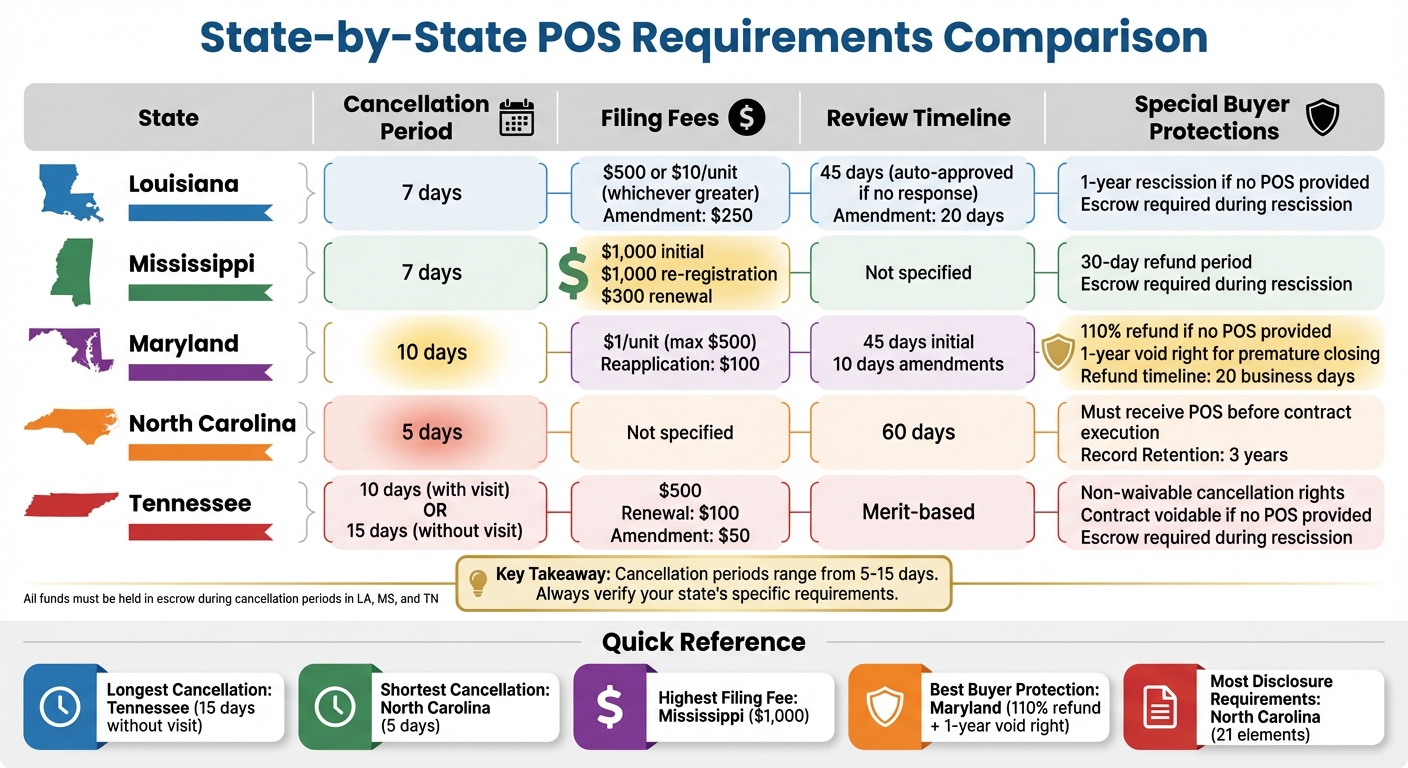
Public Offering Statement Requirements by State: Comparison of Cancellation Periods, Filing Fees, and Key Protections
1. Louisiana POS Requirements
Filing Agency and Fees
The Louisiana Real Estate Commission (LREC) is responsible for managing public offering statement (POS) filings for timeshare plans in Louisiana. Before any timeshare units can be marketed to potential buyers, developers must submit their POS to the LREC for approval. The commission processes these applications within 45 days. If no certificate or deficiency notice is issued during this time, the registration is automatically considered effective.
The filing fee is $500 or $10 per timeshare unit, whichever is greater. For instance, a timeshare development with 75 units would owe $750, exceeding the base $500 fee. Filing amendments to an existing POS costs $250. Developers must complete their application process within six months or face the requirement of submitting a new application with full fees.
In addition to fees and timelines, Louisiana enforces strict disclosure standards for POS filings.
Disclosure Requirements
A Louisiana POS must include several key details, such as the developer’s name and address, a thorough description of the timeshare interests being offered, and a 12-month budget (either current or projected). It must also disclose any liens or encumbrances on the property title, pending lawsuits or disciplinary actions, and details about liability and casualty insurance. For multisite timeshare plans, additional information is required, including descriptions of all component sites, rules for the reservation system, and an explanation of the purchaser’s financial obligations for associated fees.
Purchaser Receipt Certification
Developers are legally required to obtain written confirmation from buyers that they have received the POS. According to LA Rev Stat § 9:1131.9.2:
"The public offering statement shall be dated and shall require the purchaser to certify in writing the receipt thereof."
The POS can be delivered electronically, such as on a CD-ROM, but only with LREC approval. Regardless of the delivery method, written acknowledgment from the purchaser is mandatory.
Rescission Rights
Louisiana law allows purchasers to cancel their timeshare agreement within seven days of receiving the POS or signing the contract – whichever comes later – without incurring penalties. If the developer fails to provide the POS before or at the time of sale, the purchaser has the right to cancel the transaction within one year of eventually receiving the statement. To further protect buyers, all purchase payments must be held in an independent escrow account until the rescission period ends. Noncompliance with escrow requirements can result in penalties of up to $3,000 or a prison sentence of up to 10 years.
Amendment Rules
Once a POS is approved, any material changes must be submitted to the LREC as an amendment before they take effect. The commission has 20 days to either approve the amendment or identify deficiencies. If no action is taken within this timeframe, the amendment is automatically approved. If a material change negatively impacts the offering and occurs before a transaction is finalized, the developer must notify the purchaser. The buyer is then granted a new seven-day cancellation period from the date they receive the updated information.
These regulations reflect Louisiana’s strong commitment to ensuring transparency and safeguarding consumer rights in timeshare transactions.
sbb-itb-d69ac80
2. Mississippi POS Requirements
Filing Agency and Fees
The Mississippi Real Estate Commission (MREC) handles public offering statement (POS) filings for timeshare developments under Rule 8.4. While the state prioritizes compliance with disclosure rules, it does not charge per-unit filing fees. For securities registrations, developers must file with the Mississippi Secretary of State’s Securities Division. The costs include a $1,000 initial filing fee, $1,000 for re-registration, and $300 for renewals. Late securities filings come with a penalty of 1% of the dollar amount sold in Mississippi, capped at $5,000.
These fees establish the foundation for the state’s detailed disclosure expectations.
Disclosure Requirements
Mississippi’s public offering statement must provide key information about the developer, including their name, primary address, and a summary of their business and property management experience. Financial details should cover a current or projected annual budget, reserves for repairs and replacements, projected common expense liabilities, and all purchaser fees, such as closing costs and annual assessments. Additionally, the statement must disclose any liens, defects, or encumbrances on the property title, along with any bankruptcies, pending lawsuits, or disciplinary actions that could impact the developer’s ability to perform. For timeshare plans using reservation systems, the POS must explain the operating entity, access rules, and how demand is managed.
Purchaser Receipt Certification
Mississippi law requires clear acknowledgment from purchasers after receiving the public offering statement. Specifically:
"The public offering statement shall be dated and shall require the purchaser to certify in writing the receipt thereof."
Electronic delivery, such as via CD-ROM, is permitted with Commission approval, but written acknowledgment from the purchaser remains mandatory.
Rescission Rights
Buyers in Mississippi have the right to cancel their timeshare contract within seven calendar days after either signing the contract or receiving the public offering statement – whichever happens later. No penalties apply for cancellations. To cancel, purchasers must send a written notice to the address listed in the POS. Developers must refund all payments within 30 days of cancellation, minus any benefits the buyer may have already received. During this seven-day period, all funds must be held in escrow at an approved depository, such as a bank, trust company, or real estate broker trust account, ensuring refunds are available. Unlike Louisiana, which offers extended rescission rights in certain cases, Mississippi consistently applies a seven-day cancellation window.
Amendment Rules
Developers must file any material changes to an approved POS or registration with the MREC before implementing them. If buyers receive updated information about material changes, they are entitled to a new seven-day rescission period starting from the date they receive the revised POS.
3. Maryland POS Requirements
Maryland’s process for handling public offering statements (POS) emphasizes thorough filing procedures and strict disclosure rules, ensuring transparency and safeguarding buyers in timeshare transactions.
Filing Agency and Fees
The Maryland Secretary of State is responsible for overseeing all public offering statement filings related to timeshare projects. Developers must submit their POS for approval before presenting it to potential buyers. The filing fee is $1 per unit, with a maximum of $500. If the filing is rejected, developers must pay a $100 reapplication fee for amendments. The agency has 45 days to review and either approve or reject the initial submission; if no decision is made within this time, the POS is automatically approved. For amendments, the review period is 10 days.
Once approved, the POS must include detailed financial and legal disclosures to provide buyers with essential information.
Disclosure Requirements
The POS must begin with a cover page that includes the project name, location, and a statutory warning:
"This public offering statement contains important matters to be considered in acquiring a time-share. The statements contained herein are only summary in nature. A prospective purchaser should refer to all references, exhibits thereto, contract documents, and sales materials. You should not rely upon oral representations as being correct."
- Maryland Code § 11A-112
Developers must also include a CPA-prepared balance sheet and a one-year projected budget outlining reserves for repairs, expense liabilities, and key assumptions. Additionally, any liens, defects, or encumbrances affecting the title must be disclosed, along with unsatisfied judgments or ongoing litigation involving the developer or managing entity. Those who contribute significant information to the POS are held accountable for false statements or omissions. Violations made knowingly are treated as misdemeanors, punishable by fines of up to $10,000 and up to six months in jail.
Rescission Rights
Buyers are granted a 10-day cancellation period, starting from the latest of the following events: signing the contract, receiving the complete POS, or when the unit becomes ready for occupancy. This right cannot be waived under any circumstances, and any attempt to do so is considered unlawful. If a buyer cancels, the developer must refund all payments within 20 business days, minus any proportional benefits received. Closings cannot occur until the 10-day period ends. If a closing happens prematurely, the buyer has the right to void the transaction for up to one year after the cancellation period. If the developer fails to provide the POS before the transfer and the buyer cancels, the purchaser is entitled to 110% of the sales price paid.
Amendment Rules
Developers must file all material changes to the POS for approval before distributing them publicly. The agency has 10 days to review and decide on these amendments; if no decision is made, the changes are automatically approved. Updates to the POS should reflect material changes such as budget adjustments, new board policies, or amendments to declarations, ensuring compliance with consumer protection laws.
4. North Carolina POS Requirements
North Carolina has specific rules for public offering statements (POS) related to timeshare programs, as outlined in Chapter 93A. These regulations are enforced by the North Carolina Real Estate Commission, which oversees the registration process and ensures compliance before any sales can occur.
Filing Agency and Fees
The North Carolina Real Estate Commission is responsible for handling timeshare program registrations. Developers must submit their applications, and the Commission will notify them of any issues within 30 days. A decision or certificate of registration is typically issued within 60 days. While the exact fees for timeshare registrations under Chapter 93A aren’t specified in the guidelines, developers must ensure their registration is approved before proceeding with sales. Once registered, developers are required to provide detailed disclosures to potential purchasers.
Disclosure Requirements
The public offering statement must include 21 specific elements. It starts with a cover page that clearly warns purchasers not to rely on oral representations. Key disclosures include:
- The developer’s name and address.
- A general overview of the timeshare program.
- Details of the unit types, including the number of bedrooms and bathrooms.
- Full information about the reservation system.
Financial details must also be provided, covering how assessments are calculated, the status of reserve funds, and any guarantees about assessment levels. Developers must include an estimate of the current year’s operating budget and attach the timeshare declaration, bylaws, and rules as exhibits. Additionally, they must disclose any significant legal or financial issues, such as lawsuits, adjudications, or bankruptcies, from the past five years. A clear warning must also be included, advising purchasers to base their decision on the vacation experience rather than any expectation of investment returns.
Purchaser Receipt Certification
Before finalizing a contract, developers must provide the public offering statement to purchasers and obtain a written acknowledgment of receipt. According to North Carolina General Statutes § 93A-44:
The developer shall, prior to the execution of a contract of sale, provide the purchaser with a copy of the public offering statement and shall obtain from the purchaser a written acknowledgement of receipt.
These signed receipts must be kept for three years. If the documents are delivered electronically, developers must also provide a separate paper or email copy of the purchaser’s cancellation rights in an easily noticeable format.
Rescission Rights
After receiving the required disclosures, purchasers have the right to cancel their timeshare contract without penalty. This five-day cancellation period begins on the later of two dates: when the contract is signed or when all necessary documents are received. The deadline for cancellation is midnight on the fifth day. This right also applies to timeshare resale contracts and transfer services agreements. The public offering statement must include a clear notice that states:
You may cancel this contract of sale without any penalty or obligation before midnight five days after the date you sign this contract of sale or received the required public offering statement and all documents required to be delivered to you, whichever is later.
Amendment Rules
Developers must promptly report any material changes to the Commission. This ensures that purchasers receive accurate and up-to-date information throughout the sales process, reinforcing consumer protection measures.
5. Tennessee POS Requirements
Tennessee’s regulations for public offering statements (POS) stand out with their detailed approach, aimed at protecting buyers and ensuring transparency. Governed by the Tennessee Real Estate Commission and outlined in Tenn. Code Ann. § 66-32-112, these rules mandate thorough disclosures and emphasize safeguarding buyer rights.
Filing Agency and Fees
The Tennessee Securities Division, part of the Tennessee Department of Commerce and Insurance, oversees the review of timeshare filings. This review is merit-based, with filing fees set at $500, while renewal and amendment fees are $100 and $50, respectively.
Disclosure Requirements
Tennessee requires the POS to address 15 key topics, such as developer details, financing options, and cancellation rights. As John O. Belcher, Founding Member of Belcher Sykes Harrington, PLLC, explains:
A public offering statement must be provided to each purchaser of a time-share interval and must contain or fully and accurately disclose… This is a very specific, toothy requirement.
The POS must include essential details like the developer’s name and address, a general description of the timeshare units, financing terms (if offered), and an explanation of the purchaser’s right to cancel. If promotional gifts or prizes are part of the sale, the seller must disclose the name and address of the offeror, the approximate retail value of the gift, the odds of winning (if applicable), and any conditions or restrictions for receiving the item. However, certain transactions are exempt from requiring a POS, such as owner-to-owner resales, court-ordered dispositions, government actions, foreclosures, or transfers made as a gift.
Purchaser Receipt Certification
The POS must be delivered to buyers no later than the signing of the sales contract. If the document is not provided, the agreement remains voidable even after the cancellation period. This ensures buyers have the opportunity to review all critical information before finalizing their purchase.
Rescission Rights
Tennessee offers a flexible cancellation policy depending on whether the buyer has visited the property. Buyers who inspect the site have 10 days to cancel, while those who do not visit have 15 days from the contract signing date. Importantly, this right to cancel cannot be waived. During the cancellation period, all funds must be held in escrow and are only released after the period ends and no cancellation notice has been received.
Amendment Rules
Any material changes to the POS must be filed as amendments to keep buyers informed and updated throughout the process.
Pros and Cons
Each state handles public offering statement (POS) requirements differently, aiming to balance consumer protection with the needs of developers. These variations shed light on why some states are seen as more buyer-focused, while others prioritize smoother processes for developers. Here’s a closer look at how some states approach these regulations and what it means for buyers and developers alike.
Louisiana gives buyers a 7-day window to cancel their purchase. The state charges a filing fee of $500 or $10 per unit (whichever is higher) and has a 20-day amendment review period. If the commission doesn’t act within those 20 days, the amendment is automatically approved. While this reduces delays, it also shortens the time buyers have to review changes.
Maryland stands out as being more buyer-friendly. It offers a 10-day rescission period, giving purchasers extra time to back out of a deal. If the developer fails to provide the POS before the transfer, buyers can cancel and receive 110% of the sales price they paid. This added protection ensures developers follow through on disclosure requirements.
Tennessee provides flexible cancellation terms: buyers who inspect the property have 10 days to cancel, while those who don’t inspect get 15 days. These rights cannot be waived, offering additional safeguards, especially for remote buyers.
Mississippi has a 7-day cancellation period and does not charge per-unit filing fees for POS submissions. However, securities registrations come with a $1,000 initial filing fee. To protect buyers, all funds must be held in escrow during the rescission period.
North Carolina offers buyers a shorter 5-day cancellation period, which is less time compared to other states. However, the state mandates that the POS includes 21 specific disclosure elements, ensuring buyers receive detailed information upfront.
For developers, filing fees and review timelines vary widely. Louisiana and Maryland have similar review periods of around 45 days, both including "deemed approved" provisions to prevent indefinite delays. North Carolina’s review period extends to 60 days, and Tennessee uses a merit-based review process. These differences create unique challenges for developers operating across multiple states, as they must navigate varied administrative requirements and timelines.
Conclusion
Navigating state-specific POS requirements can be a challenge for timeshare buyers, as the rules differ widely across the country. For example, cancellation periods range from 5 days in North Carolina to 10 days in Maryland, with Tennessee allowing up to 15 days for buyers who haven’t inspected the property. These differences can be the deciding factor in whether a buyer can cancel a contract or becomes legally bound. Filing fees and disclosure rules also vary significantly. In Louisiana, developers pay $500 or $10 per unit (whichever is greater) for POS submissions, while Mississippi doesn’t impose per-unit fees. Understanding these nuances is crucial before committing to a timeshare.
Failing to account for these state-specific rules can lead to serious consequences. Maryland, for instance, offers strong protections: if a developer misrepresents cancellation rights, buyers may void the transaction for up to a year after the cancellation period ends. However, these protections only work if buyers are aware of them.
The importance of written disclosures cannot be overstated:
"The purchase of a timeshare interest should be based upon its value as a vacation experience or for spending leisure time, and not considered for purposes of acquiring an appreciating investment." – Florida Statutes § 721.07
Make sure to check your state’s cancellation deadline before signing anything. Missing this deadline could mean losing your right to rescind. Pay close attention to disclosures in the POS, especially those in "conspicuous type", as they highlight critical risks. Never rely on verbal promises from sales representatives – if it isn’t in writing within the POS or contract, it likely isn’t enforceable.
Given the complexity of these regulations, consulting with an experienced attorney is highly recommended. Aaronson Law Firm specializes in timeshare-related legal issues and can help you understand state-specific requirements, spot illegal contract terms, and safeguard your cancellation rights before you’re locked into a binding agreement. They offer free consultations to help you navigate these legal intricacies and protect your interests. Taking the time to review these details can make all the difference in securing your investment.
FAQs
When does my cancellation period start?
When it comes to canceling a contract, the cancellation period – also known as the rescission or cooling-off period – usually starts either when you sign the contract or when you receive the public offering statement. The exact timing depends on the laws in your state. Most states give you anywhere from 3 to 15 days to cancel, so it’s important to act fast. To make sure your cancellation is valid, send your notice using an approved method, like certified mail, and do so within the allowed timeframe.
What if I never got the public offering statement?
If you didn’t get a public offering statement before buying a timeshare, it might be a breach of state laws. In many states, developers are legally required to provide this document before finalizing a sale or contract. Without it, you could have the right to dispute or cancel the agreement. To understand your situation and potential next steps, consult a legal professional who specializes in timeshare law.
Does a POS apply to timeshare resales too?
A Public Offering Statement (POS) is primarily relevant during the initial sale of a timeshare interest. Developers are required to provide this document before marketing timeshares to potential buyers. When it comes to resales, the POS generally doesn’t come into play. Instead, most states emphasize disclosure requirements for resellers rather than requiring the reissuance of a POS. However, a few states may have specific rules for resales that mandate providing details similar to those in the original POS.
Related Blog Posts
- State Laws on Timeshare Documentation Requirements
- Timeshare Laws: Federal vs. State Protections
- State Laws on Timeshare Resale Restrictions
- Acknowledgment of Receipt in Timeshare Contracts