
Consumer rights addendums ensure transparency and protect timeshare buyers from hidden fees, unclear terms, and high-pressure sales tactics. These addendums outline your right to cancel, require clear contract terms, and prevent developers from finalizing sales during the rescission period. They also mandate developers to disclose all costs upfront, ensuring buyers avoid unexpected financial obligations.
Key protections include:
- Right to cancel: Buyers can back out penalty-free within 3 to 15 days, depending on state laws.
- Clear terms: Contracts must clearly state fees, cancellation rights, and contact details.
- Legal remedies: Violations, like denying cancellation rights, can lead to legal action.
If you face issues, review your contract, document violations, and consult an attorney to enforce your rights.
Problems Timeshare Owners Face
Before consumer rights addendums became standard, timeshare buyers often found themselves locked into long-term commitments they didn’t fully understand. Let’s break down the key challenges that made these protections so necessary.
High-Pressure Sales Tactics
Timeshare sales presentations are notorious for their aggressive and manipulative tactics. They’re designed to make you sign on the spot, often without giving you time to think it through. Salespeople create a false sense of urgency with "today-only" deals and claims of limited availability. The Federal Trade Commission (FTC) warns against this, stating: "The company sets the rates, so why aren’t those available later? This kind of rush is a warning sign: they may not want you to talk to trusted advisers about the timeshare offer or stop and think about what you’re getting into."
These presentations can stretch far beyond the promised 90 minutes, sometimes lasting for hours. By the end, you’re worn down and more likely to give in. Emotional manipulation is another common tactic – they’ll ask about your family, your dream vacations, or even imply that not buying means depriving your children of cherished memories. Some sales teams even separate couples, targeting the more enthusiastic partner to create pressure from within the relationship. It’s no wonder industry research shows about 15% of attendees leave these pitches as timeshare owners. This high-pressure environment highlights why transparent contract protections are so important.
Hidden Fees and Financial Obligations
The price you’re shown during a sales pitch is rarely the full picture. Timeshare owners often discover unexpected costs after signing, turning what seemed like an affordable getaway into a financial headache. For instance, the average annual maintenance fee is around $660 – but this figure can climb each year due to inflation, resort upgrades, or repairs. And here’s the kicker: you’re required to pay these fees whether you use your timeshare or not.
On top of maintenance fees, there are often additional charges like per-night taxes and special assessments, which can add thousands to your yearly costs. These fees are often buried in the fine print or glossed over during the sales pitch, leaving buyers shocked when the bills start piling up. Worse, failing to pay these fees can lead to foreclosure and a damaged credit score – consequences many buyers never see coming. These hidden costs make it clear why better disclosure and consumer protections are vital.
Unclear Contract Terms
Even if you manage to resist the sales pressure and read the fine print, timeshare contracts are often riddled with vague and confusing language. Salespeople might make verbal promises about easy resale options or simple exit strategies, but these guarantees rarely make it into the written agreement. Contracts often blur the lines between "deeded" timeshares and "points-based" systems, leaving buyers unsure of what they actually own – or what they’re passing down to their heirs.
Many contracts also include perpetuity clauses, which lock owners and their families into financial obligations indefinitely. Yet, these clauses are rarely explained during the sales process. Another common issue? Rescission periods – your window to cancel the agreement – are often short and not clearly disclosed. By the time buyers realize what they’ve signed, it’s often too late to back out. These unclear terms underscore the need for stronger consumer protections and clearer contract language.
Understanding Consumer Rights Addendums
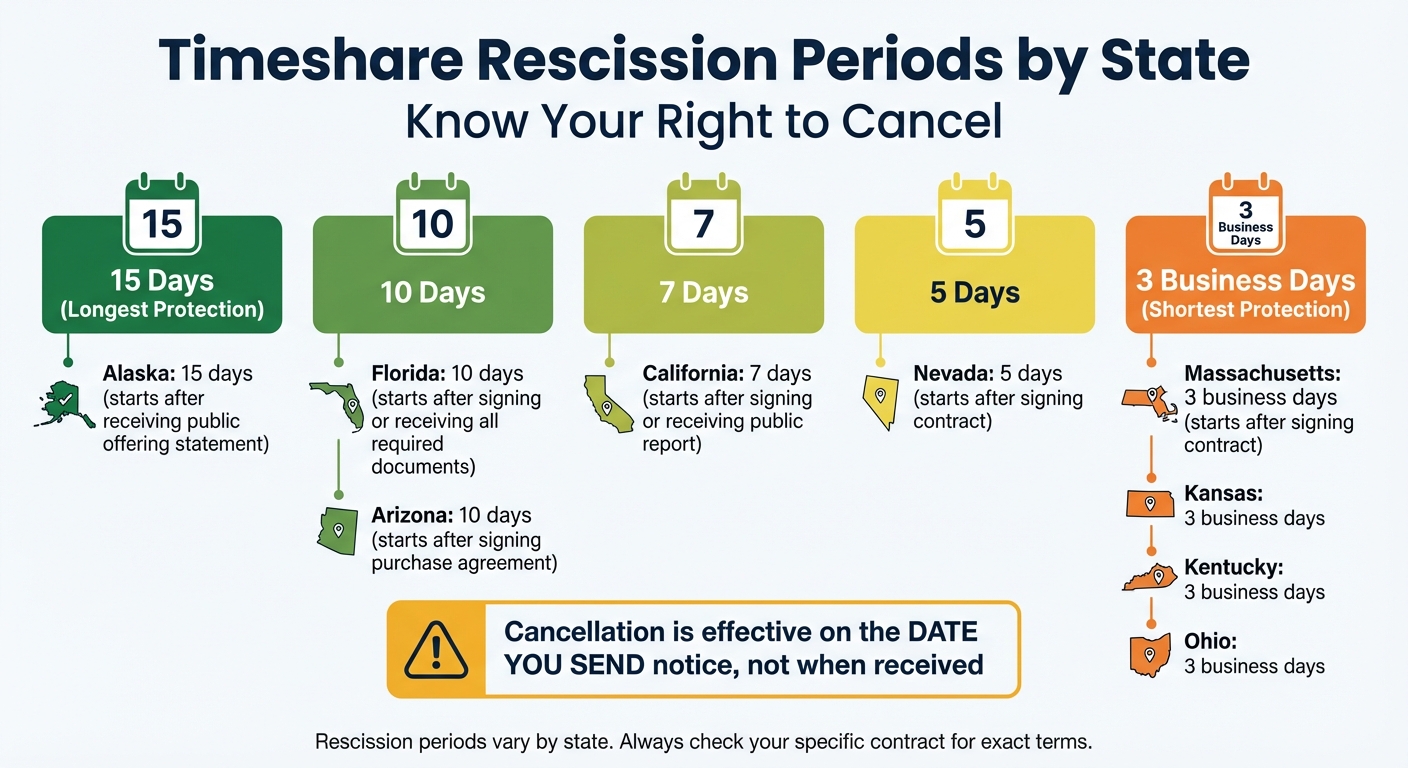
Timeshare Rescission Periods by State: Your Cancellation Rights Timeline
Consumer rights addendums are a mandatory safeguard built into timeshare purchase agreements. Their role is straightforward: they promote transparency and shield buyers from questionable practices. Below, we’ll break down what these addendums entail and the legal framework that governs them.
Definition and Purpose
Consumer rights addendums require developers to provide clear, prominent disclosures about your rights as a buyer. One of the most critical rights is your ability to cancel the contract, penalty-free, within a specific timeframe. This right, known as the rescission right, cannot be waived under any circumstances. As stated in Florida Statutes § 721.06:
"Any attempt to obtain a waiver of your cancellation right is void and of no effect." – Florida Statutes § 721.06
These addendums also require developers to include detailed financial disclosures. This includes the initial purchase price, additional fees, and estimates for recurring annual costs like maintenance or taxes. States such as Florida and Arizona mandate that these disclosures appear prominently – often in bold – right before the signature line, ensuring they aren’t buried in fine print.
Legal Framework for Addendums
The specifics of consumer rights addendums vary by state, with laws tailored to where the timeshare is located. For example, Florida’s Chapter 721, Arizona’s Title 32, and Washington’s RCW 64.36 all outline the required format and content for these disclosures.
One key protection is the rescission period, which gives buyers time to cancel the contract. These periods range from 3 to 15 days, depending on the state. During this time, developers are prohibited from finalizing the sale, ensuring buyers have the chance to review the agreement thoroughly. For instance, Florida and Arizona provide a 10-day window, while Alaska offers a generous 15-day period. At the shorter end, states like Kansas, Kentucky, and Ohio allow only 3 business days. Below is a quick comparison:
| State | Rescission Period | When It Starts |
|---|---|---|
| Florida | 10 Days | After signing or receiving all required documents |
| Arizona | 10 Days | After signing the purchase agreement |
| Alaska | 15 Days | After receiving the public offering statement |
| California | 7 Days | After signing or receiving the public report |
| Nevada | 5 Days | After signing the contract |
| Massachusetts | 3 Business Days | After signing the contract |
Knowing these timelines is essential for protecting your right to cancel. This structure ensures developers cannot finalize a sale until the buyer’s rescission period has passed. If a developer blocks your cancellation without a valid legal reason, it may be considered an unlawful act and could lead to an investigation by the state Attorney General.
Protections Provided by Consumer Rights Addendums
Consumer rights addendums are designed to shield timeshare owners from potential pitfalls, offering three key protections. These safeguards tackle common challenges like hidden fees and difficulties in canceling agreements.
Clear Contract Terms
One of the most important protections is the requirement for clear and detailed contract terms. Developers must provide written documentation of your purchase, ensuring you receive a full paper copy of the signed agreement immediately. This guarantees that you have an accurate, unaltered record of the deal.
The contract must include essential financial details, such as the purchase price, all associated fees, and the seller’s physical address and phone number. These details are critical, especially if you need to send a cancellation notice. Additionally, the rescission disclosure – your right to cancel – must be printed prominently near the signature line, leaving no room for ambiguity. This transparency lays the groundwork for enforcing your cancellation rights.
Right to Cancel Contracts
The addendum also strengthens your ability to cancel the contract. You can back out of the agreement without penalty, provided you do so within the timeframe set by state law. For instance, the Arizona Revised Statutes specify:
"The purchaser may cancel the purchase agreement without a penalty or obligation within ten calendar days, or another time period if applicable, after the purchaser signs the purchase agreement."
- Arizona Revised Statutes
Cancellation becomes effective on the date you send the notice. Once the agreement is rescinded, any security interest tied to the contract is void, and you’re no longer responsible for any payments, including finance charges.
Developers are required to return any money or property you provided – such as application fees or broker fees – within 20 calendar days of receiving your cancellation notice. If they fail to collect the returned property within that timeframe, you’re released from any further responsibility for it.
Legal Remedies for Violations
If a developer violates the addendum requirements, you have legal options to hold them accountable. For example, denying your right to cancel without a valid legal reason is considered an unlawful act. As outlined in the Arizona Revised Statutes:
"The denial of a purchaser’s rights under this section without a good faith legal basis constitutes an unlawful practice… The attorney general may investigate and take appropriate action."
- Arizona Revised Statutes
Federal laws add another layer of protection. If a developer fails to provide critical disclosures – like information on annual percentage rates or membership fees – you may have up to three years to rescind the agreement. These rules ensure developers remain accountable, with potential consequences including civil penalties, administrative sanctions, and the filing of release or termination statements in public records.
sbb-itb-d69ac80
How Consumer Rights Addendums Solve Timeshare Problems
This section delves into how consumer rights addendums offer practical solutions to common timeshare challenges. The focus here is on verifying compliance, asserting your rights, and seeking professional assistance when necessary.
Checking Compliance with Addendum Requirements
Start by carefully reviewing your timeshare contract to ensure it meets legal requirements. Pay special attention to the rescission disclosure, which must be placed immediately before the signature line. For example, in Florida, this notice must be in bold, 12-point font or larger. If the contract lacks the seller’s physical address or telephone number, this is a red flag for non-compliance. These details are legally required so you can properly send a cancellation notice.
Also, verify whether the developer attempted to finalize the sale or transfer the deed before your rescission period expired – a practice that is prohibited under state law. If you identify any of these violations, document them thoroughly, including retaining pages with missing disclosures.
Once non-compliance is confirmed, it’s time to take action to enforce your rights.
Using Addendums to Enforce Legal Rights
If you find that your contract is non-compliant, send a written cancellation notice to the address specified in your agreement. It’s important to note that your cancellation notice is considered effective on the date you send it – not when the developer receives it. To ensure you’re within the required timeframe, keep proof of when you mailed the notice.
In cases where the developer fails to provide necessary disclosures – like annual percentage rates or membership fees – federal law grants you a three-year rescission period from the transaction date. This extended period can be a powerful tool. Successfully rescinding voids any security interest and frees you from paying finance charges, application fees, or title search fees. Additionally, the developer is required to refund your money within 20 calendar days of receiving your cancellation notice.
Getting Legal Help for Enforcement
If a developer ignores your cancellation notice, it’s crucial to seek legal assistance. Firms like Aaronson Law Firm specialize in helping consumers enforce their timeshare cancellation rights. They issue legal demand letters, known as Rescission Predicate Correspondence, to formally notify developers of violations and support the cancellation process.
If a developer denies your rescission rights without a valid legal reason, it constitutes an unlawful practice. This allows the Attorney General to investigate and take action. Legal experts can also file regulatory complaints with your state’s Attorney General’s Office or Department of Business and Professional Regulation. For instance, in Florida, violations of timeshare resale disclosure and cancellation laws can lead to penalties of up to $15,000 per violation. Having an attorney review your contract ensures you’re equipped with the strongest legal arguments to protect your rights.
How to Use Consumer Rights Addendums
Understanding how to enforce your rights is key when dealing with timeshare agreements. Here’s a step-by-step guide to help you navigate the process effectively.
Review Your Timeshare Contract
Start by carefully examining your timeshare purchase agreement. Pay close attention to the section directly above the signature line, where the rescission disclosure should be clearly outlined. According to Arizona Revised Statutes:
"The disclosure required by this subsection shall be printed immediately before the space reserved in the purchase agreement for the signature of the purchaser…"
Check that your contract includes the required rescission disclosure and meets all legal standards. These include:
- A minimum 10-day cancellation period
- A requirement for written notice to cancel
- The seller’s contact information (address and phone number)
- A statement confirming that "cancellation is effective on the date the notice is sent"
If any of these elements are missing or unclear, your contract may not comply with legal requirements. In such cases, it’s wise to take the next step.
Consult with Legal Experts
If you suspect your contract isn’t compliant or you’re unsure about the addendum language, seek advice from a legal professional who specializes in timeshare law. Firms like Aaronson Law Firm offer free initial consultations, which can help you assess your situation. For instance, they can determine if the developer tried to close the sale before your rescission period ended – a practice that’s prohibited in many areas.
Act on Any Non-Compliance
If you identify violations, take action promptly. Send your cancellation notice to the address listed in the contract and keep proof of mailing. If the developer ignores your notice or denies your cancellation rights without a valid reason, this could be considered an unlawful practice and may warrant further action.
Legal professionals can help escalate the matter by:
- Sending formal demand letters
- Filing complaints with your state’s Attorney General’s Office
- Pursuing litigation if necessary
Conclusion: Using Consumer Rights Addendums to Protect Yourself
Key Takeaways
Consumer rights addendums are your shield against unfair timeshare practices. They clearly outline your nonwaivable rescission rights, which typically range from 3 to 15 days. As attorney Amy Loftsgordon explains, "The right to cancel is typically nonwaivable, meaning the seller can’t ask or require you to give up this right." This means you’re safeguarded from being pressured into forfeiting your legal protections.
These addendums also ensure clarity and guard you against hidden fees or vague contract terms. By requiring clear disclosures, instructions for cancellation, and seller contact details, they help you avoid unexpected costs and long-term commitments. However, the rescission period is short, so it’s crucial to act quickly to protect your rights.
Steps for Timeshare Owners
To make the most of these protections, here’s what you should do right away:
- Review your contract: Look closely at the rescission disclosure, typically located above the signature line. Ensure it includes all legally required details. If anything is unclear or missing, take immediate action.
- Consult an attorney: Consider reaching out to a timeshare attorney, such as those at Aaronson Law Firm, for a free review of your contract. They can help confirm your rights and identify any violations of state-mandated protections.
- Document your cancellation: If you decide to cancel, send your notice via certified mail. This creates a verifiable record, which can be essential if further action is needed to enforce your rights.
FAQs
What can I do if my timeshare developer refuses to let me cancel?
If your timeshare developer denies your request to cancel, the first step is to double-check that you’re still within your state’s rescission period (also called a cooling-off period). This timeframe usually lasts anywhere from 3 to 15 days after you’ve signed the contract, depending on your state. Once confirmed, draft a formal cancellation letter. Be sure to include the following details:
- Your full name and contact information
- The contract number and purchase date
- Property details
- A clear statement that you intend to cancel
- Copies of important documents like the contract and proof of payment
Send this letter via certified mail with a return receipt to ensure you have proof of delivery. Keep copies of everything for your records.
If the developer continues to ignore your cancellation request, it might be time to get legal help. A timeshare attorney can step in to enforce your rights, draft a demand letter, or even escalate the matter to your state’s consumer protection agency. Acting quickly is essential – once the rescission period expires, your options become more limited. Legal assistance can safeguard your credit and help you recover any refunds you’re entitled to.
How can I spot hidden fees in my timeshare contract?
When reviewing your timeshare contract, take a close look at the cost disclosure section. This is where you’ll find details about maintenance fees, property taxes, and special assessments. Be on the lookout for clauses that permit annual fee increases, and make sure all charges are clearly listed, as required by disclosure laws.
Watch out for vague or unclear language that could result in surprise expenses down the line. If anything seems confusing or unclear, reaching out to a legal expert can provide clarity and help safeguard your financial interests.
What can I do if my timeshare contract terms seem unclear or unfair?
If the terms of your timeshare contract seem confusing or unfair, there are legal options available to help you protect your rights. One option is to use rescission rights, sometimes called "cooling-off" rights. These allow you to cancel the contract within a specific period after signing. Another step is sending a formal legal demand letter to dispute the terms or request cancellation. In some cases, if the contract is found to be excessively one-sided or unfair – also known as unconscionable – you may have the basis to take legal action to void the agreement and potentially recover any payments you’ve made.
For tailored advice, reaching out to a legal professional who focuses on timeshare law can provide the guidance you need to handle these steps effectively.
Related Blog Posts
- 5 Consumer Rights Often Hidden in Timeshare Contracts
- 5 Consumer Rights in Timeshare Contracts
- Timeshare Disclosure Laws vs. Consumer Protections
- How Consumer Protection Laws Impact Timeshare Complaints