
Scammers are targeting timeshare owners with schemes that can cost you thousands. Here are the main scams to avoid and how to protect yourself:
- Resale Scams: Fraudsters claim they have buyers lined up but demand upfront fees for fake costs like appraisals or taxes.
- Upfront Fee Schemes: These scams charge $3,000–$10,000 for "exit services" but fail to deliver.
- Fake Exit Companies: They promise quick cancellations (30–90 days), but often disappear after taking your money.
- High-Pressure Sales: Long presentations use manipulative tactics to push you into bad deals.
- Rental Fraud: Scammers offer rental income but demand upfront "marketing fees" and vanish.
Protect Yourself:
- Avoid paying upfront fees.
- Verify companies through the Better Business Bureau or state agencies.
- Contact your resort directly for legitimate exit options.
- Report scams to the FTC at ReportFraud.ftc.gov.
Key Tip: If it sounds too good to be true, it probably is. Always research thoroughly before committing to any service.
1. Resale Scams
Resale scams often begin with an unexpected phone call or email. The person contacting you claims they already have a buyer lined up for your timeshare – even if you never listed it for sale. They dangle the promise of a quick deal, often at three or four times your original purchase price. But here’s the catch: those promises are entirely fraudulent.
Upfront Fees Are the Goal
The real aim of these scammers? Getting you to pay upfront fees. They disguise these charges with terms like closing costs, transfer taxes, title insurance, or appraisal fees. In the case of Mexican timeshares, they might even mention a "naturalization certificate" or "tax ID fee."
Take this example: In October 2018, a company called Master International targeted Mexican timeshare owners, demanding $4,720 for something they called a "temporary naturalization certificate" and tax ID. A representative, "Michael Greco", promised a lucrative sale. But when the owner tried to visit their supposed New York City office at 1090 3rd Ave, they found nothing but an unrelated condo sales office. The scammers? Gone without a trace.
Beyond these upfront fees, scammers reel victims in with promises of massive profits.
Unrealistic Profits Are a Red Flag
Once you’ve paid those hidden fees, the lies don’t stop. Victims are often told they’ll make extravagant profits. The truth? Legitimate timeshare resales typically fetch just 10%–20% of the original purchase price. So, if someone guarantees you’ll make a profit – or claims they already have a buyer waiting – it’s a major warning sign. As Lisa Lake from the Federal Trade Commission explains:
"If you’re selling a timeshare, listen carefully for the promise of lots of money quickly and a request for an upfront fee. Those are two key signs of timeshare resale scam."
High-Pressure Tactics Seal the Deal
Scammers thrive on creating urgency. They’ll say the buyer will back out if you don’t pay immediately. To make matters worse, they often demand payment through untraceable methods, leaving you with no way to recover your money. Remember, legitimate resale brokers earn commission after the sale is finalized, not before.
sbb-itb-d69ac80
2. Upfront Fee Schemes
Upfront fee schemes prey on timeshare owners looking to sell, rent, or exit their agreements. Unlike resale scams that bait victims with fake buyers, these schemes focus on getting your money before offering any actual service.
Involves Upfront Fees
The mechanics are straightforward but highly effective. Scammers demand payment upfront, often labeling it as "marketing fees", "closing costs", "transfer taxes", or "appraisal costs." For exit or cancellation services, these fees can range from $3,000 to $10,000. Once the payment is made, the scammer either vanishes or provides no meaningful service.
Take the case of Edgar in August 2018. He came across Travelstart.mx, a fraudulent company impersonating a legitimate one. They used the name of Brian Smith, a New Jersey attorney who had passed away four years earlier, to appear credible. Edgar was asked to wire $4,000 to Mexico for a title transfer and received fake documents in return. When he attempted to verify the details, he uncovered the entire operation was a scam.
Beyond the upfront fees, these scammers often reel victims in with promises that sound too good to be true.
Promises Unrealistic Outcomes
These schemes thrive on exaggerated claims. Scammers offer "guaranteed" exits, "100% money-back" assurances, or insist they have buyers "ready and waiting." They may even claim they can cancel any contract or sell your timeshare in a matter of weeks. In reality, legitimate brokers earn their commission only after a sale is successfully closed.
As Rand Millwood, CFP®, CIMA®, AIF®, and Partner at Guardian Wealth Partners, points out:
"The biggest tip I would give clients to avoid pretty much any financial-related scam is to never feel pressured to act immediately and absolutely never provide funds to anyone until you have done extensive research to confirm the validity of the group you are speaking with."
Lack of Transparency or Legal Backing
To appear legitimate, scammers often create an elaborate façade. They might list prestigious office addresses that actually belong to unrelated businesses or banks. They invent fake legal requirements, like "temporary naturalization certificates" for Mexican timeshares, and provide contracts that contradict their verbal promises – if they provide contracts at all.
Before sending any money, take these precautions: verify the company’s physical address, check their licensing through your state bar association or real estate commission, and contact your resort directly using official phone numbers to confirm any third-party claims. These steps can help you differentiate between legitimate services and scams.
3. Fake Exit Companies
Fake exit companies are one of the most harmful scams in the timeshare industry, targeting owners who feel trapped by rising fees and lengthy commitments. These companies don’t actually aim to help you exit your timeshare – they’re just after your money.
Unrealistic Promises
A common tactic of fake exit companies is making promises they can’t deliver. The biggest red flag? The claim of "100% guaranteed cancellation" within 30 to 90 days. In reality, a legitimate legal exit process can take anywhere from 6 to 18 months, depending on the resort’s cooperation and legal complexities. If a company guarantees quick results, they’re likely misleading you – or worse, advising you to stop paying your fees, which isn’t a legally valid solution.
Take the case of a Texas couple in early 2026. They paid $7,500 to a company that promised to cancel their timeshare in 90 days. After receiving their payment, the company went silent and dissolved within six months, leaving the couple with unpaid fees and ongoing financial obligations [1].
Lack of Transparency or Legal Support
These fraudulent companies often operate under a veil of secrecy. They’ll use impressive-sounding office addresses that are difficult to verify and claim to have "special relationships" with developers or "secretive methods" for cancellations. However, they rarely provide any concrete details about their legal strategies. When pressed, they often dodge questions, citing "trade secrets." In contrast, legitimate exit services are upfront about their process and provide verifiable attorney credentials.
Dennis Donovan, Esq., from Stonegate Firm, highlights this critical point:
"If you’re working with a law firm, it’s very easy to vet an attorney. Check that they’re licensed with the state bar and in good standing. Not all companies have legal expertise behind them, so people need to be careful and do their due diligence."
Before committing to any exit service, take these precautions:
- Verify the company’s physical address.
- Confirm the attorney’s bar number and check their standing with the state bar.
- Look up the company’s rating on the Better Business Bureau.
If a company pressures you to sign without allowing time for an independent attorney to review their contract, that’s a serious warning sign.
Up next, find out how to identify these scams and protect yourself before handing over any money.
4. High-Pressure Sales Presentations
High-pressure sales presentations may not qualify as scams in a legal sense, but their manipulative tactics can push people into making hasty, often regrettable, decisions. These sessions are deliberately structured to exhaust your defenses, nudging you to sign contracts before you fully grasp the long-term implications. While they stop short of outright fraud, their methods can mislead buyers in ways that feel just as deceptive.
Use of High-Pressure Tactics
It often begins with an enticing offer, like a "free vacation." You’re told the presentation will only take 90 minutes, but it drags on for 4 hours or more – a calculated move designed to wear you down.
Sales teams operate in shifts, with one representative after another stepping in to present new angles or "exclusive deals." This tag-team approach is no accident; it’s designed to chip away at your resistance. On top of that, they use exaggerated claims to make their offers seem irresistible.
Promises of Unrealistic Outcomes
One of the most common pitches is that a timeshare is a wise financial investment with excellent resale value. However, the reality often tells a different story. Resale values rarely meet these lofty claims, and the presentation conveniently skips over the mounting costs of maintenance fees, special assessments, and exchange fees – all of which can add thousands of dollars to your yearly expenses.
To heighten the pressure, salespeople push "today-only" pricing, creating a false sense of urgency. But as one expert source puts it:
"The ‘special offer’ will mysteriously be available tomorrow too." – Anti Fraud News
Lack of Transparency or Legal Backing
These presentations are infamous for glossing over critical details about long-term commitments. They rarely discuss how difficult it can be to exit a timeshare contract or the potential damage to your credit score if payments are missed. Salespeople may even guilt-trip you, suggesting that since you accepted a "free" gift or trip, you owe them a purchase.
While the focus may be on immediate pressure rather than hidden fees, the end result is the same: buyers are left with obligations they didn’t fully understand. If you’re ever urged to sign on the spot without a chance to review the terms independently, take it as a red flag and walk away – any legitimate deal will give you time to make an informed decision.
Next, we’ll cover ways to protect yourself from falling victim to these high-pressure tactics.
5. Rental Fraud Promises
Some scammers prey on timeshare owners by offering a tempting pitch: the chance to turn their property into a source of passive income. These rental fraud schemes often revolve around upfront fees and exaggerated promises. Typically, they’ll reach out unexpectedly – often by phone – claiming they can rent out your timeshare and help you cover rising fees. But there’s always a catch.
Upfront Fees Disguised as Legitimate Costs
Fraudsters demand upfront payments, labeling them as "marketing fees", "rental guarantee deposits", or even "taxes." These fees can range from $500 to $2,000. Unlike trustworthy rental agents who earn a commission after successfully renting your property, these scammers disappear as soon as they get your money.
Unrealistic Promises to Lure You In
To reel you in, these scammers make outlandish claims, such as offering rental rates far above market value – think $3,850 per week – and guaranteeing constant bookings. These promises are designed to distract you from the reality of rising maintenance fees. As Rand Millwood, CFP®, CIMA®, AIF® from Guardian Wealth Partners, warns:
"The biggest tip I would give clients to avoid pretty much any financial-related scam is to never feel pressured to act immediately and absolutely never provide funds to anyone until you have done extensive research to confirm the validity of the group you are speaking with."
Without proper contracts or enforceable agreements, these promises are nothing more than smoke and mirrors.
Lack of Contracts or Legal Protections
These scams rarely involve proper contracts, and when they do, the documents are often vague or contradict verbal agreements. Fraudsters may falsely claim connections to well-known resorts or reputable companies to gain your trust. Alarmingly, some cases involving U.S. owners of Mexican timeshares have shown ties to criminal organizations like the Jalisco New Generation Cartel (CJNG), which use fake "transfer fees" to funnel money into Mexico.
High-Pressure Tactics to Seal the Deal
In addition to their dubious promises and fees, these scammers rely on aggressive sales tactics. They might insist that a renter is ready to book your timeshare right now, but only if you pay immediately to "lock in" the deal. If you’re being rushed to make a payment on the spot, it’s a major red flag. Always take a step back and assess the situation carefully.
How to Protect Yourself from Timeshare Scams
To steer clear of timeshare scams, it’s crucial to stay vigilant and take proactive steps. Start by verifying credentials before engaging with any real estate agents, brokers, or appraisers. Make sure they’re licensed in the state where your timeshare is located. A quick online search of the company name along with terms like "scam" or "complaint" can reveal red flags. Also, check the company’s records with the Better Business Bureau (BBB) or your State Attorney General’s office.
Avoid paying upfront fees for any service before any actual work is completed. As the Federal Trade Commission (FTC) advises, "Anyone who guarantees a sale or big returns is a scammer." If someone pressures you to pay immediately to "secure" a deal or claims to have buyers lined up, it’s a clear signal to walk away.
Before hiring an exit company, reach out to your resort management. Many resorts offer official exit programs or deed-back options, which can save you from unnecessary third-party involvement. If legal assistance is needed to cancel your contract, consult a licensed attorney who specializes in timeshare law. For example, Aaronson Law Firm focuses exclusively on timeshare-related issues and provides free consultations through their website, aaronsonlawgroup.com.
When reviewing contracts, take your time. Go over all documents off-site with a trusted advisor before signing anything. Look into the "right of rescission" or "cooling-off period", which allows you to cancel a deal within a set timeframe after signing. This safeguard exists to protect consumers – don’t hesitate to use it.
If you suspect fraudulent activity, act quickly. File a report with the FTC at ReportFraud.ftc.gov or contact the attorney general in the state where your timeshare is located. Reporting scams not only protects you but also helps prevent others from becoming victims.
Legitimate Services vs. Scam Red Flags
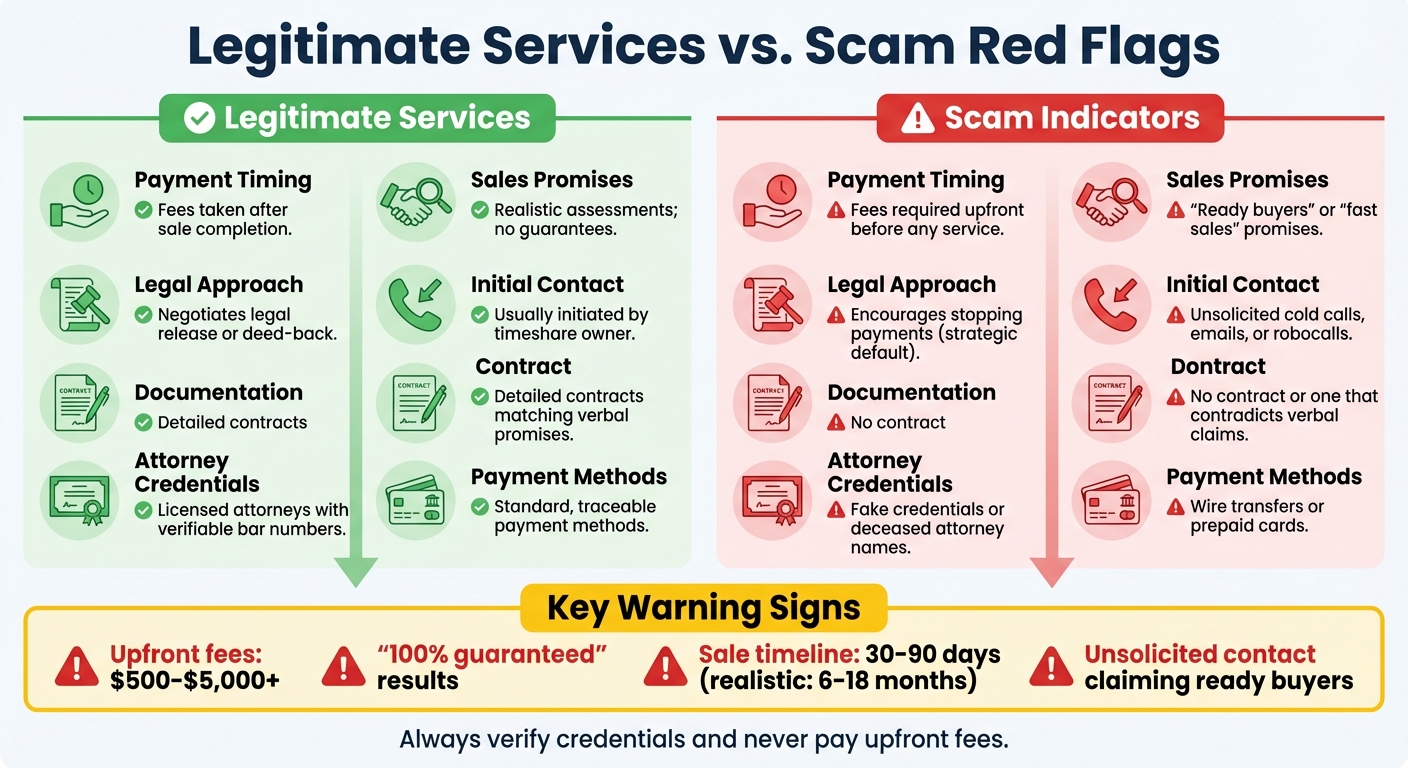
Legitimate Timeshare Services vs Scam Red Flags Comparison
Spotting the difference between legitimate services and scams can save you both time and money. One of the easiest ways to tell them apart? When they ask you to pay. Legitimate resellers usually collect their fees only after your timeshare is sold. Scammers, on the other hand, demand upfront payments for things like "taxes", "registration", or "closing costs", which can range anywhere from $500 to $5,000 – or more.
Guarantees are another red flag. Scammers often make bold claims, like "100% guaranteed" sales or cancellations. They might even tell you they already have a buyer lined up or promise to close the sale within 30 to 90 days. Lisa Lake, a Consumer Education Specialist at the FTC, offers this advice:
"If you’re selling a timeshare, listen carefully for the promise of lots of money quickly and a request for an upfront fee. Those are two key signs of timeshare resale scam."
Legitimate companies, by contrast, provide realistic market timelines, noting that sales often take between 6 and 18 months to close.
Here’s a quick breakdown of the key differences:
| Feature | Legitimate Services | Scam Indicators |
|---|---|---|
| Payment Timing | Fees taken after sale completion | Fees required upfront before any service |
| Sales Promises | Realistic assessments; no guarantees | "Ready buyers" or "fast sales" promises |
| Legal Approach | Negotiates legal release or deed-back | Encourages stopping payments (strategic default) |
| Initial Contact | Usually initiated by timeshare owner | Unsolicited cold calls, emails, or robocalls |
| Documentation | Detailed contracts matching verbal promises | No contract or one that contradicts verbal claims |
Attorney involvement is another key factor. Reputable services will list licensed attorneys with verifiable bar numbers. Scammers, however, often fake credentials or even use the names of deceased attorneys to appear legitimate. In one case, a fraudulent company used a deceased attorney’s identity to demand a $4,000 wire transfer.
How you’re contacted also matters. If someone cold-calls you claiming to know about your specific timeshare and says they already have a buyer, that’s a major warning sign. Legitimate services are usually sought out by the timeshare owner or recommended through official resort programs. Always verify the company’s physical office address independently – scammers often use fake or unverifiable locations. Lastly, avoid wiring money or using prepaid cards for any payments. Once funds are sent this way, they’re almost impossible to recover. Stay vigilant and double-check all details before moving forward with any timeshare service.
Conclusion
Timeshare scams can drain owners of thousands of dollars. Common warning signs include demands for upfront fees, promises of "100% guaranteed" results, unsolicited cold calls claiming a buyer is ready, and high-pressure tactics urging immediate action without time to review contracts. Legitimate services will never ask for large payments before starting work, nor can they guarantee outcomes in complex contract situations. These red flags highlight the importance of careful verification.
To steer clear of these scams, make sure to do your homework. Confirm credentials, review contracts with an independent expert, and avoid paying upfront. As Rand Millwood, CFP®, CIMA®, AIF® from Guardian Wealth Partners wisely advises:
"The biggest tip I would give clients to avoid pretty much any financial-related scam is to never feel pressured to act immediately and absolutely never provide funds to anyone until you have done extensive research…"
If you’re dealing with a challenging timeshare contract, your first step should be contacting your resort directly. Many resorts offer official deed-back or exit programs that are safer and more affordable than third-party services. For legal advice, Aaronson Law Firm provides free consultations to assess your situation and craft a strategy suited to your needs.
Also, avoid payment methods like wire transfers or prepaid cards, as they are often irreversible. If you’ve fallen victim to a scam, report it immediately to the Federal Trade Commission at ReportFraud.ftc.gov, your state attorney general, and the FBI’s Internet Crime Complaint Center (IC3). Acting quickly not only increases your chances of recovery but also helps protect others from falling into the same trap.
FAQs
How can I verify a timeshare resale or exit company is legitimate?
To ensure a timeshare resale or exit company is trustworthy, start by verifying their credentials, reviews, and licensing through reliable sources like the Better Business Bureau (BBB). Watch out for companies that ask for hefty upfront fees without providing clear documentation or evidence of a legitimate legal process. Make sure they employ licensed legal professionals and take the time to thoroughly review any contracts before signing. For added protection, consider consulting a licensed timeshare attorney to help you avoid potential scams.
What should I do if I already paid an upfront fee to a scammer?
If you’ve already handed over an upfront fee to a scammer, it’s crucial to act fast. Report the scam to authorities such as the FTC, the FBI’s IC3, your state’s Attorney General, or the BBB. Make sure to collect any evidence you can, like contracts, receipts, or communications, to back up your claim.
You might also want to consult with a qualified timeshare attorney – firms like Aaronson Law Firm specialize in helping individuals explore legal options for canceling contracts or recovering lost funds.
Can Aaronson Law Firm help me cancel my timeshare contract legally?
Yes, Aaronson Law Firm can help you legally cancel your timeshare contract. They specialize in assisting clients with rescinding timeshare agreements and ending ongoing financial obligations tied to those contracts. Their practice is dedicated solely to timeshare-related legal matters, offering focused and professional support to guide you through the process.
Related Blog Posts
- 7 Warning Signs of Timeshare Contract Fraud to Watch For
- How Timeshare Resale Scams Operate
- Spot Fake Timeshare Exit Companies
- Timeshare Resale Scams: Case Studies