
Timeshare resale scams are a growing problem, costing victims thousands of dollars and immense emotional distress. These scams often target desperate timeshare owners through unsolicited calls or emails, promising quick sales and high profits. Victims are tricked into paying upfront fees for fake services like "closing costs" or "property taxes", only to find no buyer exists.
Key facts:
- Losses: Victims report losing $1,500 to $24,000, with total damages exceeding $48 million.
- Tactics: Scammers impersonate real professionals, use fake documents, and apply high-pressure sales tactics.
- Warning signs: Upfront fees, unsolicited contact, guaranteed profits, and urgency to act.
To protect yourself, verify credentials, avoid upfront payments, and consult legal professionals. If scammed, report incidents to the FTC or your state Attorney General.
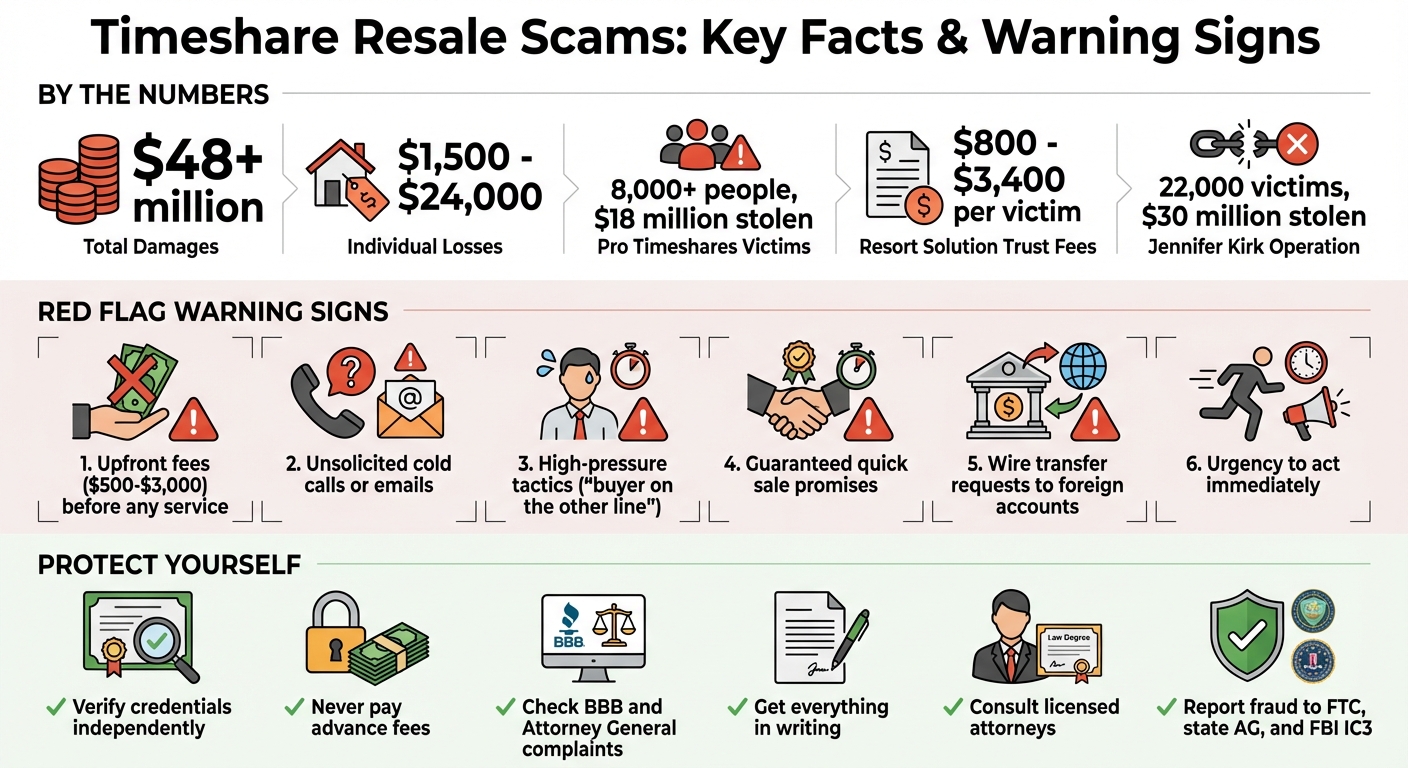
Timeshare Resale Scam Warning Signs and Statistics
Pro Timeshares: A Florida-Based Scam
How the Scam Worked
For five years, Pro Timeshares ran two sales rooms in Florida, targeting timeshare owners with deceptive telemarketing schemes. Their telemarketers promised that buyers or renters were already lined up for the victims’ timeshares, creating a false sense of urgency. Victims were pressured to act immediately, with warnings that hesitation would cost them the supposed deal.
The scam revolved around upfront fees, ranging from $500 to $2,500. These fees were labeled as "title checks" or "closing costs" and were falsely advertised as refundable once the sale or rental was finalized. However, contracts provided to victims only mentioned "advertising" services, not actual sales or rentals. When victims raised concerns, they were reassured that this language was just standard legal jargon and that the deal was legitimate. In reality, no sales or rentals ever materialized, and victims often faced repeated demands for additional fees, leading to even greater financial losses. This fraudulent operation not only drained victims’ bank accounts but also inflicted emotional and financial strain.
Damage to Victims
The scam resulted in over $17 million in losses, with individuals losing anywhere from $500 to $2,500 initially – and often more due to repeated fee requests. Beyond the monetary losses, the aggressive sales tactics and false promises left victims feeling betrayed and emotionally distressed, compounding the harm caused by the fraud.
Legal Response and Results
Authorities acted quickly to shut down Pro Timeshares. In December 2016, the FTC’s Atlanta office filed a lawsuit against the company. A federal judge immediately issued a Temporary Restraining Order, freezing the company’s assets and appointing a Receiver to take control of its operations. This decisive action stopped the fraudulent activities in their tracks. The defendants later agreed to a preliminary injunction, ensuring the asset freeze remained in place until the case reached its final outcome.
sbb-itb-d69ac80
Resort Solution Trust Inc.: A High-Pressure Scheme
Fraudulent Fees and Tactics
Resort Solution Trust Inc. targeted timeshare owners with unsolicited cold calls, using aggressive and deceptive sales tactics. Their salespeople often claimed a buyer was "on the other line" or ready to purchase immediately, creating a false sense of urgency to pressure victims into acting quickly.
The scam revolved around upfront fees ranging from $800 to $3,400, disguised as "recording fees", "closing costs", or "deposits" necessary to secure the sale. For instance, in November 2012, Thomas Hilliard received a call claiming a buyer was ready to purchase his timeshare. Under pressure, he paid a $2,381 deposit. After discovering online complaints, Hilliard tried to cancel within the legal seven-day period, but the company refused, bluntly stating, "no deal." Ultimately, he recovered his money after a four-month fraud investigation by Wells Fargo Bank.
Adding to the deception, the written contracts revealed that while salespeople verbally promised guaranteed sales, the paperwork only committed the company to listing the timeshare. Victims who questioned this were met with evasive legal jargon. The company also dismissed concerns about their "F" rating from the Better Business Bureau, blaming it on a competitor’s slander lawsuit.
These unethical practices not only exploited consumers but also violated federal regulations.
Federal Law Violations
Resort Solution Trust Inc. blatantly disregarded federal telemarketing laws designed to protect consumers. They made illegal calls to individuals on the National Do Not Call Registry, directly violating the Telemarketing Sales Rule. Additionally, they falsely claimed to have buyers ready to purchase, violating the FTC Act.
The company also ignored consumers’ legal rights to cancel contracts during the mandatory cooling-off period. By routinely denying these cancellation requests, they committed further federal violations. Their entire business model preyed on financially vulnerable individuals desperate to sell their timeshares.
These actions triggered swift federal enforcement.
FTC Enforcement Response
In May 2013, the FTC filed a complaint against Resort Solution Trust Inc., along with Lincoln Renwick II and Anthony Talavera, in the U.S. District Court for the Middle District of Florida. On May 20, 2013, the court issued an order that froze the company’s assets, placed it into temporary receivership, and immediately halted its operations.
"Con artists take advantage of timeshare owners who have been in tough financial straits and are desperate to sell their timeshares. They persuade owners to pay fat up-front fees by saying they have someone ready to buy the property, but that’s a lie."
- Charles A. Harwood, Acting Director of the FTC’s Bureau of Consumer Protection
What These Cases Teach Us
Warning Signs of Scams
The cases mentioned earlier highlight some common red flags that every timeshare owner should recognize. For instance, the Pro Timeshares and Resort Solution Trust cases showcase a pattern of fraudulent behavior. One of the most glaring signs is demanding upfront fees – legitimate companies never ask for $500–$3,000 before providing a service. Similarly, unsolicited cold calls claiming a buyer is ready or that the market is "hot" should immediately raise suspicion.
Another tactic to watch out for is high-pressure sales methods. Scammers often create urgency by claiming an offer will expire soon or that a buyer is waiting "on the other line." Promises of a guaranteed quick sale or offers that far exceed your timeshare’s actual value are also major red flags. Reputable brokers never make such guarantees, especially at inflated prices.
Be cautious about payment methods as well. Scammers frequently request wire transfers, often to foreign accounts, under the guise of covering "Mexican taxes" or "transfer fees." Many victims have lost thousands of dollars after wiring money for these so-called "fees."
Recognizing these warning signs is crucial, but knowing how to protect yourself is equally important.
How to Protect Yourself
Start by independently verifying credentials before working with any resale company. Use the company’s official website and contact number – avoid the details provided by an unsolicited caller. Check their real estate license with your state licensing board to ensure it’s valid and that it matches the person contacting you.
Never agree to pay advance fees. Lisa Lake, Consumer Education Specialist at the Federal Trade Commission (FTC), advises:
If you’re selling a timeshare, listen carefully for the promise of lots of money quickly and a request for an upfront fee. Those are two key signs of timeshare resale scam.
Legitimate companies only collect fees after a sale is finalized.
Research the company’s physical address. Use online maps to verify it and compare it to official records. Scammers often use PO boxes, residential addresses, or even parking lots as their "corporate headquarters." Additionally, check for complaints with your state’s Attorney General and the Better Business Bureau. Always get everything in writing and ensure the contract aligns perfectly with any verbal promises.
When self-protection isn’t enough, knowing when to involve legal help can make all the difference.
When to Get Legal Help
If you’ve already paid fees or need to cancel your timeshare, it’s essential to seek licensed legal assistance without delay. As seen in the examples above, postponing legal action can lead to even greater losses. Unlike "exit companies", attorneys are legally bound to act in your best interest and can provide the necessary support, including litigation if required.
Aaronson Law Firm, for instance, focuses solely on canceling timeshare contracts. They apply legal pressure on developers to terminate agreements and eliminate ongoing maintenance fees. Their services include free consultations, legal demand letters, credit protection, and court representation. If you’re still within the rescission period (usually 3–5 days) and a company refuses to honor your cancellation, legal action can safeguard your rights and help recover your funds.
Finally, report any suspected fraud to the FTC, your state Attorney General, and the FBI’s Internet Crime Complaint Center (IC3). These reports help authorities identify patterns and shut down fraudulent operations before more people are harmed.
Conclusion
The cases discussed reveal a troubling pattern of deception in the timeshare resale market. Between 2012 and 2016, Pro Timeshare Resales swindled over 8,000 individuals out of more than $18 million, while Jennifer Kirk’s telemarketing operation defrauded 22,000 people, stealing $30 million – all without completing a single legitimate sale [1][2].
Common warning signs include upfront fees, unsolicited contact, aggressive sales tactics, and promises that sound too good to be true. Scammers often go to great lengths to appear legitimate, using stolen identities, fake financial documents, and even the names of real brokers. They capitalize on fear and urgency to pressure victims into sending money quickly, leaving little time for careful consideration. FBI Special Agent William Stewart highlights this behavior:
"If the people on the other end of the transaction are pushing you, saying this has to happen now, that something bad will happen, that should set off alarm bells."
The takeaway here is clear: quick verification and immediate action are essential. If you suspect fraud or need assistance canceling a timeshare contract, act without delay. Licensed attorneys, such as those at Aaronson Law Firm, specialize in timeshare cancellations. They offer free consultations, legal demand letters, credit protection, and litigation support to stop fraudulent practices in their tracks. Additionally, reporting scams to the FTC, your state Attorney General, and the FBI’s IC3 can help prevent others from falling victim to these schemes.
FAQs
How can I verify a timeshare resale company is legit?
To determine if a timeshare resale company is legitimate, keep an eye out for red flags. Requests for upfront fees, fake claims of partnerships with resorts, or aggressive sales tactics are clear warning signs. Never share personal or financial information without confirming the company’s credibility. Take time to review feedback or complaints through consumer protection agencies. Be especially wary of companies that promise fast sales or high payouts – trustworthy businesses usually steer clear of making such guarantees.
What should I do if I already paid an upfront fee?
If you’ve already paid an upfront fee for a timeshare resale or exit service, it’s important to act fast. Start by checking whether the company you’re dealing with is legitimate. Consulting with a licensed attorney who specializes in timeshare law can help you understand your options for cancellation. Take a close look at your contracts, and you may also want to file a complaint with consumer protection agencies. In some cases, legal action – like rescission – could allow you to recover your money, but this typically needs to happen within the applicable rescission period.
When should I contact a timeshare cancellation attorney?
If you believe you’ve been scammed or decide to cancel your timeshare contract legally, it’s important to reach out to a timeshare cancellation attorney immediately. Acting promptly is especially critical during the rescission period, which usually lasts between 3 and 15 days. Taking swift action can help safeguard your finances and credit from potential issues.