
Canceling a timeshare in New York requires understanding your legal rights and acting quickly. Here’s a step-by-step guide:
- Know Your Rescission Period: You have 7 days to cancel your contract without penalty. This includes weekends and holidays.
- Review Your Contract: Confirm the signing date and locate the cancellation instructions.
- Gather Documents: Collect your contract, closing documents, and any related paperwork.
- Write a Cancellation Letter: Include your details, contract number, and an explicit statement to cancel.
- Send via Certified Mail: Use certified mail with a return receipt to ensure proof of delivery.
- Request Confirmation: Follow up with the company for written confirmation and track your refund.
If the rescission period has passed, review your contract for exit options or consult a licensed attorney for further assistance. Acting promptly and following these steps can help you avoid long-term financial obligations.
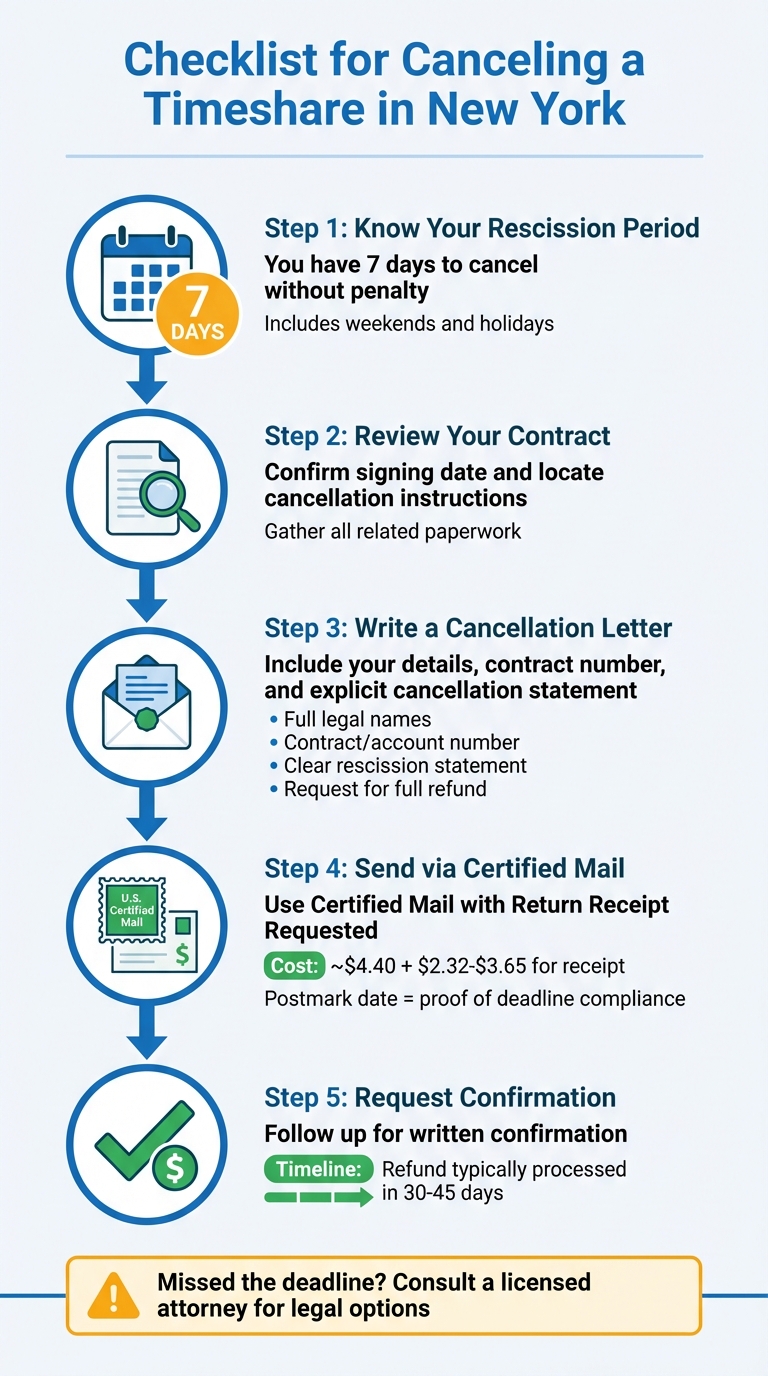
5-Step Process to Cancel Your Timeshare in New York
Step 1: Review Your Legal Rights and Rescission Period
The 7-Day Cancellation Window
In New York, you have the right to cancel your timeshare contract without penalty within 7 days of signing it or receiving all required documents – whichever comes later. This period includes weekends and holidays, so make sure to calculate your deadline based on the actual date you received the contract documents.
"You can rescind (or cancel) a timeshare agreement without cause and without penalty within a certain timeframe. A buyer’s right to rescind is generally non-waivable." – Aaronson Law Firm
If you cancel within this timeframe, you’re entitled to a full refund of any payments made. This safeguard exists because New York law mandates that your funds remain in an escrow account until the deal is finalized or you decide to cancel.
Make sure to confirm your exact cancellation deadline and take action promptly if you choose to rescind.
Legal Protections for Timeshare Owners in New York
Under Article 5 of the New York State Real Property Law, developers must clearly outline your cancellation rights in the contract. They cannot require you to waive these rights or bury them in hard-to-find sections of the agreement.
Your contract should include detailed cancellation instructions. Additionally, developers are obligated to provide a complete offering plan that discloses essential information like maintenance fees, usage limitations, and other important terms. If these documents are not provided, the 7-day rescission window might not begin until you receive them, potentially giving you extra time to cancel if the developer fails to meet disclosure requirements.
sbb-itb-d69ac80
Step 2: Collect Required Documents
Documents You Need to Cancel Your Timeshare
Your original timeshare contract is key. It contains the terms, deadlines, and cancellation clauses necessary for your notice. Without it, you can’t verify the signing date or locate the specific provisions needed to process your cancellation.
In addition to the contract, gather all the closing documents you signed during the sales presentation. Be sure to include account numbers tied to your membership or financing, personal identification for everyone listed on the deed, and any offering plans or disclosure statements, which New York law requires sellers to provide.
"We will work together with you to put together a file of information relevant to your situation. Names, account numbers, sales information and all paperwork that was provided to you at the time of sale are among the items that we will need." – Aaronson Law Group
Don’t overlook sales and marketing materials. These can help establish a timeline and may highlight inconsistencies between verbal promises and the written contract. Financial records, like your first bill, later invoices, or proof of payments, are also important pieces of evidence.
Once you’ve gathered everything, the next step is to organize your paperwork efficiently.
How to Organize Your Paperwork
Always make copies of your documents and store the originals in a safe place. Submit only the copies. To avoid delays caused by missing items, create a simple checklist to ensure you have every required document.
Arrange your paperwork in chronological order. This will help you establish a clear timeline and confirm the contract execution date, which is crucial for determining your 7-day rescission deadline. Be sure to include the offering plan in your organized documents to verify deadlines and mailing addresses.
Step 3: Write and Send Your Cancellation Letter
What to Include in Your Cancellation Letter
Once you’ve gathered your documents, it’s time to craft a clear and effective cancellation letter.
Start by including the full legal names of everyone who signed the original contract, exactly as they appear on the paperwork. Add your current mailing address, phone number, and email. These details ensure the company can identify you without confusion.
Next, provide your contract or account number along with the exact date you signed the agreement. Clearly state the full name of the timeshare resort and the developer or management company involved. These details are essential for pinpointing your specific transaction.
The heart of your letter is the explicit statement of rescission. Use straightforward language, such as: "I am writing to formally notify you of my decision to cancel this timeshare contract effective immediately." Avoid ambiguous wording that could lead to misunderstandings. Follow this statement with a formal request for a full refund of your down payment and any fees paid during the purchase.
Finally, ensure that every original signer of the contract signs the letter. Missing signatures could render your cancellation invalid.
Mail Your Letter via Certified Mail
When sending your letter, Certified Mail with Return Receipt Requested is a must. This method provides legal proof of when the letter was sent and when it was received. Certified Mail costs around $4.40, with an additional ~$3.65 for a hard copy receipt or ~$2.32 for an electronic one.
The postmark date is critical – it serves as evidence that you met New York’s 7-business-day cancellation deadline. Hand your letter directly to a USPS clerk to ensure it’s postmarked in your presence. Don’t forget to keep the certified mail receipt (PS Form 3800) in a safe place for your records.
Check the "Notice of Right to Cancel" section in your contract for the correct mailing address. This address is often different from the resort’s physical location or sales office. Sending your letter to the wrong address could void your cancellation, even if it’s sent on time. Once you have your tracking number, monitor it online daily. As soon as the status updates to "Delivered", print the delivery confirmation page for your records.
Step 4: Verify Cancellation and Request Your Refund
Get Written Confirmation of Cancellation
After sending your cancellation letter, your next step is making sure the process has been completed and keeping an eye on your refund. Staying on top of this ensures the timeshare company follows New York’s 7-day rescission rules.
Wait about 5–7 business days after your letter has been delivered, then call the timeshare company to request a written confirmation of your cancellation. When speaking with customer service, have your contract number, the date you mailed your cancellation letter, and the certified mail tracking number handy. Ask for a formal letter that confirms your contract has been canceled.
This written confirmation should include key details like your full name, contract number, the cancellation date, and a statement clearly indicating the contract is void. Keep this document – it’s your legal proof that the company recognized your cancellation.
If you don’t hear back in a timely manner, send a follow-up certified letter. Reference your original cancellation letter and include copies of your certified mail receipts. New York law requires the company to honor your rescission within 7 days, and they cannot impose penalties for doing so.
Track Your Refund
Once you have written confirmation of cancellation, it’s time to track your refund. Typically, refunds are processed within 30–45 days after confirmation. Keep a record of the refund amount, the date you received confirmation, and the expected refund timeline.
Check your bank or credit card statements weekly. If the refund hasn’t shown up by day 45, reach out to the company’s accounting department. Ask for a clear timeline on when the refund will be processed and confirm the payment method (such as a check, wire transfer, or credit card reversal). Be sure to document these conversations, including dates and the names of anyone you speak with.
If the refund still hasn’t been issued after 45 days, follow up immediately. In some cases, legal assistance may be necessary to enforce New York’s consumer protection laws and ensure the company fulfills its obligation.
"They were able to get us completely out of our contract in 4 months from us contacting them." – Katelynn C., Client, Aaronson Law Firm
Keep all your documentation organized and secure. It’s your safety net if any disputes arise.
Step 5: Options After the Rescission Period Ends
Once the rescission period has ended, there are still ways to explore an exit from your timeshare agreement. These options are often outlined in your contract, so it’s important to review it carefully.
Check Your Contract for Exit Options
If New York’s 7-business-day rescission period has passed, your contract might still include exit strategies. Look for sections titled "Transfer of Ownership", "Resale Rights", or "Exit Programs." These clauses often outline ways to sell, transfer, or even return your timeshare under certain conditions.
For example, some agreements allow owners to transfer ownership, though this usually requires specific documentation to confirm the property’s status. Other contracts might offer developer buyback programs, especially in cases of financial hardship. Keep in mind, however, that resale options often come with financial downsides, as timeshares typically sell for just 20-50% of their original price at auction.
You might also consider working with a licensed real estate broker in New York to handle the resale, but proceed cautiously to avoid scams or hidden fees. Alternatively, donating your timeshare to a registered charity could be an option, though this too requires thorough documentation and verification.
If the options in your contract don’t seem viable, or if you’re facing challenges, consulting a legal expert can provide additional avenues for resolution.
Get Legal Help from Aaronson Law Firm

When your contract doesn’t offer clear solutions or if you’re encountering roadblocks, professional legal assistance can make a difference. Aaronson Law Firm focuses exclusively on timeshare cancellations and can uncover legal vulnerabilities in your agreement – such as fraud, misrepresentation, or mishandling of trust funds – that might render the contract invalid, even after the rescission period.
"Unlike timeshare exit companies, we are actual attorneys. That means that we have a fiduciary and legal obligation to put our client’s interests first." – Aaronson Law Firm
Aaronson Law Firm offers free consultations and provides services like legal demand letters, credit protection, and litigation support. Their attorneys have the authority to subpoena developer records, which can be instrumental in building a case for contract termination. Unlike unregulated "timeshare exit" companies, licensed attorneys are bound by strict fiduciary duties, ensuring your interests are safeguarded. In some cases, they’ve successfully helped clients terminate contracts in as little as four months, even when the rescission window has long passed.
Common Mistakes and How to Avoid Them
When working through the checklist to cancel your timeshare in New York, it’s important to sidestep a few common errors that can complicate the process. While the steps are straightforward, even small mistakes can lead to delays or worse, a failed cancellation.
One of the biggest pitfalls is missing the 7-day deadline. To avoid this, review your contract as soon as possible and send your cancellation letter within the first few days. Waiting until the last moment increases the risk of missing the cut-off.
Another frequent issue involves choosing the wrong professional assistance. Many people hire inexperienced exit companies that lack legal credentials and a fiduciary responsibility to their clients. Unlike licensed attorneys, these companies cannot subpoena developer records or represent you in court. If you’re past the rescission period, it’s crucial to work with a licensed attorney who specializes in timeshare law.
Some owners mistakenly believe that fine print in their contracts can waive their cancellation rights. However, New York law ensures that rescission rights cannot be waived, regardless of any misleading clauses in your contract. Don’t let confusing language deter you from exercising your rights.
The table below highlights these common errors and provides clear solutions to address them.
Comparison Table: Mistakes and Solutions
| Common Mistake | Consequence | Recommended Solution |
|---|---|---|
| Missing the 7-day deadline | Loss of the right to cancel without penalty | Review your contract immediately and send your cancellation letter within the first few days |
| Sending via regular mail | No proof of delivery; developer may claim the letter was never received | Use Certified Mail with Return Receipt Requested to create a verifiable paper trail |
| Incomplete signatures | Rejection of the cancellation if all co-owners don’t sign | Ensure every person listed on the contract signs the cancellation letter |
| Using unqualified exit companies | Risk of scams or lack of legal recourse | Hire a licensed attorney experienced in timeshare law |
| Assuming no options after the deadline | Remaining trapped in an expensive timeshare contract | Consult a timeshare attorney to explore additional legal grounds for termination |
| Sending to the wrong address | Missed deadline if the notice doesn’t reach the appropriate legal department | Double-check your contract’s rescission clause for the correct address to send your cancellation notice |
Conclusion
Canceling a timeshare in New York demands quick action and a solid understanding of your rights. The state’s 7-day rescission period offers the simplest way to cancel your contract without penalties or legal issues. To take advantage of this, review your contract immediately after signing, write a clear cancellation letter, and send it via certified mail with a return receipt. Following these steps can save you from years of financial obligations and maintenance fees. If you’ve missed this window, there are still legal options to explore.
After the 7-day period, carefully review your contract for potential exit clauses or legal issues, such as misrepresentation or financial mishandling, that an experienced attorney can investigate. Unlike timeshare exit companies, attorneys have subpoena power to access developer records and are bound by law to prioritize your best interests.
"If the deadline to cancel your contract has passed, don’t lose hope, as other options are still available." – Aaronson Law Firm
For example, Katelynn C. successfully canceled her timeshare contract within 4 months of reaching out to attorneys Sean and Micah at Aaronson Law Firm. This highlights how professional legal guidance can resolve even challenging cases effectively.
FAQs
When does the 7-day rescission period start?
In New York, the 7-day rescission period starts the day after you sign the timeshare contract. Keep in mind that weekends and holidays don’t count – only business days are included in this timeframe.
What if I don’t have all my timeshare paperwork?
If you’re missing some paperwork, you can still cancel your timeshare. Start by collecting any available documents, such as your contract (if you have it), payment records, and any correspondence with the timeshare company. If the original contract isn’t accessible, submit a formal cancellation letter along with proof of identity or payment records. For guidance on what additional evidence might strengthen your case, consider consulting a legal professional.
What can I do if I missed the cancellation deadline?
If you’ve missed the cancellation deadline for your New York timeshare, don’t lose hope – there may still be ways to address the situation. Once the 7-day rescission period has passed, canceling your timeshare becomes more challenging and often requires legal assistance. A qualified attorney can carefully examine your contract to uncover potential issues, such as misrepresentation or breach of contract, which could provide grounds for termination. Reaching out to a timeshare lawyer can help you explore legal options that are specific to your circumstances.
Related Blog Posts
- 5 Legal Methods to Cancel Your Timeshare Contract
- How Attorneys Enforce Timeshare Rescission Rights
- North Carolina Timeshare Cancellation Laws
- New York Timeshare Rescission Periods Explained